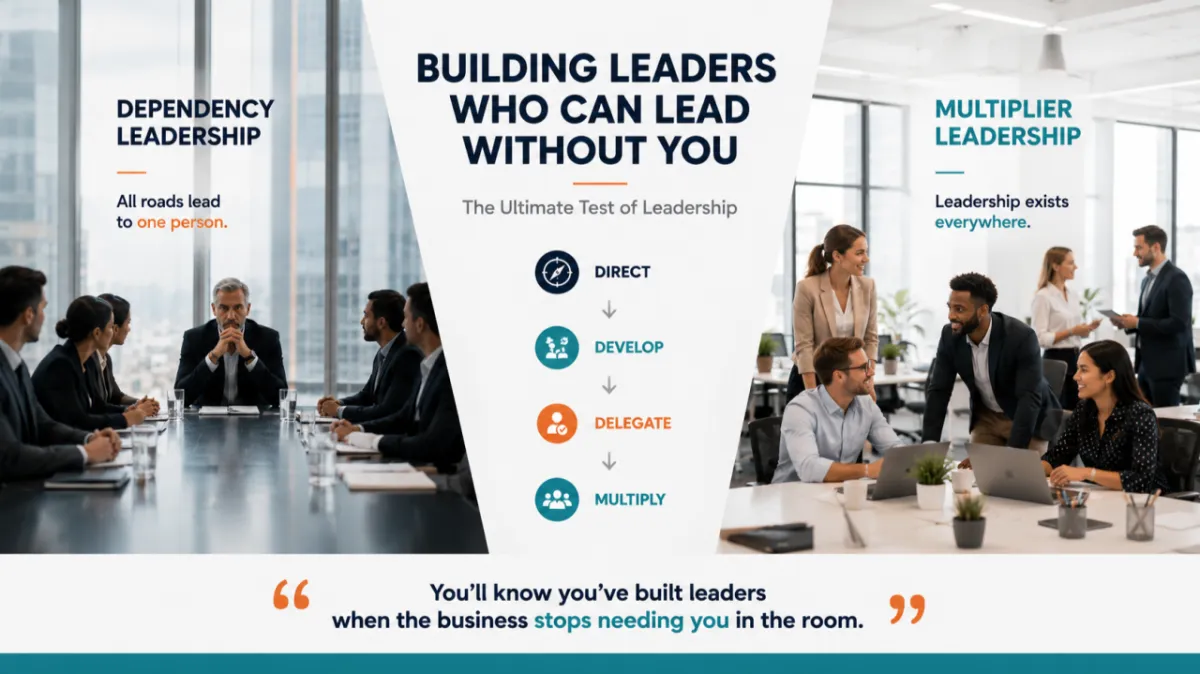
Building Leaders Who Can Lead Without You
Building Leaders Who Can Lead Without You
The Ultimate Test of Leadership
Most leaders begin their leadership journey by becoming indispensable.
They solve problems.
Make decisions.
Answer questions.
Provide direction.
Rescue situations.
Create results.
And initially, this works.
The organization grows.
The team succeeds.
The leader becomes increasingly valuable.
But eventually a new challenge emerges.
The organization starts depending on them.
Every decision flows upward.
Every difficult situation requires their involvement.
Every important conversation needs their approval.
At first, this feels like leadership success.
Over time, it becomes leadership limitation.
Because the ultimate goal of leadership is not to be needed everywhere.
The ultimate goal is to build leadership capacity everywhere.
The Dependency Trap
Many organizations unknowingly create dependency.
Not because leaders are ineffective.
Because they are effective.
The strongest performers become the people everyone relies on.
The founder makes every major decision.
The executive solves every difficult problem.
The manager becomes the answer to every question.
The result is predictable.
The organization grows.
Leadership capacity does not.
And eventually growth slows because leadership becomes concentrated in too few people.
The organization is no longer limited by opportunity.
It is limited by leadership capacity.
The Ultimate Leadership Test
A simple question reveals leadership maturity:
What happens when you are not in the room?
Do decisions stop?
Do people wait?
Do issues escalate?
Do projects stall?
Or does leadership continue?
The answer reveals whether leaders have created dependency or developed capability.
You will know you have built leaders when the business stops needing you in the room.
The Multiplier Leader Model
The strongest leaders operate differently.
They do not measure success by how many people need them.
They measure success by how many people no longer need them.
This requires a shift.
From solving to developing.
From directing to coaching.
From controlling to empowering.
From being the answer to building judgment.
That shift is captured in the Multiplier Leader Model.
Stage 1: Provide Direction
Leaders initially create clarity.
They establish expectations.
Define standards.
Provide guidance.
This stage is necessary.
But it cannot be the destination.
Stage 2: Develop Judgment
Great leaders teach people how to think.
Not just what to do.
They help team members understand decisions.
Evaluate options.
Solve problems.
Exercise discernment.
Judgment is what creates leadership capacity.
Stage 3: Transfer Ownership
As judgment increases, ownership increases.
Leaders gradually transfer authority.
Responsibility.
Decision-making.
Accountability.
The goal is not task completion.
The goal is leadership growth.
Stage 4: Multiply Leaders
Eventually leadership begins to replicate.
People develop other people.
Managers develop future managers.
Leaders develop future leaders.
The organization becomes less dependent on individuals and more capable as a system.
This is multiplication.
Why Organizations Struggle
Many organizations stop at delegation.
They transfer tasks.
But retain decisions.
They assign responsibility.
But maintain control.
The result is predictable.
People complete work.
But leadership capacity does not grow.
The missing ingredient is leadership development.
The goal is not simply getting work done.
The goal is creating leaders.
The Role of the Leadership Operating System
This is where a Leadership Operating System becomes essential.
Without a system, leadership development becomes inconsistent.
With a system, leadership multiplication becomes repeatable.
Leadership standards create expectations.
Leadership assessments create diagnosis.
Development pathways create growth.
Coaching rhythms create reinforcement.
Accountability systems create consistency.
Succession planning creates continuity.
Together, these elements create leadership capacity beyond any individual leader.
A Leadership Example
One organization depended heavily on its founder.
Major decisions required approval.
Key relationships flowed through one person.
Important issues escalated upward.
Growth eventually slowed.
Not because demand disappeared.
Because leadership capacity was concentrated.
The organization began intentionally developing leaders.
Decision-making authority was clarified.
Leadership expectations were established.
Coaching became consistent.
Future leaders were developed.
Over time, teams operated effectively without requiring constant executive involvement.
The founder remained important.
But no longer essential to every decision.
The organization became stronger because leadership capacity expanded.
The Future of Leadership
The organizations that scale successfully understand something important.
Growth follows capacity.
And leadership capacity determines organizational capacity.
The future belongs to organizations that develop leaders faster than they develop dependence.
Because dependence eventually creates bottlenecks.
Leadership multiplication creates scale.
A Question Worth Asking
Think about your team.
Think about your department.
Think about your organization.
What would happen if you were unavailable for 30 days?
Would leadership continue?
Or would progress pause?
Your answer may reveal the next stage of leadership development required.
Final Thought
The ultimate test of leadership is not what happens when you are present.
It is what happens when you are absent.
The strongest leaders do not create followers.
They create leaders.
They build judgment.
Transfer ownership.
Multiply capacity.
And create organizations that grow beyond their direct involvement.
Because leadership is not measured by how many people depend on you.
It is measured by how many people no longer need you.
Executive Debrief & Leadership Operating System Workshop
If you're ready to build leadership capacity beyond a handful of key people, schedule an Executive Debrief or Leadership Operating System Workshop.
We'll help you identify:
✓ Leadership dependency risks
✓ Succession gaps
✓ Leadership capacity constraints
✓ Leadership system opportunities
✓ Growth-limiting bottlenecks
Because sustainable organizations are built on distributed leadership, not concentrated leadership.
Take the Leadership Stage Assessment and discover where your leaders are—and what it will take to move them forward.
I’ll be unpacking this topic further in this week’s Multiplier Briefing. If you are responsible for building leadership capacity inside your organization, you can Register Here


