
How to Build a Culture of Accountability That Survives Without You
A culture of accountability is one where commitments are met when nobody with authority is watching.
If accountability only appears when you enter the room, that is not culture. That is supervision.
Culture of accountability is one of those phrases used as though it means something specific, and it seldom does.
So here is a definition you can actually test. A culture of accountability is one where commitments are met when nobody with authority is watching.
That is the whole test. Not whether people say the right things about ownership — whether things get done when you are not there.
By that definition, most businesses that believe they have one do not. They have a founder who notices.
The moment that is the culture
A culture of accountability is not a value printed on the wall. It is what happens after a commitment is missed and you are not there to notice.
Does the system expose the miss, require an explanation and produce a recovery plan? Or does everybody wait for you to discover it?
That moment, repeated across the organization, is the culture. Everything else is decoration.
The four requirements
Four things have to be true. Most businesses have one or two.
One — every outcome has exactly one named owner. Not a team, not a function, not a committee. A person. Two owners means no owner. And if you cannot name the single person accountable for client retention in under three seconds, that outcome is currently yours.
Two — it is measured, and both of you can see the measure without asking each other. Without this, accountability becomes an argument about perception, and the person with more authority wins that argument, which is not the same as being right.
Three — it is reviewed on a rhythm that exists independently of you. A standing meeting that happens whether or not you called it, and whether or not you are in it. If the review only happens when you remember, then you are the review, and the whole thing collapses the week you are distracted.
Four — there is a consequence that is not your disappointment. When the only cost of missing a commitment is that you are visibly unhappy, accountability has become emotional and personal. People then manage your mood rather than the outcome, and the smartest available strategy becomes staying off your radar.
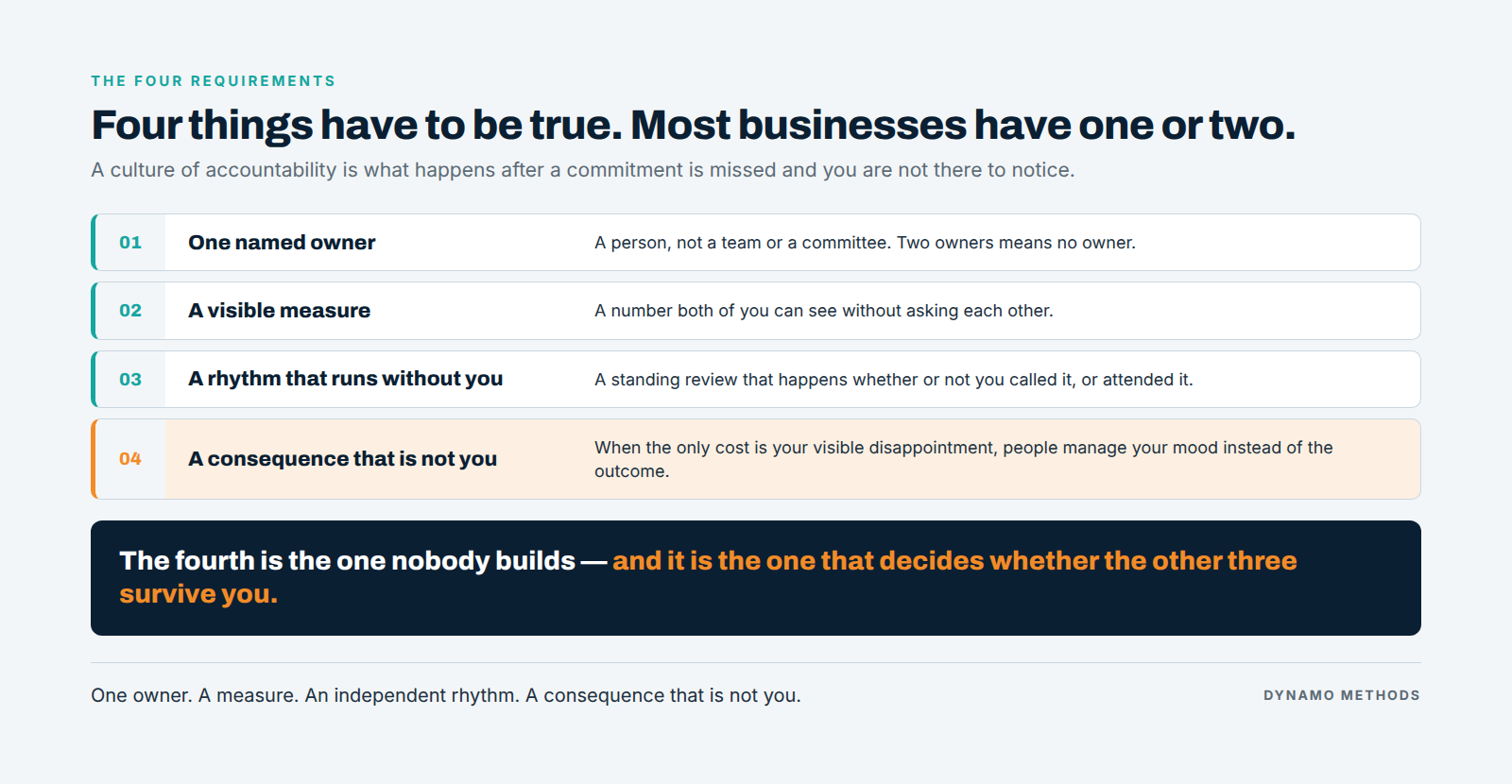
One owner. A measure. An independent rhythm. A consequence that is not you.
What a consequence actually is
The fourth one is the one nobody builds, largely because people hear consequence and think discipline.
It does not mean punishment. It means something happens automatically and visibly that is not your reaction.
Practically: the miss is visible to peers in the standing review, because the list is shared. The reason gets recorded, so patterns become obvious. A recovery plan is required at that same meeting, not later. And a repeated pattern triggers a defined conversation — not a mood, a defined conversation with a name.
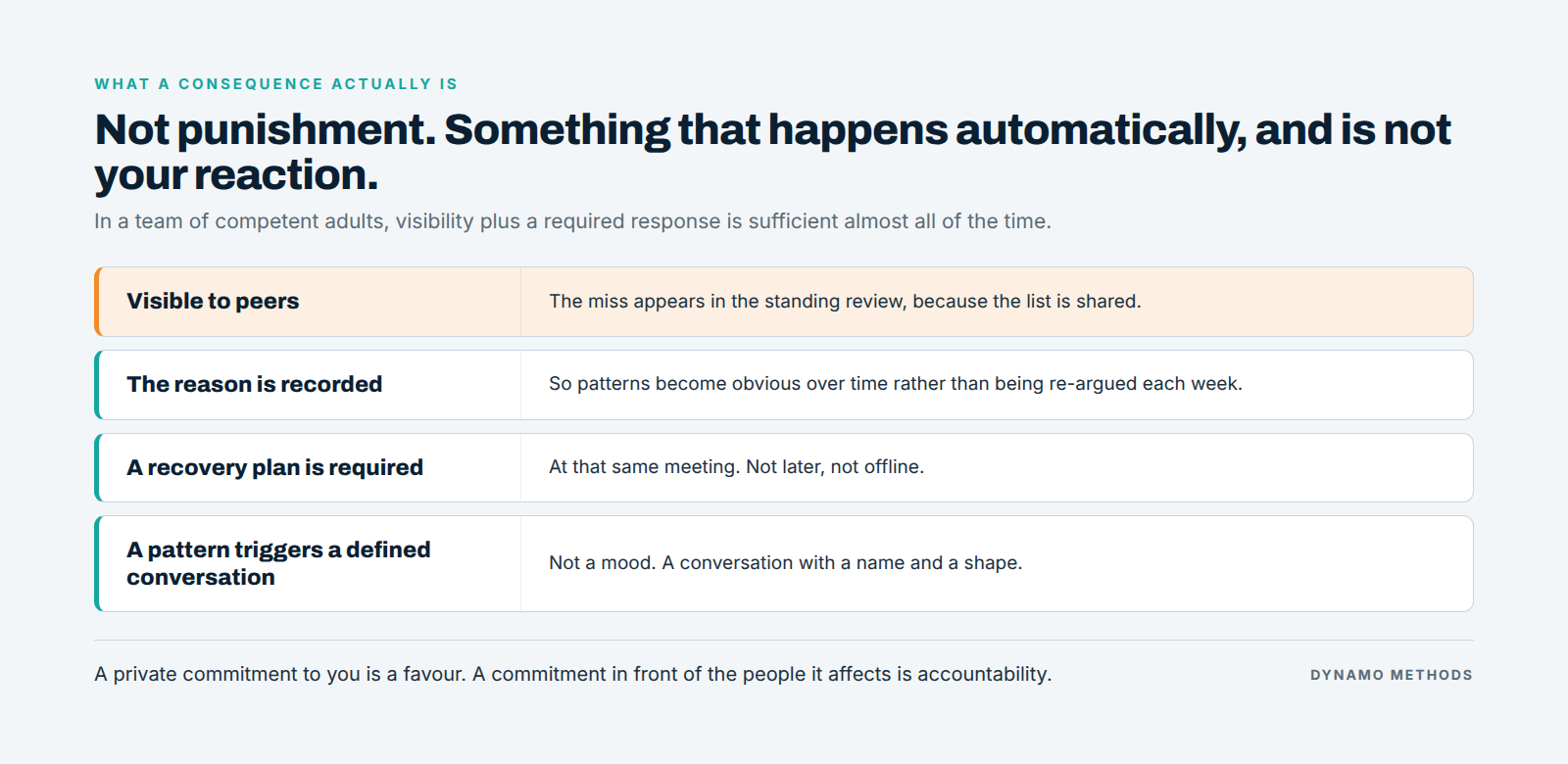
That is it. The consequence is mostly visibility plus a required response. In a team of competent adults, that is sufficient almost all of the time, because the thing that actually drives follow-through is knowing your peers will see it.
Which is why it has to be shared. A private commitment to you is a favour. A commitment in front of the people it affects is accountability.
The half everyone skips
You can have all four requirements on paper and still fail, if the person accountable for the outcome cannot make the decisions that produce it.
Documentation without authority is bureaucracy. Authority without documentation is dependency.
Here is the two-minute test. Ask the owner of any outcome: is there anything stopping you from hitting this number?
If the answer includes waiting on you for anything routine, you have built bureaucracy — someone accountable for a result they cannot control. That is the most demoralising position in any organisation, and it is why people in it stop owning things.
So for every owned outcome, three things: what they own, what they can decide alone with a real threshold, and what escalates as a rule.
How to install it — one meeting
Do not do this everywhere at once. Start with one meeting. Your weekly leadership meeting, or whatever the equivalent is.
Change four things about it.
Every item on the agenda has one name against it. Not a department — a person.
Every commitment made in that meeting is written where everyone can see it, with a date.
The meeting starts by reviewing last week's commitments. First item, every week, before anything new. Nothing else earns that slot.
The meeting runs whether or not you are there. Someone else chairs it when you are away, and it happens.
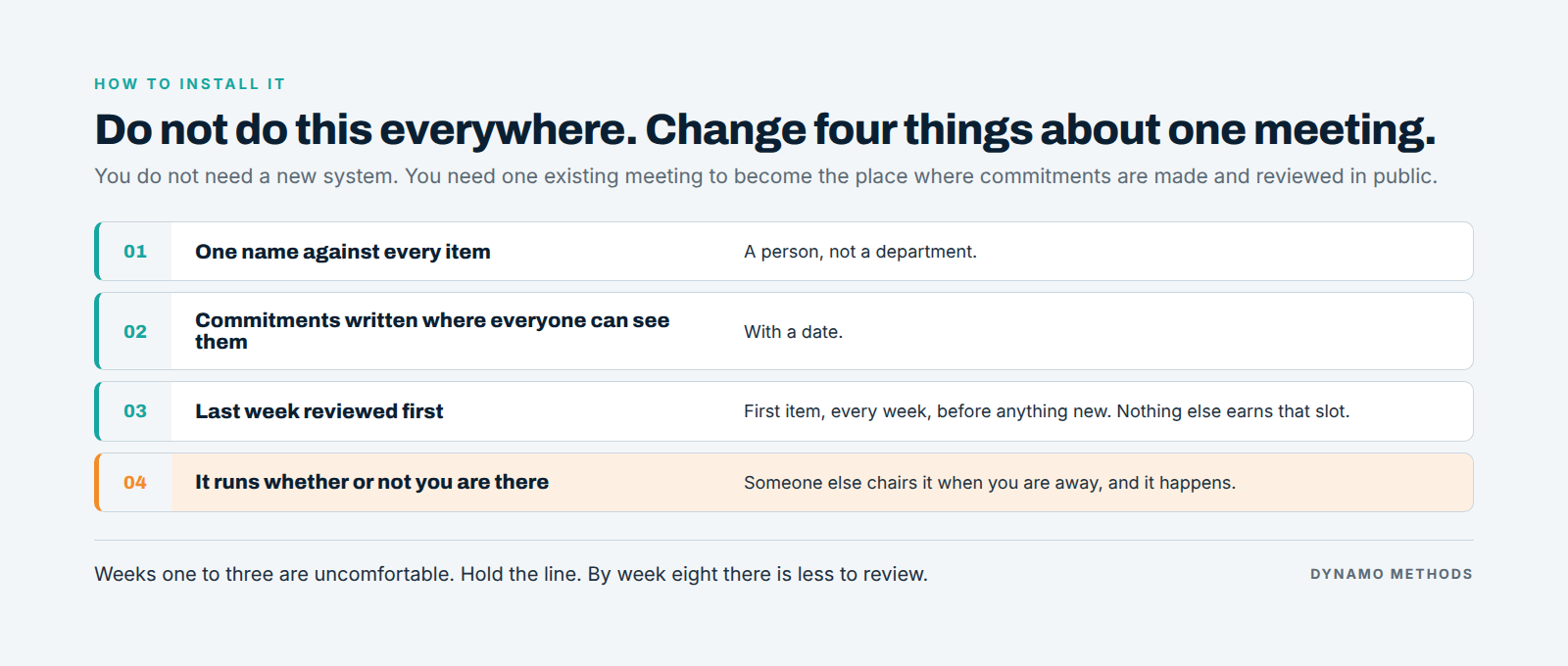
That is it. Four changes to one meeting. You do not need a new system , you need one existing meeting to become the place where commitments are made in public and reviewed in public. Once that is stable, apply the same four things to the next layer down.
What to expect:
This is consistent enough to predict.
Weeks one to three are mostly uncomfortable. Reviewing last week's commitments first means starting each meeting with what did not get done, and the room will not enjoy it. Hold the line.
Around week four, commitments start getting more careful. People commit to less and hit more, which looks like a slowdown and is actually the system working. This is where most owners panic and intervene. Do not.
By week eight the review takes less time, because there is less to review — and people start reporting misses before the meeting, which is the real signal that you have arrived.
You will also stop chasing. Not because you decided to, but because the rhythm is doing it.
Six hours a week of chasing
An owner I worked with — professional services, about twenty-three million — had what he described as a chronic follow-through problem. He estimated he spent six hours a week chasing commitments.
We changed one meeting. His Monday leadership meeting. One name per item. Commitments written on a shared board with dates. Review of last week's list as the first agenda item. And a rotating chair, so it ran without him.
The first three weeks were, in his words, brutal. Starting with the misses meant starting with failure, every week, in front of everyone.
Week five, something shifted. His finance lead came to the meeting and said, before anyone asked, that she had missed hers, why, and what she was doing about it.
That was the turn. Once one person did it voluntarily, it became the norm within a month.
His chasing dropped from about six hours a week to under one. He described the change as: I stopped being the reason things happened, which he said was uncomfortable for about a month and then a relief.
What to do this week:
One meeting. Take your most important recurring meeting and change four things.
One name against every item. Commitments written where everyone can see them, with dates. Last week's commitments reviewed as the very first item. And name someone to chair it when you are not there.
Then run it that way for four weeks without adjusting it. Four weeks is the minimum before it tells you anything, and the first three will be unpleasant.
And say this at the start of the first one, close to word for word:
"From now on we start by reviewing what we committed to last week. Not to catch anyone out, because commitments that are not reviewed are not commitments. And this meeting will run whether or not I am in the room."
The objection: this feels bureaucratic. We are a relationship business, not a process business, and this will make us corporate.
I take that seriously, because it comes from a real instinct.
What you have now is not informal. It is dependent. Follow-through is currently a function of your personal attention. That is not a warmer culture — it is a more fragile one, and everyone in it knows their real job is to stay on the right side of you.
And this is four changes to one meeting. Not a management system, a piece of software or a policy document. If four changes to one meeting makes you corporate, the meeting was doing very little.
The outcome is usually the opposite of corporate. When commitments are visible and reviewed, you stop needing to chase people — which means the conversations you do have get to be about the work rather than about whether they did it.
𝗧𝗮𝗸𝗲 𝘁𝗵𝗲 𝗙𝗿𝗲𝗲 𝗕𝘂𝘀𝗶𝗻𝗲𝘀𝘀 𝗦𝘁𝗮𝗯𝗶𝗹𝗶𝘁𝘆 𝗗𝗶𝗮𝗴𝗻𝗼𝘀𝘁𝗶𝗰: https://dynamomethods.com/business-os
Isaac Wambua is an industrial engineer, business systems architect, and the creator of the Dynamo Business Operating System (DBOS) and the Dynamo Leadership Operating System (DLOS). He is the author of The Dynamo Business Blueprint: How to Build a Business That Runs, Grows and Thrives Without You. Through Dynamo Methods, he helps owners and executive teams install the operating systems and leadership capacity that allow a company to run — and improve — without depending on any one person.


