How to Get Employees to Take Ownership
Ownership is not an attitude. It is a structure, and you can install it.
You cannot demand ownership of something people are not actually allowed to own.
When an owner tells me they wish their team took more ownership, I have learned to ask one question back.
Ownership of what, specifically?
There is usually a pause.
Because ownership gets talked about as an attitude — something people either have or do not, something you hire for or motivate into existence.
It is not an attitude. It is a structure. And you can install it.
Ownership attaches to outcomes, never to tasks
Most businesses assign tasks. Some assign responsibilities. Very few assign outcomes. And ownership only ever attaches to an outcome.
Think about what you own in your own life. You do not own brushing your teeth. You own your health. The task is a means; the outcome is the thing you are actually accountable for, and it is the outcome that makes you think, adapt and care when something is not working.
So when someone has been given tasks and you are waiting for them to display ownership, you are waiting for something the structure cannot produce. There is nothing for the ownership to attach to.
Here is the principle underneath it:
Outcome ownership precedes task assignment. Not the other way round. If you assign work before you have assigned the result, every system you build will eventually revert to you — because you will remain the only person in the building thinking about the result.
Why it defaults to tasks
Two reasons.
Tasks are easier to describe. I can tell you exactly what to do. Telling you what result you are accountable for requires me to have decided what the result is, in measurable terms — which is harder, and which many owners have never actually done.
The second is riskier to say out loud. Assigning an outcome means giving up the right to specify the method. If you own client retention, you get to decide how. And if your way is not my way, I have to live with that.
A lot of owners will say they want ownership and then correct the method the first time it differs — which teaches everyone that the outcome was never really theirs.
That is the fastest way to kill ownership. Assign an outcome, then override the method. Do it twice and the person will start checking with you first, and you are back where you started with a new label on it.
The four things that make an outcome owned
It fits on one page. I call it a role scorecard.
One — the outcome, in plain language. Not a list of duties. Client retention. On-time delivery. Qualified pipeline. One to three of these per person, maximum. If someone has nine outcomes, they own none of them.
Two — the measure. A number, and where that number lives, so both of you can see it without asking each other. Without this, ownership becomes an argument about perception, and the person with more authority wins that argument — which is not the same as being right.
Three — decision authority. What they can decide alone to hit the number, with thresholds. Real numbers, not use your judgment. This is the one that is usually missing, and without it you have made someone accountable for a result they cannot influence — the most demoralising position in any organisation.
Four — escalation criteria. What must come to you, stated as a rule. Irreversible things. Things over a spend threshold. Things that cross into someone else's outcome. Things that set a precedent you would be uncomfortable repeating fifty times.
The version that looks right and does not work
There is a failure mode here that is extremely common, and it looks like success on paper.
You write the scorecard. Outcome, measure, review rhythm. It is clear, it is written down, everyone has signed it. And nothing changes — because to hit the number, they need four decisions they cannot make.
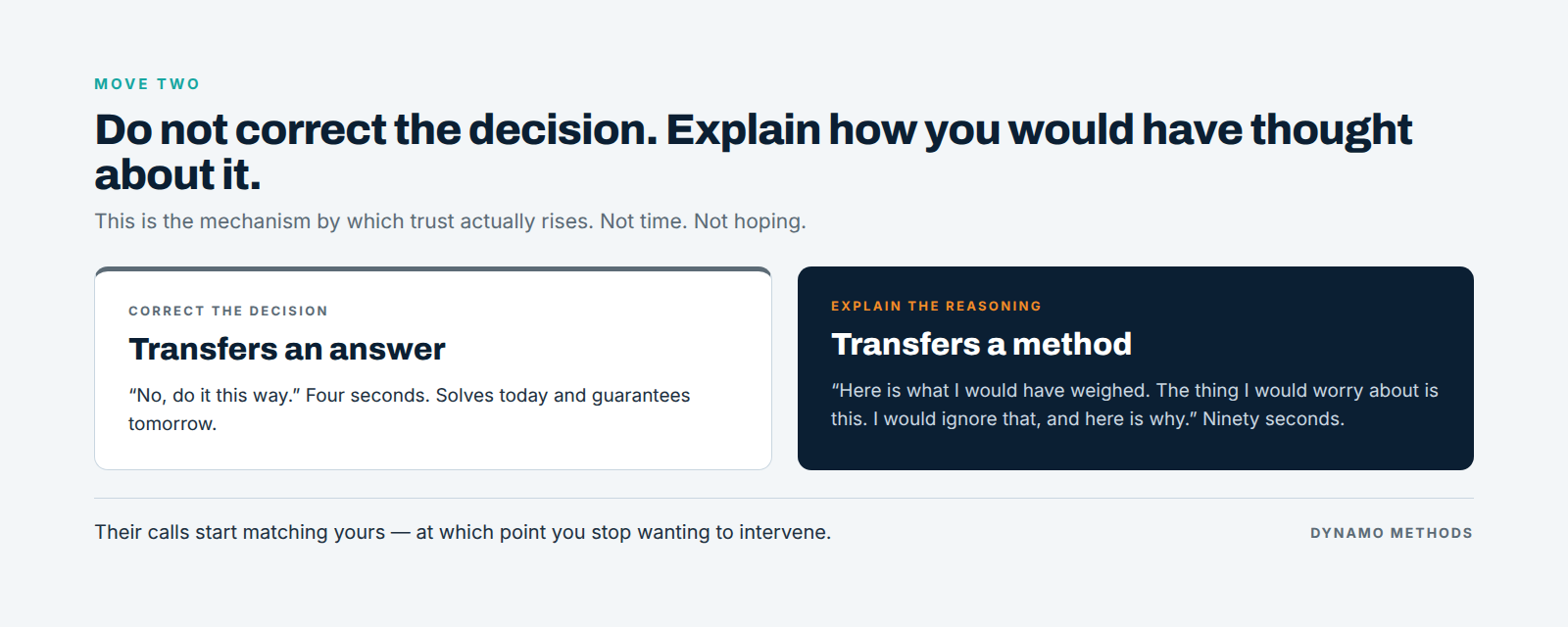
Documentation without authority is bureaucracy. Authority without documentation is dependency. You need both, and most businesses do the paperwork half, because it is the half you can do alone on a Sunday.
Here is how you know which one you have built. Ask the person: what is stopping you hitting this number?
If the answer includes waiting for you on anything routine, you have built bureaucracy. If the answer is entirely within their control, you have built ownership.
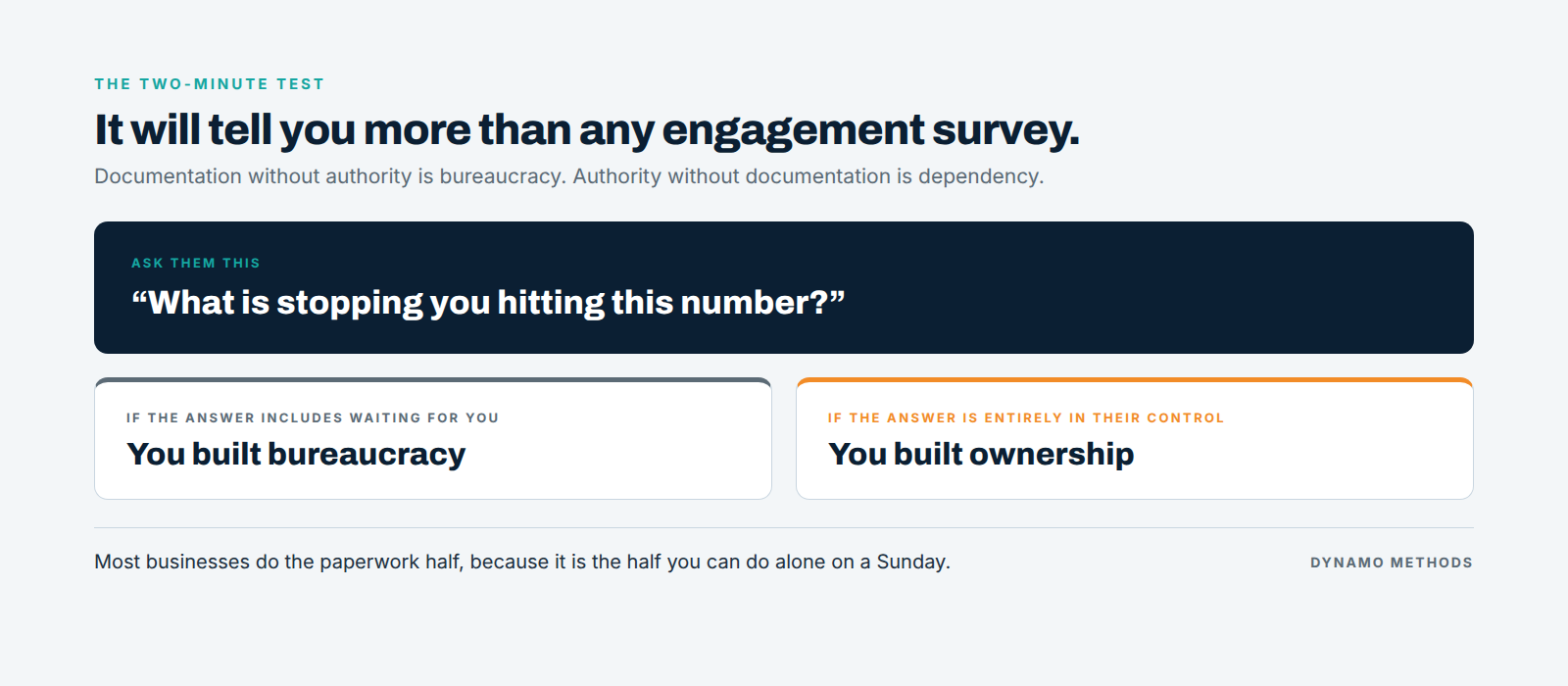
That is a two-minute test and it will tell you more than any engagement survey.
A year of reading it as passivity
An owner I worked with — distribution business, around twenty-five million — was frustrated that his customer service lead did not own retention. Churn was creeping up and, in his words, she treated it as somebody else's problem.
So we wrote it out. Her outcome: client retention, measured by net revenue retention, reviewed monthly.
Then I asked what she could decide.
She could not offer a goodwill credit. She could not extend a payment term. She could not authorise a site visit. She could not escalate a delivery issue past the operations lead without going through him.
So every time an account was at risk, she could see it coming and could do exactly nothing about it except tell him. Which she had been doing. For a year.
And he had been reading that as passivity.
We gave her three thresholds. Goodwill credits up to a limit, her call. Payment terms inside a defined band, her call. Direct authority to escalate operational issues, no gatekeeping.
Net revenue retention improved over the following two quarters. Same person, same outcome. The difference was that she could act on the thing she was accountable for.
And here is the part worth sitting with. Every single day of that year, he had believed he had a people problem.
What to do this week
One person, one outcome. Pick the person whose ownership you most wish were higher.
Write their scorecard. One page, four sections: the outcome in plain language, the measure and where it lives, what they can decide alone with thresholds, what must come to you as a rule.
Then sit with them and do two things. Read it to them. And ask the test question:
"With this authority, is there anything stopping you owning this number?"
Whatever they say next is the most valuable information you will get this month. Write it down. And if it is a decision they need and do not have — give it to them, or accept that they do not own the outcome.
Two objections worth answering.
Some people genuinely do not want ownership. True, and rarer than people think, but real. Here is how you tell. Give somebody a clear outcome, a real measure and genuine authority, then wait six weeks. Someone who wants ownership will start bringing you decisions they have already made. Someone who does not will keep bringing questions even when they do not need to. That is now a real performance conversation, with evidence, about someone who had what they needed — completely different from the conversation you are having now.
Won't we end up going in different directions? That is why escalation criteria are one of the four things rather than an afterthought. Ownership is not autonomy without limits — it is a defined space with clear edges. The precedent test does most of the work: if this decision were repeated fifty times, would I be comfortable? If not, it escalates. That single question resolves most of the coordination risk without you approving anything.
NEXT STEP
See how this scores across your whole business. The Dynamo Business Stability Diagnostic scores all seven systems and names your biggest constraint.
𝗧𝗮𝗸𝗲 𝘁𝗵𝗲 𝗙𝗿𝗲𝗲 𝗕𝘂𝘀𝗶𝗻𝗲𝘀𝘀 𝗦𝘁𝗮𝗯𝗶𝗹𝗶𝘁𝘆 𝗗𝗶𝗮𝗴𝗻𝗼𝘀𝘁𝗶𝗰: https://dynamomethods.com/business-os
Isaac Wambua is an industrial engineer, business systems architect, and the creator of the Dynamo Business Operating System (DBOS) and the Dynamo Leadership Operating System (DLOS). He is the author of The Dynamo Business Blueprint: How to Build a Business That Runs, Grows and Thrives Without You. Through Dynamo Methods, he helps owners and executive teams install the operating systems and leadership capacity that allow a company to run — and improve — without depending on any one person.


