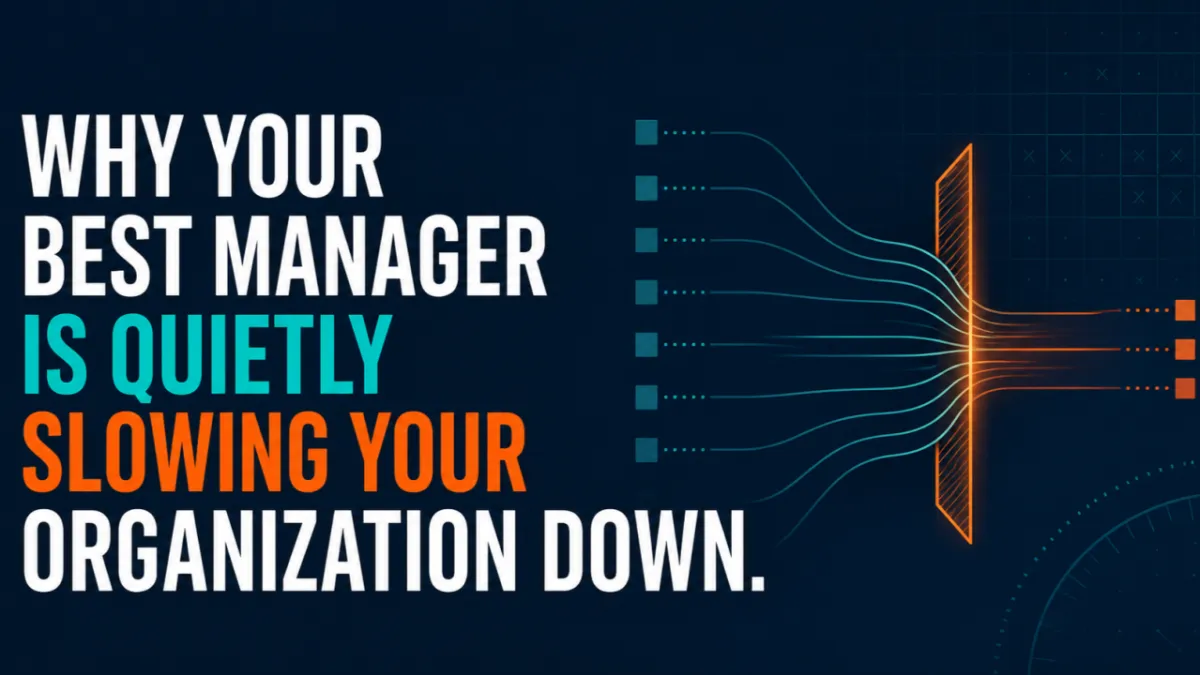
Every leader hits a ceiling. The mistake is believing the ceiling is external.
Here's a pattern I see with senior leaders almost universally.
By the time they reach me, they've already done the obvious work. They've read the books. They've attended the cohort programs. They've hired the executive coach. They've restructured the team at least once.
And they're still stuck.
Not failing — stuck. Their numbers are fine. Their team looks capable. Their reviews are good. But somewhere inside, they know the work isn't compounding the way it should. They know they're carrying weight that shouldn't still be theirs. They know they're the constraint, even when everything around them suggests otherwise.
This is the leadership ceiling. And almost every leader makes the same mistake about it.
They believe it's external.
WHY EXTERNAL EXPLANATIONS FEEL TRUE
The external story is always available. Markets are tougher. Talent is thinner. Customers are more demanding. The team isn't quite where it needs to be. The board isn't aligned. Headwinds are real.
These explanations are not wrong. They're just incomplete. If external pressure were the actual ceiling, every leader at the same level would feel the same friction. They don't. Some leaders at the same revenue band, in the same industry, with the same team size, build organizations that compound capability over time. Others plateau. The difference is not external. It's structural — and it's internal.
THE RESEARCH NAMES IT PRECISELY
The Center for Creative Leadership has tracked this for decades. Their finding: 75% of leadership derailment is caused not by external pressure but by internal factors — emotional patterns, blind spots, habits, and identity gaps.
A separate body of research finds that nearly 60% of leaders avoid acknowledging internal overwhelm until performance has already begun to slide. By the time the overwhelm becomes visible externally, the leader has been carrying it internally for months.
These are structural statistics. They describe a ceiling that operates regardless of how strong the leader is, how good the strategy is, or how capable the team is. The ceiling is the limit of the leader's internal operating system — the identity they lead from, the emotional capacity they hold under pressure, the clarity they bring to ambiguity, the energy they radiate into the room.
When the internal operating system stays static, the external organization tops out at whatever the internal one can carry.
WHY TACTICAL FIXES FAIL
Most leaders, when they sense the ceiling, reach for tactical fixes. Better systems. More senior hires. Tighter operating rhythms. Another planning offsite. None of them resolve the structural problem, because the structural problem isn't tactical.
Better systems fail when the systems still terminate at the leader. Senior hires fail when the new leadership team routes decisions back to the leader for approval. Operating rhythms fail when the leader is the architectural center the rhythm is organized around. Planning offsites produce alignment that decays within ninety days because the underlying architecture hasn't changed.
The pattern in each case is the same. The fix addresses the symptom. The architecture continues to terminate at the leader. The ceiling tightens.
WHAT THE CEILING ACTUALLY ASKS FOR
The ceiling is not a signal that the leader is failing. It's a signal that the leader is ready to grow. Specifically, it's a signal that the internal operating system that carried them this far is not the one that will carry them forward.
This is the work most leadership programs miss. They teach external behaviors — communication, delegation, strategic thinking — without addressing the internal architecture that produces them. The leaders complete the program, return to their organizations, and find that the behaviors don't sustain under pressure. Because the operating system underneath them wasn't upgraded.
Real leadership development — the kind that compounds — works in the other direction. It upgrades the inner operating system first, then the relational system, then the organizational system, and finally the multiplication system that produces leaders who develop other leaders. That's the four-stage architecture of becoming a Multiplier Leader. It's what I'll walk through over the next twelve weeks.
WHERE TO START
If you've felt the ceiling lately and you'd know if you have, the first move is visibility. Not more effort. Not another tactic. Just clarity about which stage of leadership maturity you're operating at, and what the next architectural move looks like.
The Leadership Stage Assessment locates you in eight minutes. Stabilizer, Translator, Connector, or Multiplier. It shows you where you are and what's structurally next. Take it before next week's piece. The rest of the series will be sharper if you know your starting point.
Find out which stage of leadership maturity you're operating at in eight minutes: Leadership Stage Assessment (LSA)


