
How to Manage a Team as a New Manager: Your First 30 Days
Your first thirty days are not for proving you have every answer. They are for learning where decisions belong.
In your first thirty days your job is to earn the right to change things, not to change them.
The instinct in your first month as a manager is to demonstrate that you deserve the job. Which usually means changing something quickly, so that people can see you leading.
That is the most common first-month mistake, and it costs about six months to recover from.
Here is a different plan. Four weeks, one job per week, in order.
The principle underneath the month
You arrive with almost no information and almost no trust. Both are fixable quickly — but only if you spend the month acquiring them rather than spending it acting.
There is a practical reason beyond trust. Most new managers who change something in week one change the wrong thing, because the obvious problem is rarely the real one and in week one you cannot yet tell the difference.
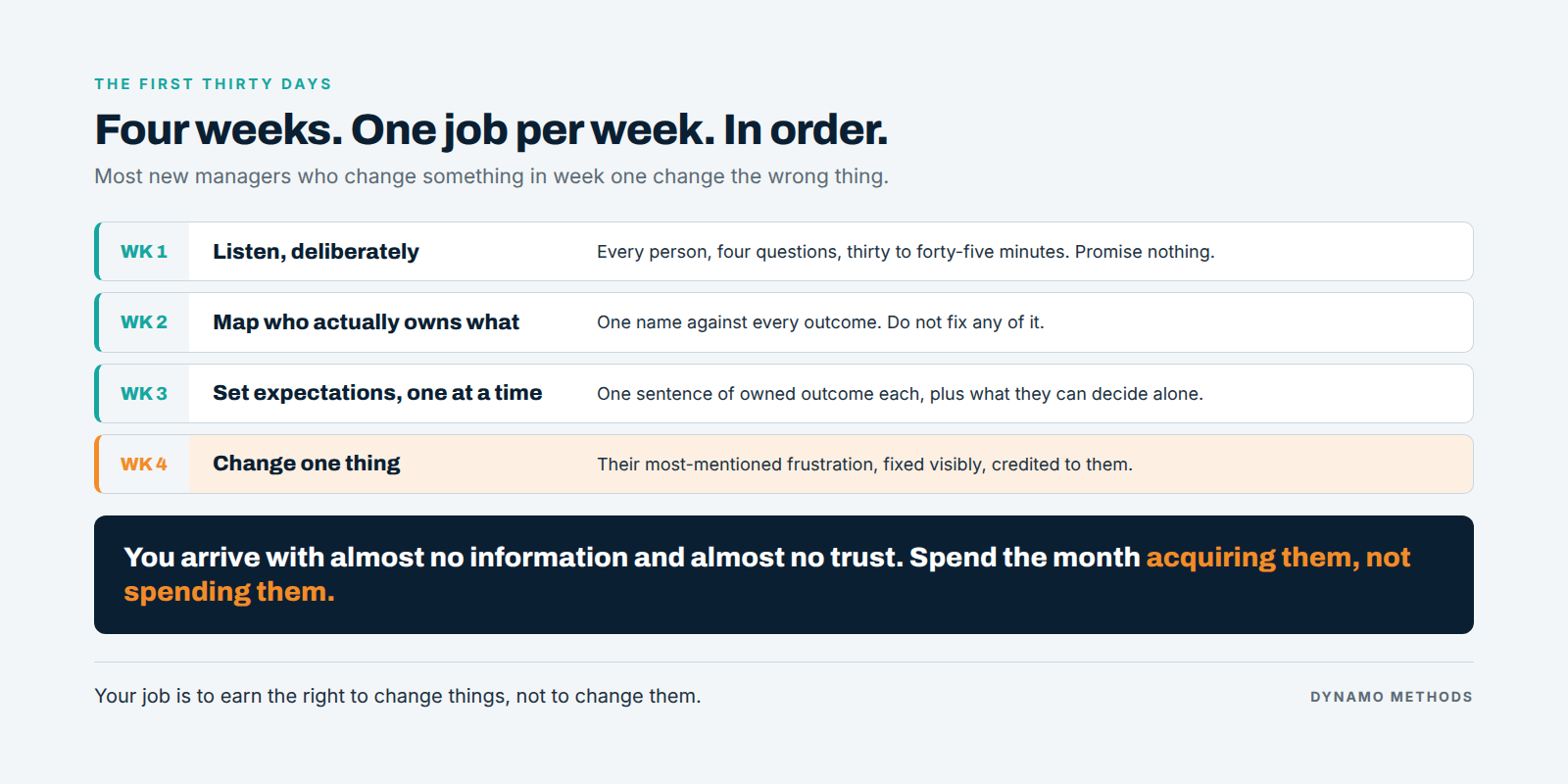
Week one — listen, deliberately
One job: an individual conversation with every single person who reports to you. Thirty to forty-five minutes each, no exceptions, and all of them inside the first week rather than spread across a month.
Four questions. The same four for everyone.
What is working well that I should protect? What is frustrating that you would fix if you could? What do you want to be doing more of in a year? And what should I know that I probably do not?
That last one is where the useful material comes from. Ask it, then leave the silence alone.
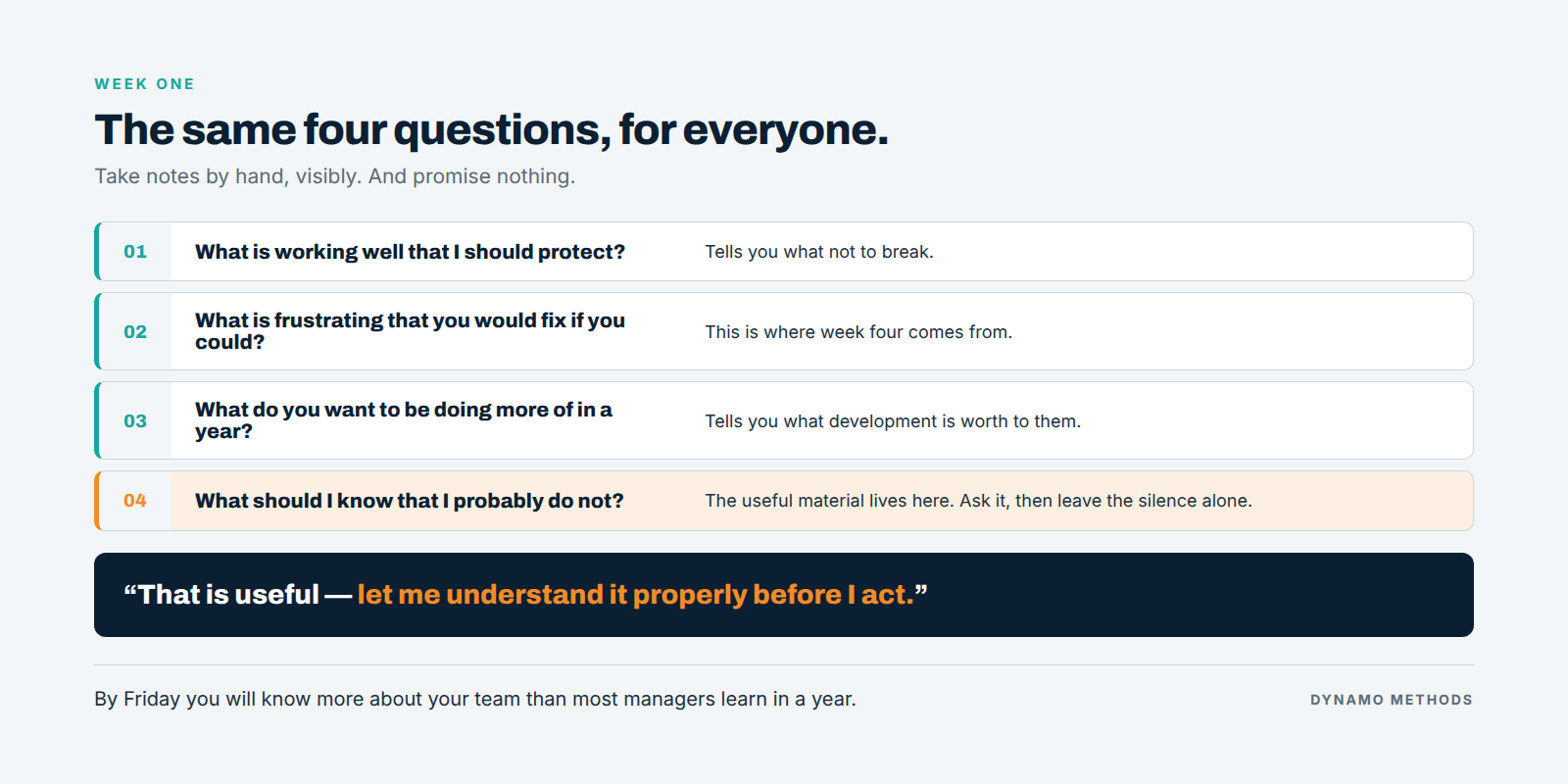
Two rules for these conversations. Take notes by hand, visibly — it signals that this is real. And promise nothing.
When somebody raises something fixable, the urge to say I'll sort that out is enormous. Say instead: that is useful, let me understand it properly before I act.
By Friday you will have more useful information about your team than most managers acquire in a year. You will have it because you asked in the first week rather than the fourth.
Week two — map who actually owns what
Not what the titles say. What is actually true.
Take every significant outcome your team is responsible for and write one name against it. Just one.
You will find three things, and you will find them in essentially every team.
Outcomes with two owners — which means nobody owns them, and there is usually a low-grade conflict there that everyone has stopped mentioning.
Outcomes with no owner — usually the ones that keep going wrong, which everyone has quietly decided is just how it is.
Outcomes owned by whoever cares most rather than whoever's job it is — unsustainable, and usually the person closest to burning out.
Do not fix any of it this week. Just map it.
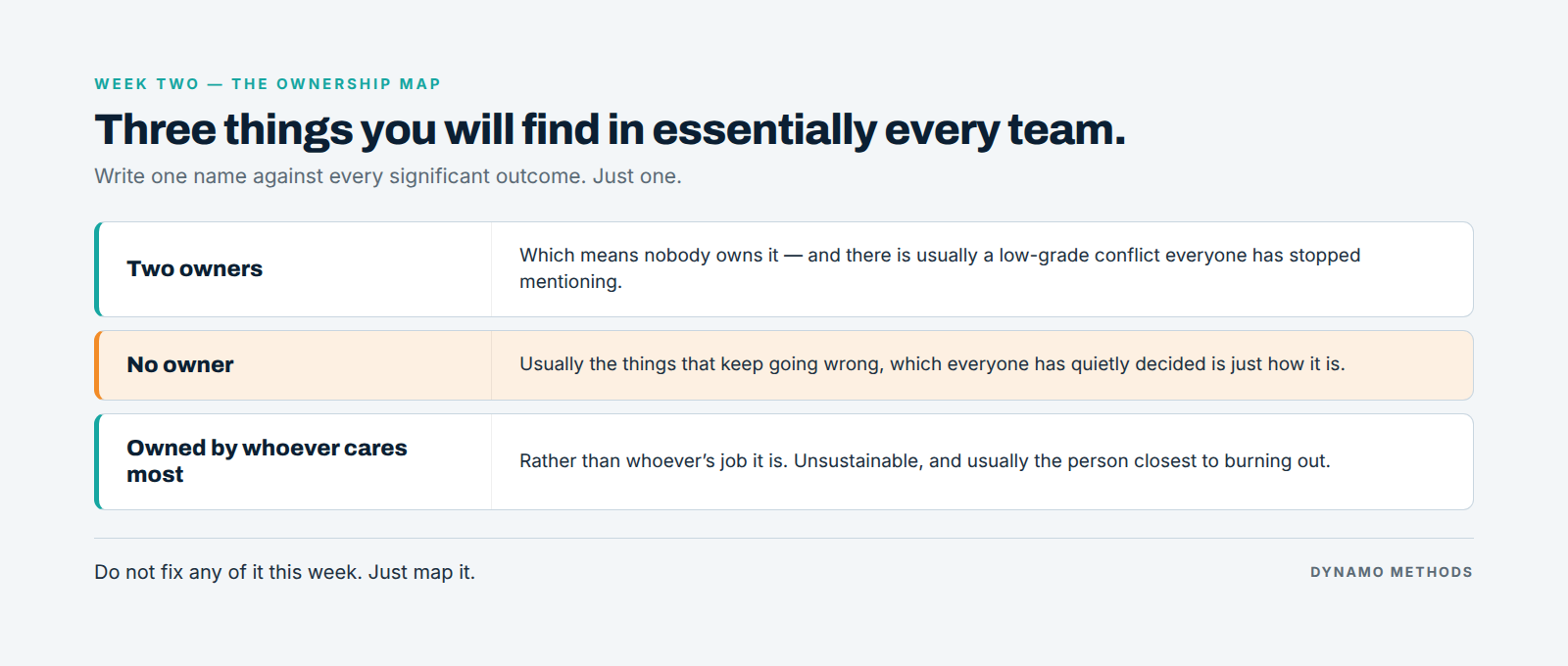
This map is the single most valuable document you will produce this month.
Week three — set expectations, one person at a time
Now you start making things clear, and clarity comes before change.
For each person, write one sentence naming the outcome they own. Then meet them again, read it to them, and ask one question: does that match what you think you own?
That question surfaces mismatches, and there will be mismatches. Someone will tell you they have been quietly carrying something you had assigned to somebody else. Someone else will be relieved to hear a boundary said out loud for the first time.
And in the same conversation, do the thing almost no new manager does. Tell them what they can decide without you. With a threshold. Even a small one.
You do not need full authority yourself to do this. You only need to name whatever latitude you do have. Someone who knows their decision-making room stops coming to you for permission — which buys you the time you will need in week four.
Week four — one change, and it should be theirs
Now, and only now, you change something. One thing. Not three, and not a reorganization.
Here is how to pick it. From your week-one conversations, find the frustration that came up most often and is within your power to fix. Not the biggest problem — the most-mentioned problem you can actually resolve.
Then fix it visibly, and say where it came from. Four of you raised this in our first conversations. Here is what we are changing, starting Monday.
Two things happen. A real irritation goes away. And your team learns that talking to you produces results — which is the most valuable thing they can learn in month one, because it sets how much they tell you for the rest of your tenure.
Notice what this is not. It is not your idea.
Your first change should almost always be their idea, implemented by you.
Four things not to do
Do not compare them to your previous team, out loud or by implication. Nobody has ever been motivated by this.
Do not restructure. You do not have the information, and restructuring in month one tells everyone their existing relationships are at risk, which ends the honest conversations immediately.
Do not try to be the most competent person in the room. You may well be, in the technical work. Demonstrating it is how you become a manager who does the work.
Do not leave the tested moment unaddressed. Somewhere in the first few weeks someone will quietly not meet a standard, to see what happens. Address it directly and kindly, within a week. That single response sets the tone for everything after.
The team that was not difficult
A manager in one of my programmes took over a team of nine with a reputation for being difficult. Her predecessor had lasted eight months.
She ran the four weeks almost exactly as described. Nine conversations in week one.
What came out of them was not what anyone expected. The team was not difficult. They had had four managers in six years, each of whom had arrived and immediately restructured something. So the team's rational strategy was to wait out every new manager, because change was always temporary and always imposed.
Her week-four change was small. She killed a weekly report that three people told her nobody read. It took an email to confirm and one decision.
She told me that was the moment the team started talking to her properly. Not because the report mattered. Because she had listened, checked and acted — which none of the previous four had done.
Eighteen months later that team had the lowest turnover in the business.
What to do this week
If you are in your first thirty days, or about to be, here is the whole month.
Week one: every person, four questions, promise nothing. Week two: the ownership map, one name per outcome, fix nothing. Week three: one sentence of owned outcome per person, plus what they can decide alone. Week four: one change, drawn from their frustrations, credited to them.
And if you are already six months in and never did this, do it anyway. It works just as well in month seven. You would simply say: I want to reset how we work together, and I should have done this when I started.
The objection: my team needs me to act now. We have real problems. I cannot spend a month listening.
Two things. This is not a month of inactivity — you are doing the most consequential work of your tenure, you are just not making structural changes yet. Week three alone will resolve problems, because most team dysfunction is unclear ownership and naming it fixes a surprising amount.
And if something is genuinely on fire this week, deal with it. Obviously. But deal with it as an exception and say so: I am stepping in on this because of the timeline, and it is not how I intend to operate generally.
What you are protecting against is treating everything as an emergency. That is how first months get consumed, and how new managers end up with a team that has learned to wait for instructions.
NEXT STEP
See how this scores across your whole business. The Dynamo Business Stability Diagnostic scores all seven systems and names your biggest constraint.
𝗧𝗮𝗸𝗲 𝘁𝗵𝗲 𝗙𝗿𝗲𝗲 𝗕𝘂𝘀𝗶𝗻𝗲𝘀𝘀 𝗦𝘁𝗮𝗯𝗶𝗹𝗶𝘁𝘆 𝗗𝗶𝗮𝗴𝗻𝗼𝘀𝘁𝗶𝗰: https://dynamomethods.com/business-os
Isaac Wambua is an industrial engineer, business systems architect, and the creator of the Dynamo Business Operating System (DBOS) and the Dynamo Leadership Operating System (DLOS). He is the author of The Dynamo Business Blueprint: How to Build a Business That Runs, Grows and Thrives Without You. Through Dynamo Methods, he helps owners and executive teams install the operating systems and leadership capacity that allow a company to run — and improve — without depending on any one person.


