
First-Time Manager Tips: 7 Things Nobody Tells You at Work
Your technical competence got you promoted. It cannot do the new job for you.
You were paid for output. Now you're paid for other people's output. Those are not related skills.
You got promoted because you were good at the work. And on your first day as a manager, you discover that none of what made you good at the work is what this job requires.
Nobody tells you that in the offer conversation. They tell you congratulations.
Here are seven things nobody tells you about your first management job — the seven that come up in almost every conversation I have with new managers.
One — your job did not get bigger; it changed
This sounds obvious and almost nobody internalizes it. You were paid for output. You are now paid for other people's output. Those are not related skills.
The practical consequence is uncomfortable. A good day as a manager can feel like a day where you personally produced nothing. You had four conversations, unblocked two things, made one decision. Your instinct will scream that you achieved nothing.
You have to rebuild your definition of a productive day consciously, and it takes months. Until you do, you will keep sneaking back into the work you are good at, because that is where the feeling of accomplishment lives.
Two — your strength is now a trap
The thing you were promoted for is now the thing most likely to hold you back.
You are the best at the work. So when something is difficult, the fastest route is for you to do it. Every time you do, three things happen: it gets done well, nobody develops, and your team learns that the difficult things belong to you.
Six months of that and you are the busiest person on your team, doing the hardest work, wondering why nobody has grown.
If you are doing something because you are the best at it, that is exactly the thing you should be teaching. Your competence is now a curriculum, not a tool.
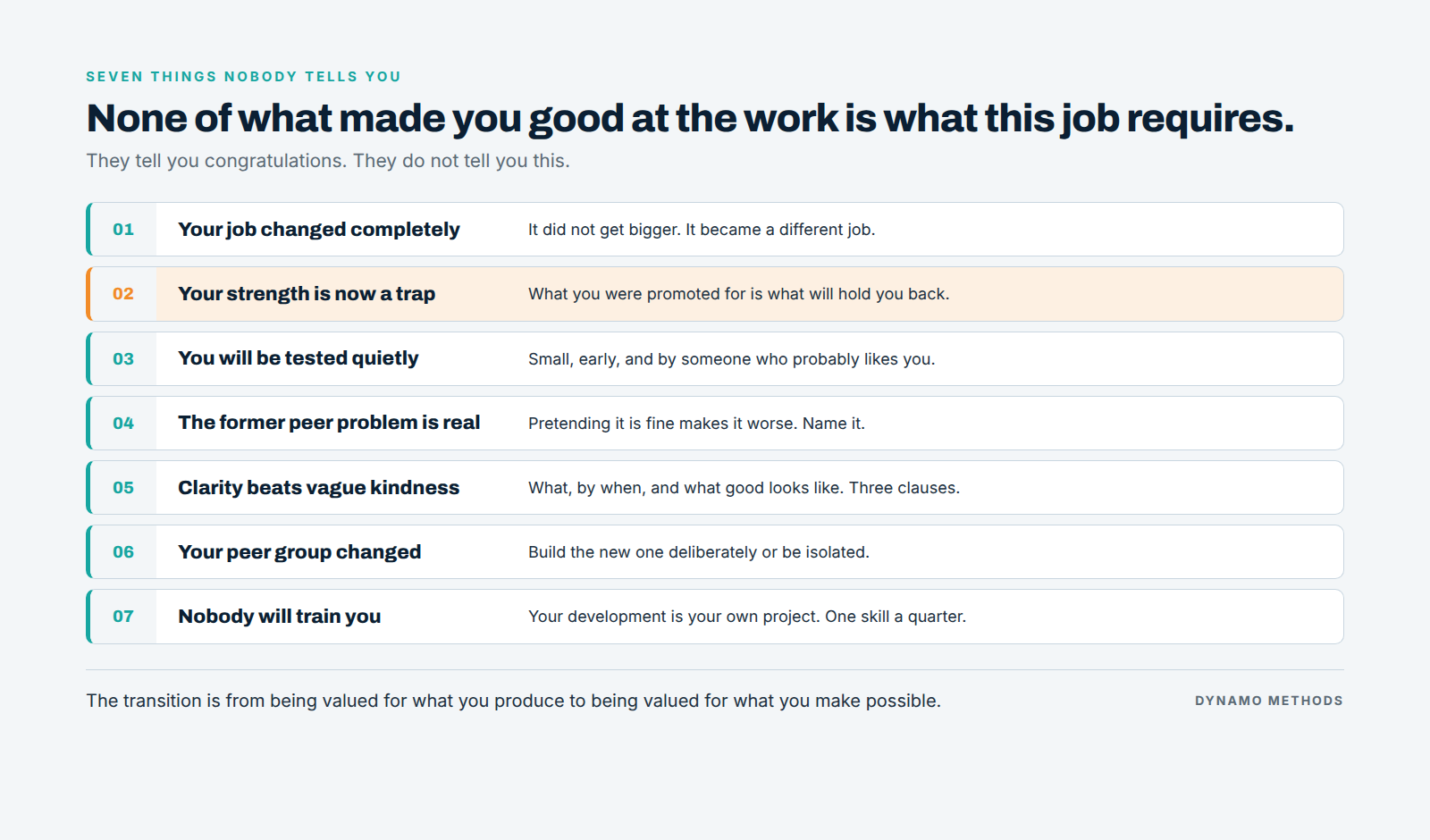
Three — you will be tested, and it will not be obvious
In your first few weeks, someone will test whether the rules apply to them now that you are the one applying them.
It will not be dramatic. A deadline missed with a casual explanation. A meeting skipped. A standard quietly not met. And it will be someone who probably likes you.
How you respond to that first small thing sets the standard for everything after, and the window is about a week.
Address it directly and kindly and you have established that standards survived your promotion. Let it pass because it is minor and you have established the opposite — and you will spend a year trying to recover ground you gave away in an afternoon.
Kindly matters here. This is not about being tough. It is about being clear early, which is the kindest thing available.
Four — the former peer problem is real
Managing people who were your peers last month is genuinely the hardest part, and pretending it is fine makes it worse.
The mistake almost everyone makes is trying to keep the relationship exactly as it was — proving you have not changed, that you are still one of them.
You have changed. You now control their review, their workload and possibly their promotion. Acting as though that is not true does not reassure anyone; it just means nobody can talk about it.
The better move is to name it out loud: this is different now, I know it is different, and here is how I am going to try to handle it. Then be consistent, because consistency is what earns you the room back.
What you lose is a certain kind of unguarded closeness, and that is a real loss worth acknowledging. What you gain is the ability to actually help their careers.
Five — clarity beats kindness that is not clear
Almost every new manager is too vague about expectations, and almost all of them believe they are being kind.
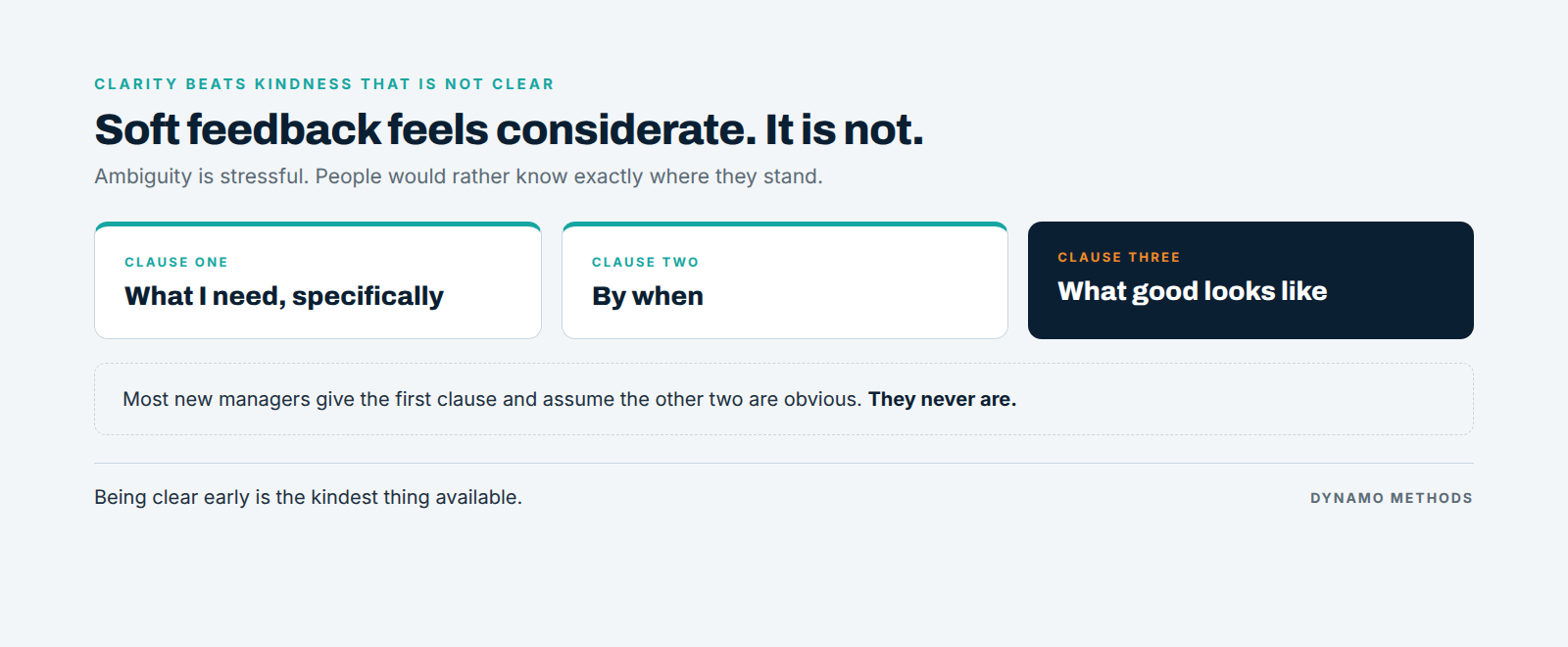
Soft feedback feels considerate. It is not. Ambiguity is stressful — people would overwhelmingly rather know exactly where they stand than be protected from it.
So the sentence to practice is: here is specifically what I need, here is by when, and here is what good looks like.
Three clauses. Most new managers give the first and assume the other two are obvious. They never are.
Six — your peer group changed
If you do not build the new one, you will be isolated.
You cannot debrief your day with your team any more — that is now their manager complaining about them. And you probably do not yet have relationships with the other managers, because until last month they were a level above you.
So build that deliberately. Find two or three other managers, inside or outside your organisation, and get honest with them.
New managers who do this get better faster. The ones who do not spend a year believing they are uniquely bad at it. Almost nobody is uniquely bad at it. It is a hard job that people are strangely reluctant to admit is hard.
Seven — nobody will train you
Most organisations promote people into management and provide no training whatsoever. You get a title, a slightly different salary, and a set of responsibilities nobody has taught you how to discharge.
That means your development is your own project. Not because it is fair — it is not — but because waiting for it will cost you two years.
Pick one skill a quarter. Delegation. Feedback. Difficult conversations. Running a meeting that is actually worth attending. One at a time, deliberately.
And know that when you struggle, it is almost never because you are unsuited to this. It is because you were handed a job with no manual and expected to intuit it.
The part that matters most
If you take one thing from this, take this.
The transition from doing to leading is a transition from being valued for what you produce to being valued for what you make possible. Everything difficult about your first year is some version of that shift.
And here is the concrete test of whether you are making it. In six months, ask yourself: could my team handle a normal week without me? Not a crisis — a normal week.
If the answer is no, you are still doing the job you were promoted out of.
What to do this week
One thing.
Take your three most important team members and, for each, write one sentence: the outcome they own. Not their tasks — the result you would hold them accountable for.
Then have a ten-minute conversation with each. Read it to them, and ask one question:
"Does that match what you think you own?"
You will discover at least one mismatch. That mismatch is probably the source of something that has been quietly frustrating you for months.
Three conversations, ten minutes each.
The objection I get from new managers, and it is honest: my manager does not do any of this. Why should I, when the person above me is managing me badly?
The practical answer: this makes you visible. Managers who develop their people are noticeably rare, and it is obvious from two levels up who has a team that functions and who has a team that depends on them.
The more important answer: you are the reason someone will or will not enjoy their job this year. The person above you does not change that. Their bad management is an argument for you being deliberate, not an excuse for drifting.
NEXT STEP
See how this scores across your whole business. The Dynamo Business Stability Diagnostic scores all seven systems and names your biggest constraint.
𝗧𝗮𝗸𝗲 𝘁𝗵𝗲 𝗙𝗿𝗲𝗲 𝗕𝘂𝘀𝗶𝗻𝗲𝘀𝘀 𝗦𝘁𝗮𝗯𝗶𝗹𝗶𝘁𝘆 𝗗𝗶𝗮𝗴𝗻𝗼𝘀𝘁𝗶𝗰: https://dynamomethods.com/business-stability-assessment
Two books written for exactly this transition: Take the Leap, on moving from employee to manager, and Now That I'm a Manager, on building a team that performs.
Isaac Wambua is an industrial engineer, business systems architect, and the creator of the Dynamo Business Operating System (DBOS) and the Dynamo Leadership Operating System (DLOS). He is the author of The Dynamo Business Blueprint: How to Build a Business That Runs, Grows and Thrives Without You. Through Dynamo Methods, he helps owners and executive teams install the operating systems and leadership capacity that allow a company to run — and improve — without depending on any one person.


