
How to Delegate as a Leader: The 5 Levels of Decision Authority
Authority should move like a staircase, not a trapdoor.
Delegation is not a leap. It is a sequence. Once you can name the levels, you can place every decision and move it deliberately.
Most delegation fails because it is binary. Either you are doing it or they are. Either you have handed it over or you have not.
And because it is binary, the handover is always a leap. A leap either succeeds or it fails — which is why delegation feels risky.
It is not binary. There are five levels, and once you can name them, delegation stops being a leap and becomes a sequence.
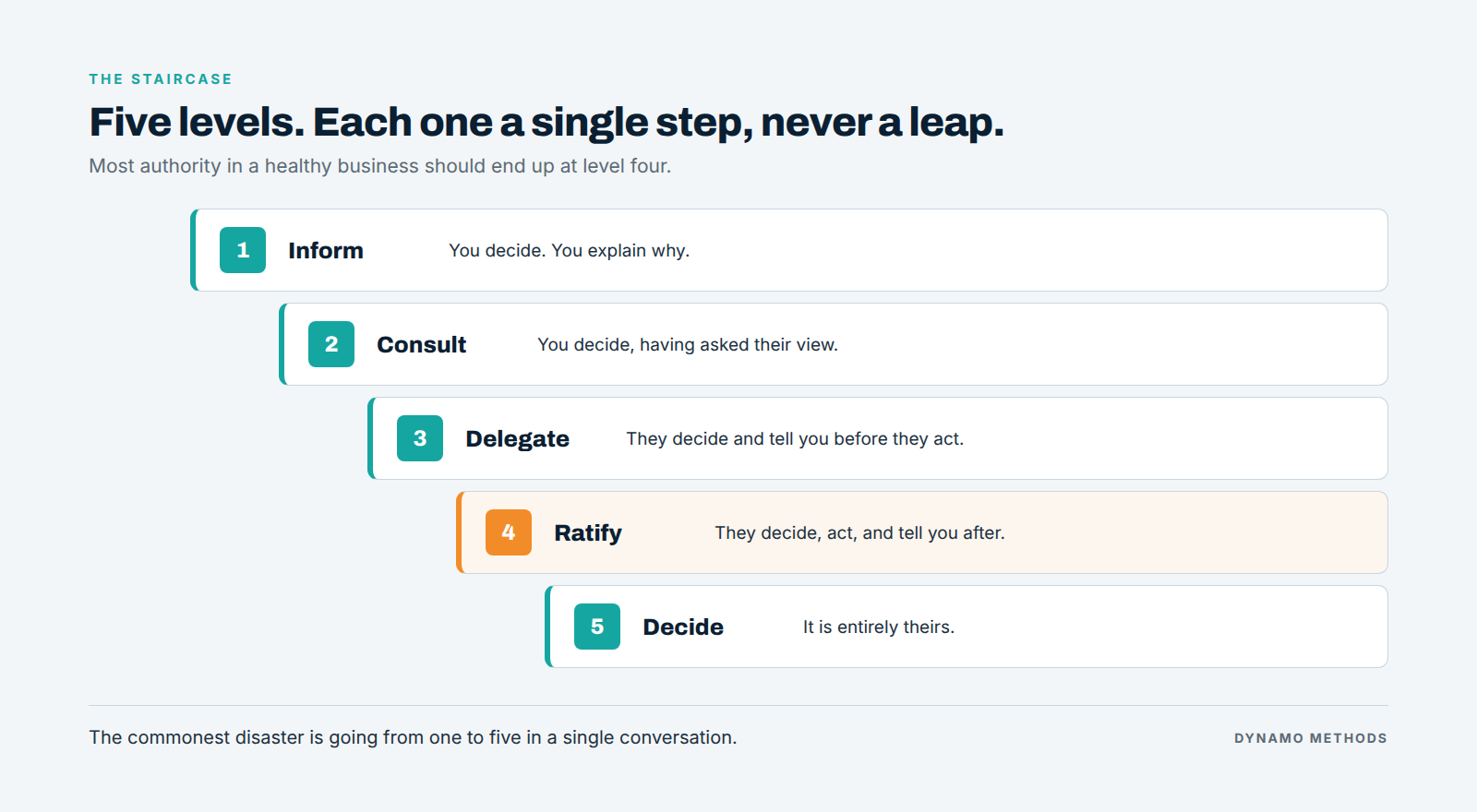
The Five Levels
Level one — Inform. You decide, and you tell them what you decided and why. Most people hear that and think it barely counts as delegation. But the why is doing real work: every time you explain your reasoning, you are transferring a decision-making model. Level one is where reasoning gets installed, and skipping it is why so much delegation collapses later.
Level two — Consult. You still decide, but you ask what they would do first. Now they are practising judgment at zero risk, and you are getting the information you actually need — how close their thinking is to yours. You cannot know whether someone is ready for more authority until you have heard them reason about a decision they did not have to make.
Level three — Delegate. They decide and tell you before they act. This is where most delegation should sit for a while, and it is the level that gets skipped. You retain a veto you will rarely use. They carry the decision. The notification is a legitimate touchpoint rather than an anxious one.
Level four — Ratify. They decide, they act, and they tell you afterwards. Genuinely different from three: the decision is theirs, and you are informed rather than consulted. Most authority in a healthy business should end up here.
Level five — Decide. It is entirely theirs. You find out through the normal reporting rhythm, or you do not find out at all, because it does not need you.
The Two Failures
The dramatic one: somebody goes from level one to level five in a single conversation. Usually out of frustration, usually with the phrase You own this now.
It fails because the person has never made a decision in this area, has no model of your reasoning, and now has full authority. What follows is either paralysis or a decision you would never have made — which you then use as evidence they were not ready.
Neither is about the person. That is a four-level jump.
The quieter failure: someone sits at level two for six years. You keep asking their view and keep deciding. They are experienced, capable, and have never made a call.
That is how you end up with a senior team that cannot decide. You built it, patiently, one consultation at a time.
How to Make a Decision
One question:
On this specific decision, what is the biggest mistake they could make, and is it recoverable?
Recoverable and cheap — level four, straight away. Stop overthinking it.
Recoverable but expensive — level three. They decide; you see it before it happens.
Genuinely irreversible — a major client, a regulatory exposure, a large financial commitment — level two, or keep it.
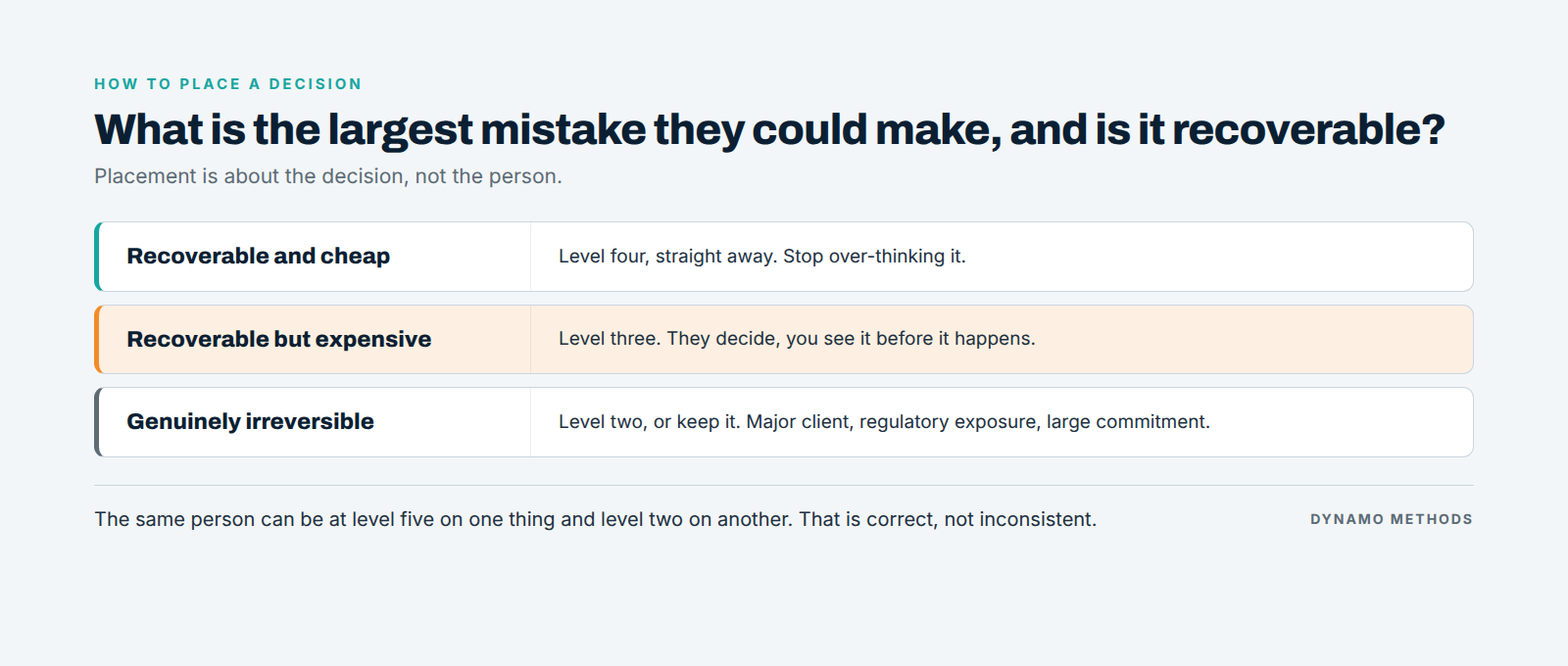
Notice that the placement is about the decision, not the person. The same person can be at level five on one thing and level two on another, and that is correct, not inconsistent.
Most owners try to assign a single level per person, which is why it never quite fits.
How To Move Someone Up
This is the part that gets neglected. Most authority is assigned once and never revisited, which means people stay where you first put them for years.
Three rules.
Move one level at a time. Two to three, three to four. Never skip.
Attach it to a count, not a feeling. After five of these at level three, we move to four. That way it is automatic, and neither of you has to make it a conversation about trust.
Say it at the point of assignment, not later. You are at level three on this, and after about five we will move you to four. Now they know there is a path, which is what makes level three tolerable rather than insulting.
And this is where transferring your reasoning earns its keep. At level three, when they tell you what they have decided and you agree, do not just say fine. Say what you would have weighed. Every one of those conversations makes the move to level four safer.
The sentence that sets your whole organisation's authority level
The moment that matters most is what you do when someone makes a call at level three or four that turns out badly.
If you take the authority back, you have established that authority is conditional on being right — and nobody in that building will use theirs again without checking. You will have undone months of work in one conversation.
What you want to say is:
"That was yours to make. You made it with the information you had. Here is how I would have weighed it — and it is still yours."
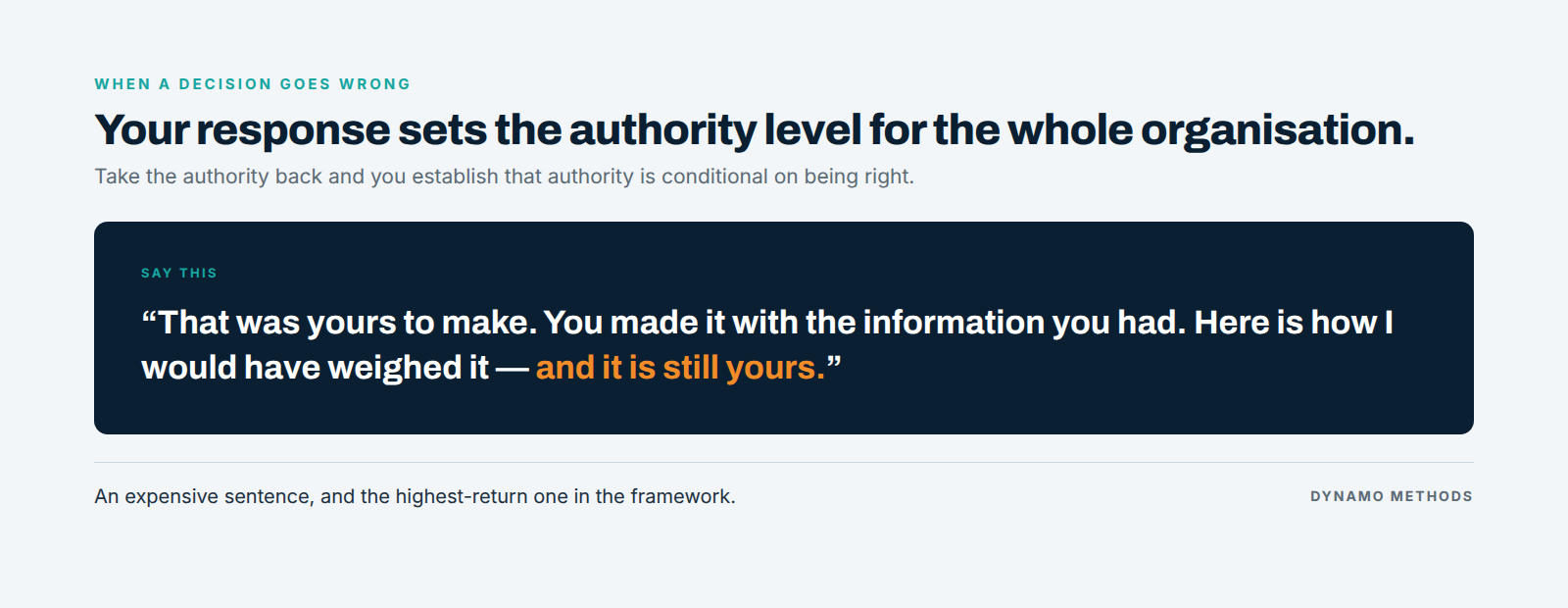
That is an expensive sentence. It is also the single highest-return sentence in this framework.
If there is a genuine pattern of poor judgment, that is a different conversation — move the level down explicitly and say why. What you must not do is move it down silently, which is what most leaders do. Silent demotion produces someone with nominal authority and no confidence, which is the worst configuration available.
Nine Years at Level Two
A CEO I worked with — manufacturing, around twenty-eight million — had a finance lead of nine years who, in his words, would not make a decision.
We went through her decisions and placed them. She was at level two on essentially everything. Nine years of him asking her view and then deciding.
So she had never made a financial decision in that business. Not one. She was extremely good at analysis and had zero decision-making practice, because he had built a role that did not require any.
We moved her to level three on everything under a threshold, with a count attached — five decisions, then level four.
She was visibly uncomfortable for about the first three. On the fourth, she brought him a decision with a rationale before he asked. By decision seven, he moved her to four ahead of schedule.
Nine years of appearing indecisive, resolved in about six weeks. Because the problem was never her. It was that nobody had ever moved her off level two.
What to do this week:
Pick your three most senior people. For each, list the four or five recurring decisions in their area, and write the level they are actually at right now.
Be honest. If you are asking their view and then deciding, that is level two, whatever you would call it.
Then for each person, pick one decision and move it up exactly one level. Say it out loud, with the count attached:
"On this, you are moving from level two to level three. That means you decide and tell me before you act. I will only step in if I see something you cannot. After about five of these, we move you to level four, where you just tell me afterwards."
Three people. One decision each. One level.
The objection: "This seems like a lot of structure for something that should be a normal working relationship."
Two responses. The structure is temporary — you are not going to be naming levels forever. You are doing it because the current arrangement is ambiguous, and ambiguity is what produces both hovering and hesitation. Once people know their room, the framework fades into the background.
And the alternative is not a natural working relationship. It is an unspoken one. Right now your people are guessing at their authority, guessing conservatively, and you are interpreting that as a lack of initiative.
There is also a fairness point. Unstated authority always favours the confident. The people who take latitude they were not given tend to be the ones who assume; the people who wait tend to be the ones who would use it best. Writing it down levels that.
NEXT STEP:
See how this scores across your whole business. The Dynamo Business Stability Diagnostic scores all seven systems and names your biggest constraint.
𝗧𝗮𝗸𝗲 𝘁𝗵𝗲 𝗙𝗿𝗲𝗲 𝗕𝘂𝘀𝗶𝗻𝗲𝘀𝘀 𝗦𝘁𝗮𝗯𝗶𝗹𝗶𝘁𝘆 𝗗𝗶𝗮𝗴𝗻𝗼𝘀𝘁𝗶𝗰: https://dynamomethods.com/stabilitydiagnostic
Isaac Wambua is an industrial engineer, business systems architect, and the creator of the Dynamo Business Operating System (DBOS) and the Dynamo Leadership Operating System (DLOS). He is the author of The Dynamo Business Blueprint: How to Build a Business That Runs, Grows and Thrives Without You. Through Dynamo Methods, he helps owners and executive teams install the operating systems and leadership capacity that allow a company to run — and improve — without depending on any one person.


