How to Hold Employees Accountable Without Micromanaging
If accountability requires you to enforce it, you have not built accountability.
Accountability that comes from a person works as long as that person is watching. Accountability that comes from a system works whether you are in the room or not.
Most accountability advice is about the conversation. What to say when someone misses a commitment. How to be firm but fair. How to have the difficult chat.
That advice is not wrong. It is answering the wrong question.
Because if you are having that conversation regularly, the conversation is not your problem. The reason you keep needing it is your problem — and the reason is almost always structural. A recurring difficult conversation is not accountability. It is a standing appointment with frustration.
I recorded a video for you. You can watch it here:
Two kinds of accountability
There is accountability that comes from a person, and accountability that comes from a system.
When it comes from a person, it works — as long as that person is watching. It is you noticing, you remembering, you following up. And it is genuinely effective, right up to the moment you are busy, or away, or dealing with something bigger. Then it evaporates. Every time.
When it comes from a system, it works whether you are in the room or not.
If accountability requires you to enforce it, you have not built accountability. You have built surveillance with extra steps.
That is also the answer to the micromanaging half of the question. Micromanaging is what personal accountability looks like from the outside. You are not hovering because you enjoy it. You are hovering because you are the mechanism.
The four requirements
For accountability to work without a person driving it, four things have to be true. Most businesses have one or two.
One named owner. Not a team, not a function. A person. If two people own it, nobody does. If a department owns it, nobody does.
A measure. Not a judgment — a measure. There is a number or a defined standard, and both of you can see it. Without that, accountability becomes an argument about perception, and the person with more authority wins the argument. Winning an argument is not the same as being right.
A rhythm that exists without you. A standing review that happens whether you called it or not. If the review only happens when you remember, then you are the review.
A consequence that is not your disappointment. This is the one almost everybody misses. When the only cost of missing a commitment is that you are visibly unhappy, accountability has become emotional and personal. It becomes about your mood — and people manage your mood rather than the outcome.
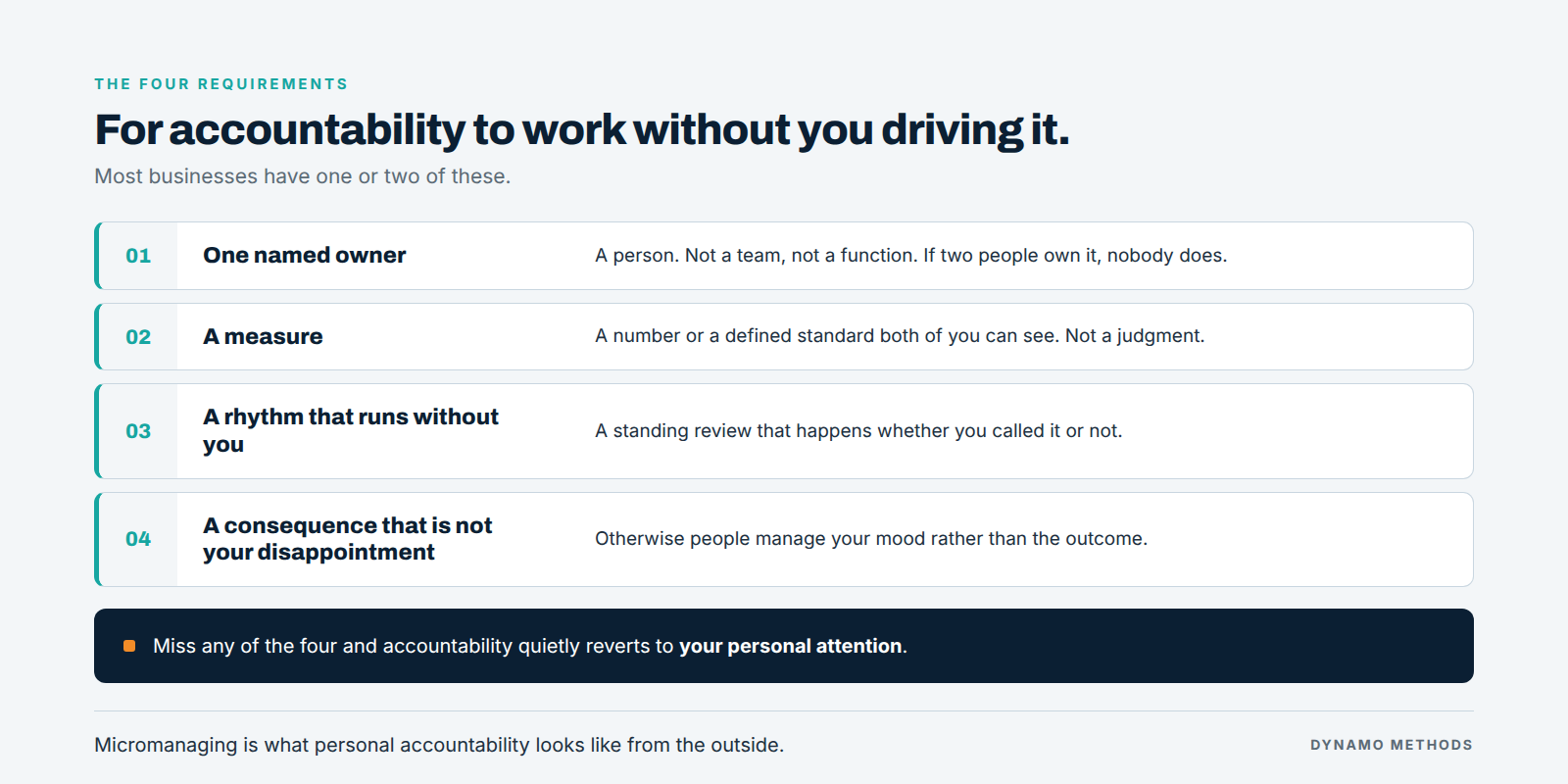
Miss any of the four and accountability quietly reverts to your personal attention.
The half everybody skips
Most owners hear that list, go away and write it all down. Roles, measures, a meeting cadence. Six months later they are back to chasing.
Here is what is missing.
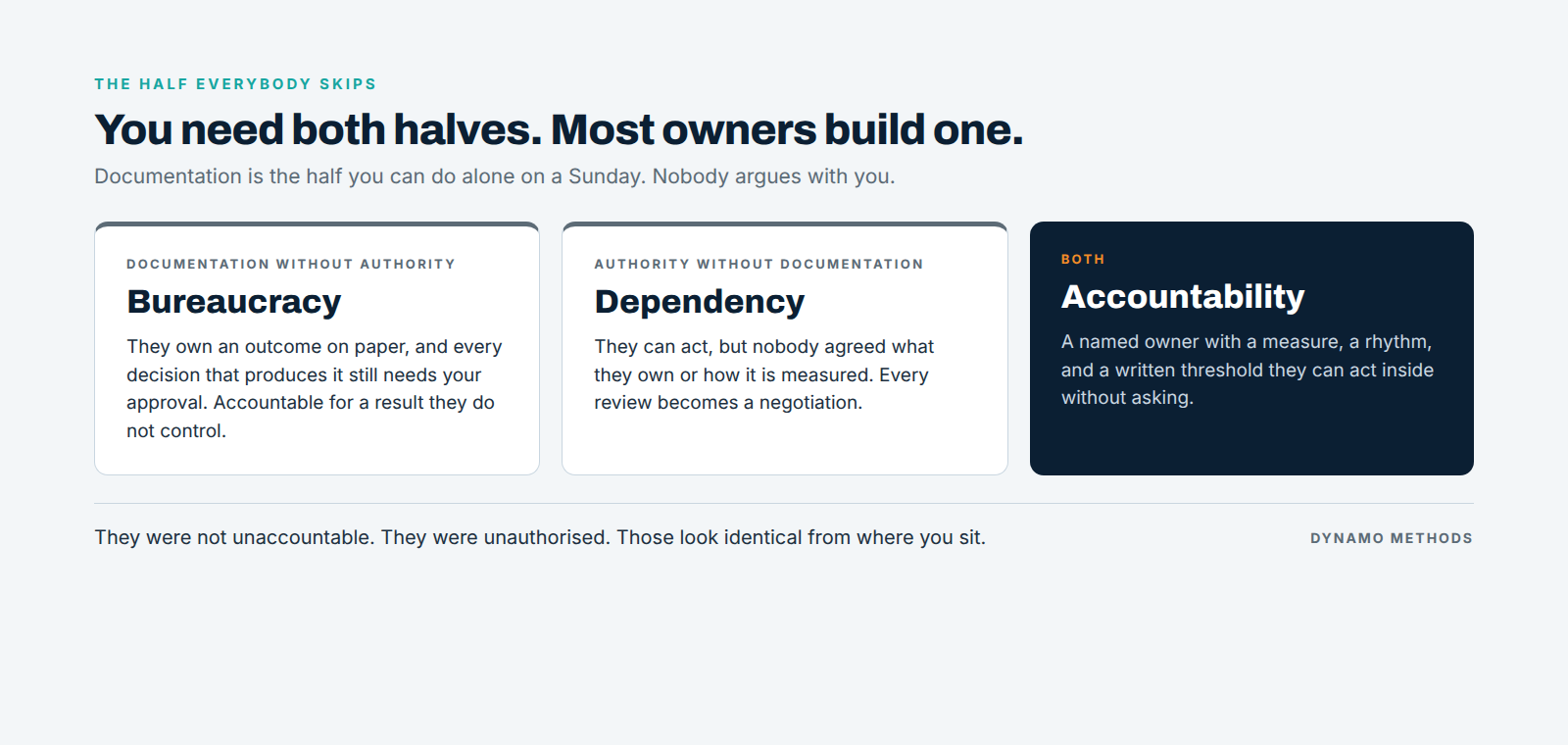
Documentation without authority is bureaucracy. Authority without documentation is dependency. You need both.
Most businesses do the documentation, because it is the half you can do by yourself on a Sunday. Nobody argues with you. Nobody makes a decision you disagree with.
Here is what it looks like when you do only half. Someone owns an outcome on paper. There is a number. There is a weekly review. And they still cannot act, because every decision required to actually hit the number needs your approval.
So they are accountable for a result they do not control.
What happens next is entirely predictable. They stop owning it — not out of laziness, but because owning something you cannot influence is intolerable. So they revert to doing tasks and waiting for instructions.
And you conclude they were not accountable. They were not authorised. Those look identical from where you sit, and they are completely different problems.
Thresholds, not vibes
Accountability requires that whoever owns the outcome can make the decisions that produce it.
Practically, for each owned outcome, you name three things. What they own. What they can decide alone. And what has to come to you — with a threshold, not a vibe.
A threshold means a number or a rule. Spend up to this. Hire below this level. Discount to this percentage. Refund under this amount. Not use your judgment, which means come to me, but I would like to feel as though I empowered you.
Then you say the fourth thing out loud, and it is the one that makes it real:
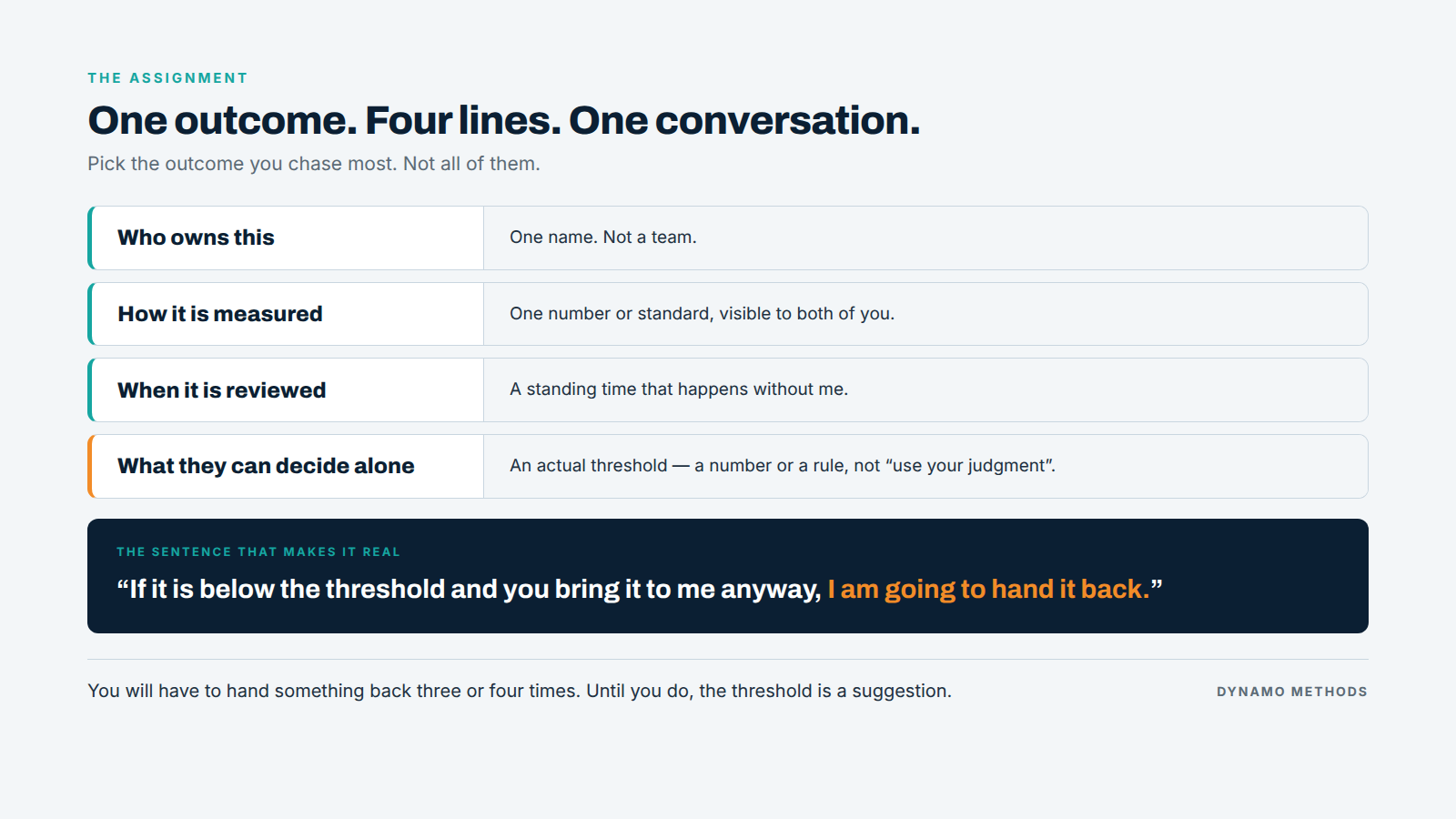
"If it is below the threshold and you bring it to me anyway, I am going to hand it back."
You will have to actually do that. Three or four times. It is uncomfortable, and it is the whole thing — because until you hand something back, the threshold is a suggestion.
Four options and no authority to use any of them
A client of mine — services business, around twelve million — had what he called an accountability problem with his delivery lead. Deadlines slipping, quality inconsistent, several hours a week of his time spent checking work.
So we looked at it. She owned delivery. There was a number. There was a weekly meeting.
And she could not approve overtime. Could not bring in a contractor. Could not move a deadline with a client. Could not decline incoming work when the team was at capacity.
Every time delivery was at risk she had four options and needed him for all of them. Which meant that when it slipped, it slipped while she waited.
He had read two years of that as she is not accountable.
We gave her three thresholds: contractor spend up to a limit, authority to reschedule with a client inside a defined window, authority to decline new work above a stated capacity line. The chasing stopped inside a month.
Same person, same job, same number. What changed was that she could act on the thing she was accountable for.
What to do this week
One outcome. Not all of them — pick the outcome you chase most. Write four lines:
Who owns this — one name. How it is measured — one number or standard. When it is reviewed — a standing time that happens without me. What they can decide alone — with an actual threshold.
Then have the conversation:
"You own this outcome. It is measured by this. We will review it at the Monday meeting whether or not I am there. And to make that fair, here is what you can decide without me — anything under this threshold. Above it, come to me with what you would do and why. If you bring me something below it, I am going to hand it back, and that is not me being difficult. It is me getting out of your way."
Two objections, both worth taking seriously.
What if they use the authority badly? Then you have a real performance conversation — with evidence, about a decision they were empowered to make. That is a much better conversation than the one you are having now, which is about vague slippage in an area where they had no room to move. You cannot fairly performance-manage someone who lacks the authority to succeed.
Does this let people off the hook? I would say the opposite. The current arrangement lets people off the hook because when accountability lives in your attention, the smartest strategy available to any employee is to stay off your radar. A system removes that option entirely. It is not softer. It is considerably harder to hide from.
See how this scores across your whole business. The Dynamo Business Stability Diagnostic scores all seven systems and names your biggest constraint.
𝗧𝗮𝗸𝗲 𝘁𝗵𝗲 𝗙𝗿𝗲𝗲 𝗕𝘂𝘀𝗶𝗻𝗲𝘀𝘀 𝗦𝘁𝗮𝗯𝗶𝗹𝗶𝘁𝘆 𝗗𝗶𝗮𝗴𝗻𝗼𝘀𝘁𝗶𝗰: https://dynamomethods.com/business-os
Isaac Wambua is an industrial engineer, business systems architect, and the creator of the Dynamo Business Operating System (DBOS) and the Dynamo Leadership Operating System (DLOS). He is the author of The Dynamo Business Blueprint: How to Build a Business That Runs, Grows and Thrives Without You. Through Dynamo Methods, he helps owners and executive teams install the operating systems and leadership capacity that allow a company to run — and improve — without depending on any one person.


