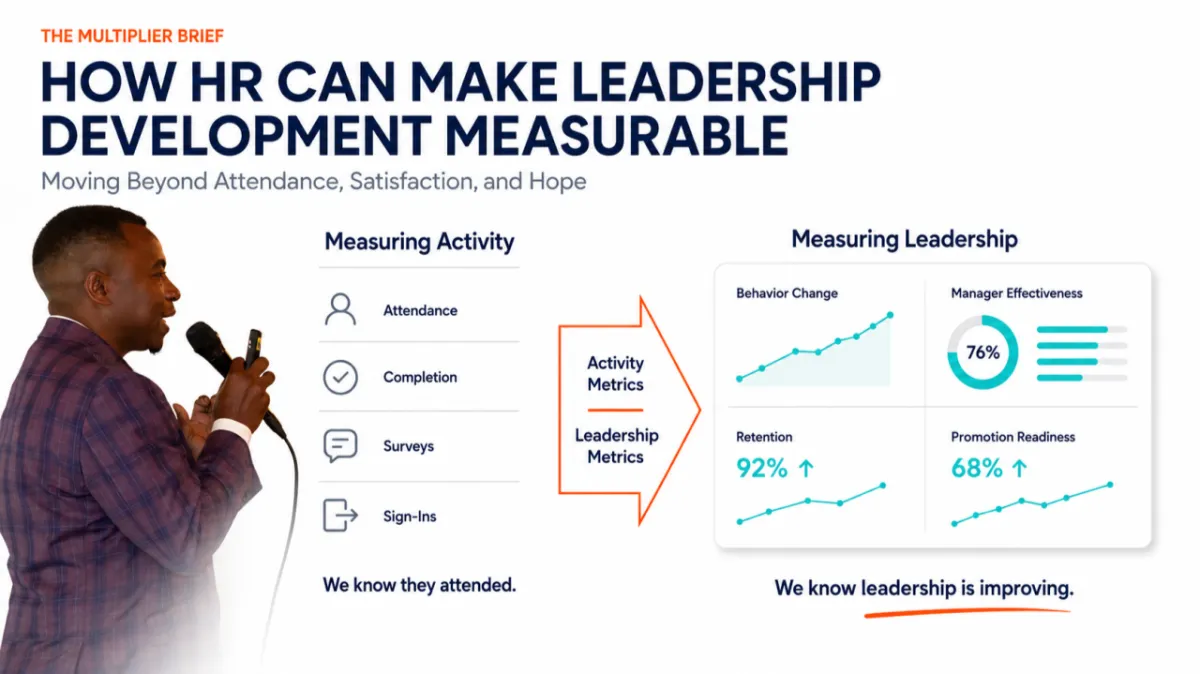
How HR Can Make Leadership Development Measurable
How HR Can Make Leadership Development Measurable
Moving Beyond Attendance, Satisfaction, and Hope
Leadership development is one of the most important investments organizations make.
It is also one of the most difficult to measure.
HR leaders are asked questions such as:
What are we getting from leadership development?
Is leadership actually improving?
Are managers becoming more effective?
Is the investment creating business results?
Unfortunately, many organizations struggle to answer these questions confidently.
Not because leadership development isn't working.
But because they are measuring the wrong things.
The Measurement Problem
Many organizations measure leadership development through activity metrics.
How many people attended?
How many completed the training?
What were the satisfaction scores?
How many coaching sessions occurred?
These metrics are easy to collect.
But they rarely answer the most important question:
Is leadership actually improving?
Attendance measures participation.
Completion measures compliance.
Satisfaction measures experience.
None of those directly measure leadership effectiveness.
And that creates a challenge for HR leaders who must justify leadership investments to executives.
Why Leadership Development Feels Difficult To Measure
Imagine a sales team.
Nobody would evaluate sales performance based solely on training attendance.
They would measure revenue.
Conversion rates.
Pipeline growth.
Customer acquisition.
Yet leadership development is often judged by attendance and feedback forms.
The result is predictable.
Leaders participate.
Organizations struggle to prove impact.
Executives become skeptical.
HR becomes frustrated.
The issue is not leadership development.
The issue is measurement.
The Leadership Development Measurement Map
Leadership becomes measurable when organizations stop measuring events and start measuring development.
That requires four levels of measurement.
Level 1: Leadership Stage
Where is the leader today?
Before improvement can be measured, a baseline must exist.
Organizations need a way to understand current leadership capability.
Without diagnosis, improvement becomes subjective.
This is why the Leadership Stage Assessment matters.
It establishes a baseline.
And baselines create measurement.
Level 2: Leadership Behaviors
What behaviors are changing?
Leadership development should create observable behavioral change.
Examples include:
Delegation.
Coaching.
Decision-making.
Communication.
Accountability.
Ownership development.
These behaviors can be observed, discussed, reinforced, and measured.
Because leadership is not merely knowledge.
Leadership is behavior.
Level 3: Leadership Rhythms
What practices are becoming consistent?
Many organizations focus on events.
The strongest organizations focus on rhythms.
Regular coaching conversations.
Consistent one-on-ones.
Structured accountability discussions.
Development planning.
Leadership reinforcement.
When leadership rhythms become consistent, behavior becomes sustainable.
Level 4: Business Outcomes
What organizational results are improving?
Leadership development should eventually influence business outcomes.
Examples include:
Employee retention.
Decision speed.
Manager effectiveness.
Internal promotion readiness.
Employee engagement.
Team ownership.
Execution quality.
Leadership development becomes strategic when it connects to business performance.
A Measurement Example
One organization wanted to improve leadership effectiveness among frontline managers.
Initially, leadership development was measured primarily through attendance and completion rates.
Participation was high.
Results were unclear.
The first step was establishing a baseline using leadership stage assessment and manager effectiveness feedback.
Several leadership behaviors were then targeted for improvement:
Coaching conversations.
Delegation.
Accountability.
Ownership development.
Over the following months, managers improved the consistency of those behaviors.
At the same time, internal promotion readiness increased significantly, and leadership bench strength improved.
The organization finally had a measurable connection between development and business impact.
Not because more training occurred.
Because measurement became intentional.
Why Baselines Matter
Most organizations want leadership improvement.
Few establish a leadership baseline.
Without a baseline:
Improvement becomes opinion.
With a baseline:
Improvement becomes measurable.
The difference is significant.
Executives trust data.
HR leaders need evidence.
Organizations need clarity.
Measurement creates all three.
What HR Leaders Should Measure
Instead of focusing only on attendance and completion, consider measuring:
Leadership stage progression.
Leadership behavior change.
Leadership rhythm consistency.
Business outcomes influenced by leadership.
These metrics create a more complete picture of leadership effectiveness.
And they create stronger conversations with executive teams.
A Question Worth Asking
If your CEO asked:
"How do we know our leaders are getting better?"
Could your current measurement system answer confidently?
The answer may reveal the biggest opportunity in your leadership development strategy.
Final Thought
You cannot improve what you refuse to measure.
Leadership development becomes measurable when organizations establish a baseline, identify desired behaviors, reinforce consistent rhythms, and connect leadership growth to business outcomes.
Attendance matters.
Participation matters.
Completion matters.
But those are not the destination.
The destination is stronger leadership.
And stronger leadership should be measurable.
Leadership Operating System Diagnostic
Want to establish a measurable leadership baseline across your organization?
Book a Leadership Operating System Diagnostic.
We'll help you identify:
✓ Leadership capability baselines
✓ Development gaps
✓ Measurement opportunities
✓ Leadership system weaknesses
✓ Capacity-building priorities
Because leadership development should be measurable.
And measurable leadership development creates measurable business results.
Take the Leadership Stage Assessment and discover where your leaders are—and what it will take to move them forward.
I’ll be unpacking this topic further in this week’s Multiplier Briefing. If you are responsible for building leadership capacity inside your organization, you can Register Here


