
How to Manage Former Peers After a Promotion
Pretending nothing changed does not preserve the friendship. It only makes your authority invisible.
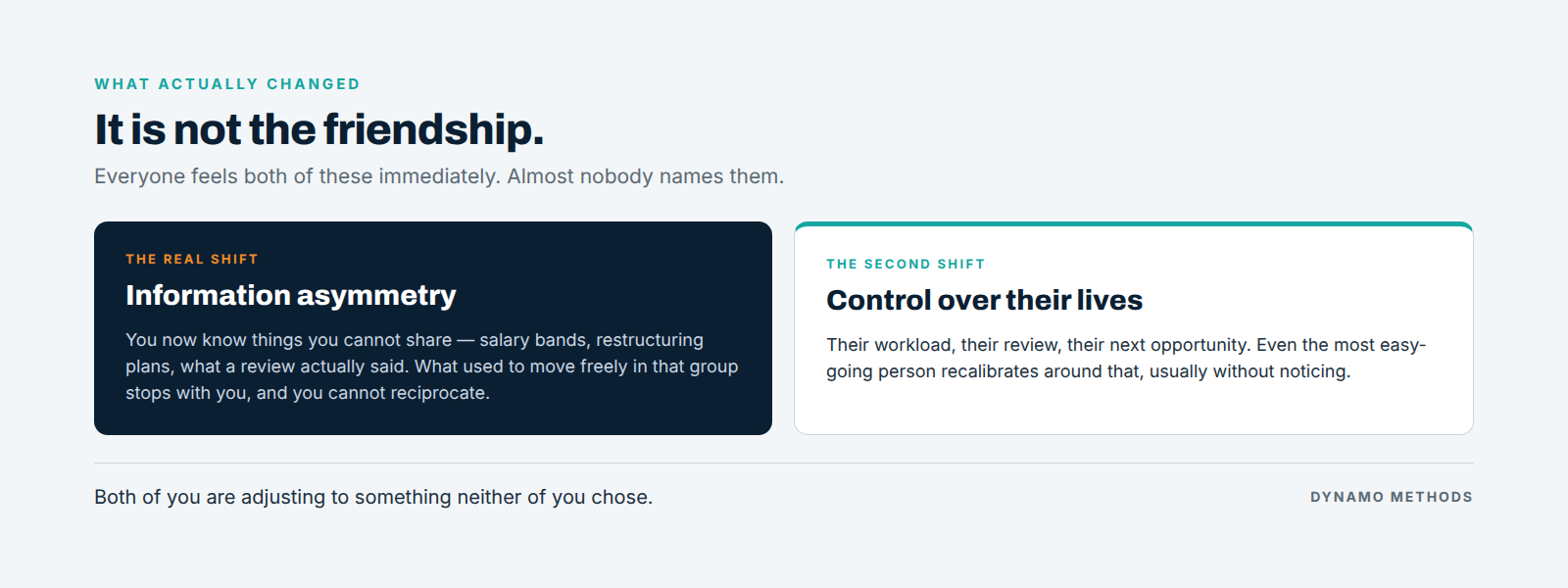
What changed is not the friendship. It is that you now carry information you cannot share, and control things that affect their lives.
Last month you complained about management together. This month you are management.
Nobody prepares you for that, and most of the advice on it is some version of just be yourself and it will be fine.
It will not be fine, not automatically. Something real has changed, and pretending otherwise is exactly what makes it awkward.
So let us be specific about what changed, and what to do in the first three weeks.
What actually changed
It is not the friendship. It is the information asymmetry.
You now know things you cannot share. Salary bands. Restructuring plans. What someone's performance review actually said. Who is being considered for what.
That is the real shift. Not that you are the boss — that you are carrying information which used to move freely inside that group, and you can no longer reciprocate. Everyone feels it immediately and almost nobody names it, which is why the relationship gets strange even when everyone is behaving well.
There is a second thing. You now control matters that affect their lives: their workload, their review, their next opportunity. Even the most easy-going person recalibrates around that, usually without noticing.
So both of you are adjusting to something neither of you chose. That is the actual situation.
Mistake one — pretending nothing changed
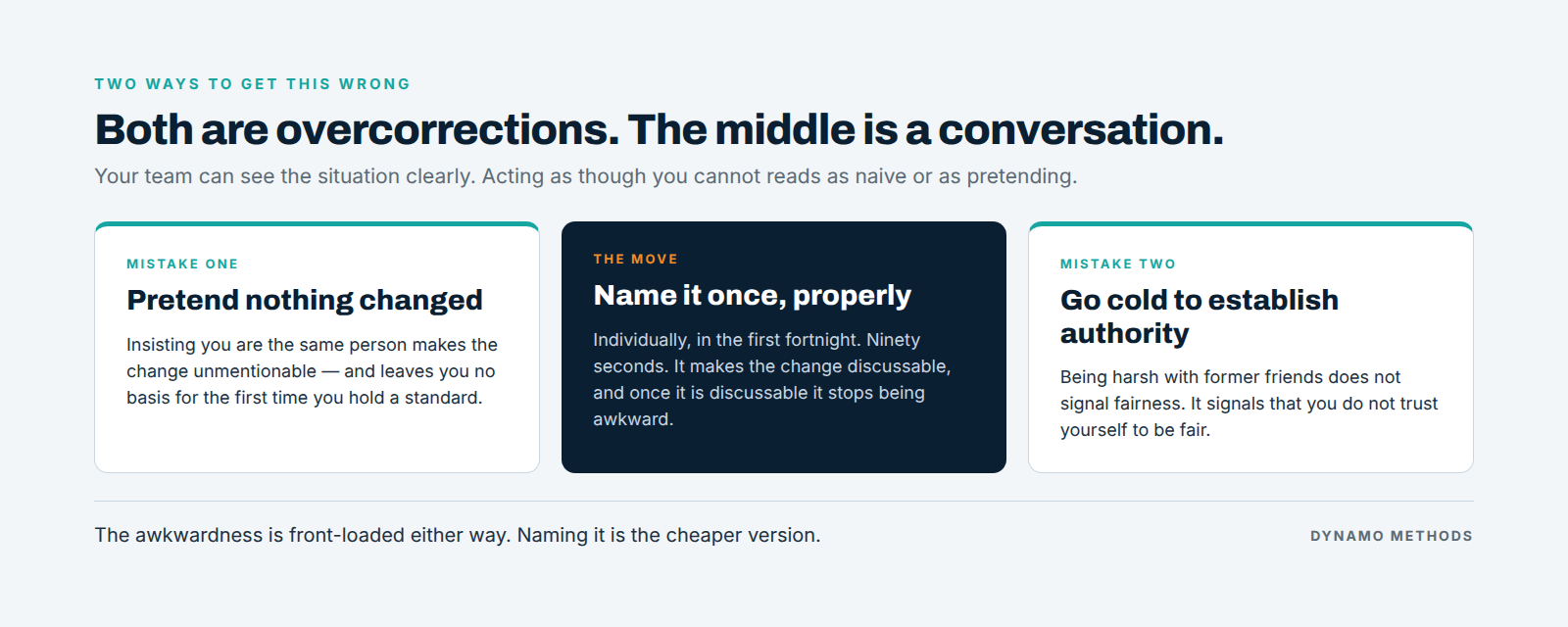
The most common failure is overcorrecting towards I am still the same person. Insisting nothing is different. Keeping every social habit exactly as it was. Being deliberately casual about your new authority.
It does not reassure anybody, and it makes the change unmentionable.
Your team can see the situation clearly. When you act as though you cannot, they conclude either that you are naive or that you are pretending. Neither builds confidence.
And there is a practical cost. If you have established that nothing has changed, you have no basis for the first time you need to hold a standard. That conversation then arrives as a betrayal rather than as your job.
Mistake two — going cold to establish authority
Less common, more damaging. Suddenly formal. Distant. Cancelling the lunches. Being harder on the people you were closest to, to prove you will not play favourites.
Your team reads this instantly, and what they read is insecurity.
Being harsh with former friends does not signal fairness. It signals you don't trust yourself to be fair, so you overcorrect.
And you lose the one genuine advantage you have, which is that you already know these people well.
Move one — name it once, properly
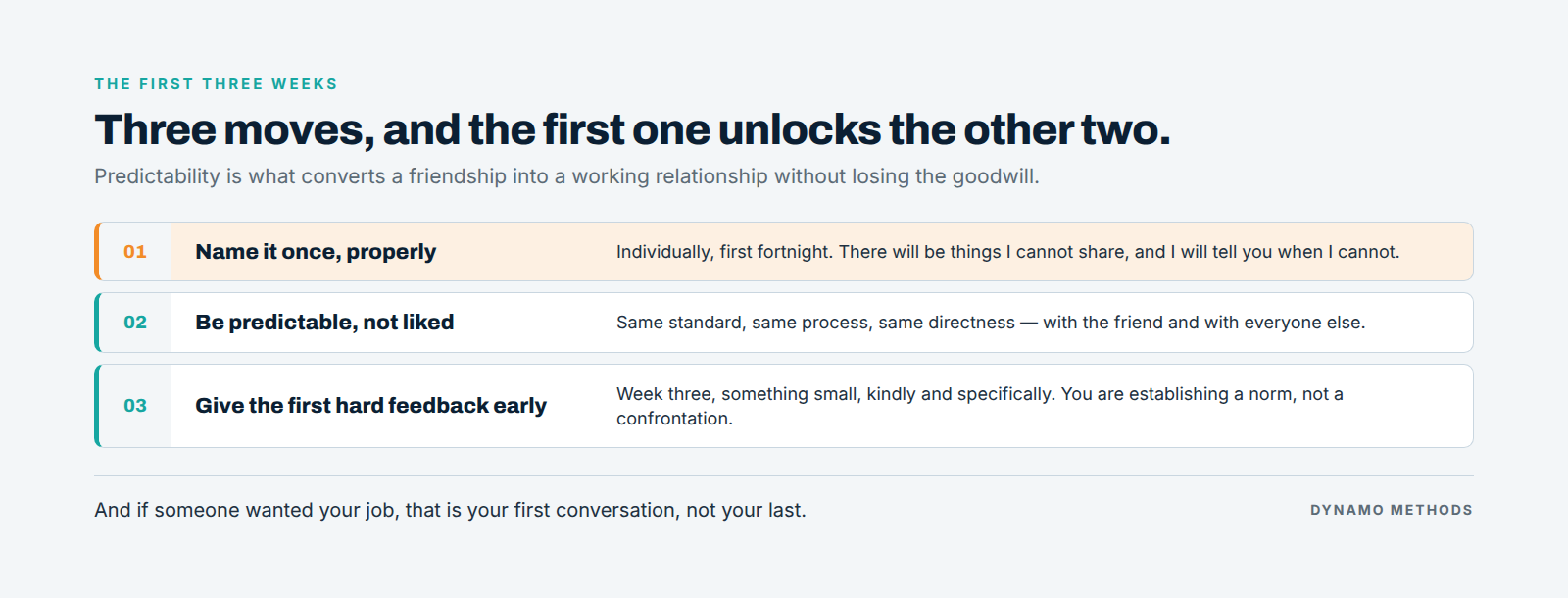
Out loud, individually, in the first week or two. Once.
Here is the language.
"This is different now, and I would rather say that than pretend it is not. There are going to be things I know that I cannot tell you, and that will feel strange for both of us. What I want you to be able to count on is that I will be straight with you about what I can say, and that I will tell you when I cannot say something rather than being vague. And if I get this wrong, I would rather you told me."
Ninety seconds. And it does something no amount of behaving well achieves on its own: it makes the change discussable. Once it is discussable, it stops being awkward.
Move two — be predictable, not liked
Your goal is not to be liked. It is to be predictable.
People can work with a manager whose standards they know, even a demanding one. What they cannot work with is a manager whose response depends on the day, or on the relationship.
So the thing to protect above everything else is consistency. Same standard, same process, same directness with everyone — the friend and the person you have never got on with.
Predictability is what converts a friendship into a working relationship without losing the goodwill. It is also much easier than trying to calibrate warmth.
Move three — give the first hard feedback early
This is the one people avoid. Give your first piece of critical feedback to a former peer early — in the first month if you possibly can.
It sounds counterintuitive. Here is why it works.
The longer you wait, the bigger it gets. The issue compounds, and the act of raising it becomes more loaded. Six months of avoidance, and your first critical conversation is an event.
Do it in week three, about something small, kindly and specifically, and you have established that this is normal. Standards apply. Nothing dramatic happened. Every subsequent conversation is easier.
Pick something genuinely small. You are not looking for a confrontation. You are establishing a norm.
The person who wanted your job
This comes up in every programme I run.
Deal with it directly, in the first week, and do not wait for them to raise it.
"I know you went for this role. I would guess this is uncomfortable, and I would rather acknowledge that than act as though it is not. I want to be useful to your career here, and I would like to talk about what you want next — not today necessarily, but soon."
Then follow through on that last part, because the words are worthless without it.
Some of those relationships recover completely. Some do not. Some of those people leave, and occasionally that is the right outcome for them. What you control is that you did not add avoidance to their disappointment.
Twenty minutes of awkward
A manager in one of my programmes was promoted over five people she had worked alongside for four years. One had been her closest friend at the company — they had holidayed together.
She had the naming conversation with all five in her first fortnight. With the friend it was, by her account, genuinely awkward, and it took about twenty minutes rather than ninety seconds.
Six weeks later she had to tell that same friend that a piece of work was not good enough.
She told me afterwards that the only reason she could do it was the earlier conversation. She had a reference point. She could say: this is the thing I meant when I said it would be different.
The friendship changed. She was clear about that, and something was lost. But it survived, and the working relationship became one of her strongest. Her view, a year on, was that the naming conversation was the whole reason.
What to do this week
If you have recently been promoted over former peers, have the naming conversation with each of them individually. Not as a group. Individually, and this week.
Use the language above or your own version of it. The essential elements: this is different; there will be things I cannot share, I will tell you when I cannot rather than being vague, and tell me if I get it wrong.
And if there is someone who wanted the role, that is your first conversation, not your last.
If you were promoted a while ago and never did this, do it anyway. Say: I should have had this conversation when I started, and I want to have it now.
The objection: will naming it not make things awkward, when they are currently fine?
They are not currently fine. They are currently unspoken, which feels like fine right up until the first time you need to hold a standard.
And the awkwardness is front-loaded either way. You either take ninety seconds of deliberate awkwardness now, in a conversation you control, or you accept an indefinite low-level strangeness that surfaces at the worst possible moment — usually during your first difficult conversation, when you have other things to manage.
Naming it is the cheaper version. It is just the one that requires you to go first.
NEXT STEP
See how this scores across your whole business. The Dynamo Business Stability Diagnostic scores all seven systems and names your biggest constraint.
𝗧𝗮𝗸𝗲 𝘁𝗵𝗲 𝗙𝗿𝗲𝗲 𝗕𝘂𝘀𝗶𝗻𝗲𝘀𝘀 𝗦𝘁𝗮𝗯𝗶𝗹𝗶𝘁𝘆 𝗗𝗶𝗮𝗴𝗻𝗼𝘀𝘁𝗶𝗰: https://dynamomethods.com/business-os
Isaac Wambua is an industrial engineer, business systems architect, and the creator of the Dynamo Business Operating System (DBOS) and the Dynamo Leadership Operating System (DLOS). He is the author of The Dynamo Business Blueprint: How to Build a Business That Runs, Grows and Thrives Without You. Through Dynamo Methods, he helps owners and executive teams install the operating systems and leadership capacity that allow a company to run — and improve — without depending on any one person.


