
How to Manage an Underperforming Employee
Most underperformance conversations happen about four months late, which makes them conversations about your frustration rather than the work.
Ambiguity is expensive. Underperformance loves to hide inside it.
By the time the conversation finally happens, the manager is already frustrated — and a frustrated manager has a conversation about the frustration, not about the performance.
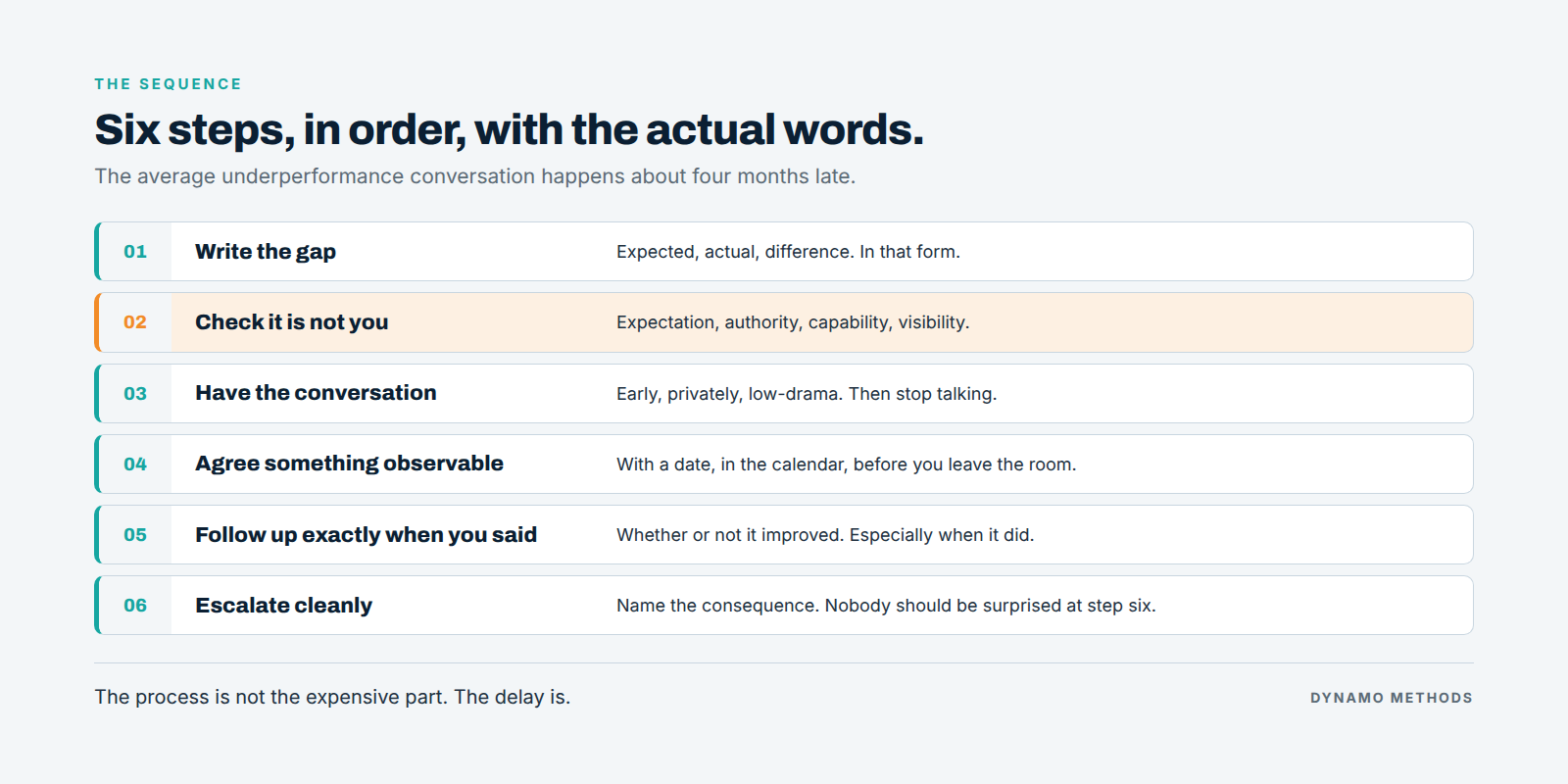
So here is the sequence. Six steps, in order, with the actual words.
Step two is the one almost everyone skips, which is why so many of these conversations go nowhere.
Step One — Write the Gap Down
Before you have the conversation, define the performance gap clearly and specifically.
Not: “They’re underperforming.”
Not: “Their attitude isn’t right.”
Those are conclusions, not measurable gaps.
A performance gap has three parts:
What is expected
What is actually happening
The difference between the two
For example:
Expected: Four client reports per week, delivered by Thursday.
Actual: Two to three reports per week, usually delivered on Friday or Monday.
Gap: Output is approximately 25–50% below expectation, and delivery is consistently late.
The clearer you are about the gap, the easier it is to have a fair, factual, and productive performance conversation.
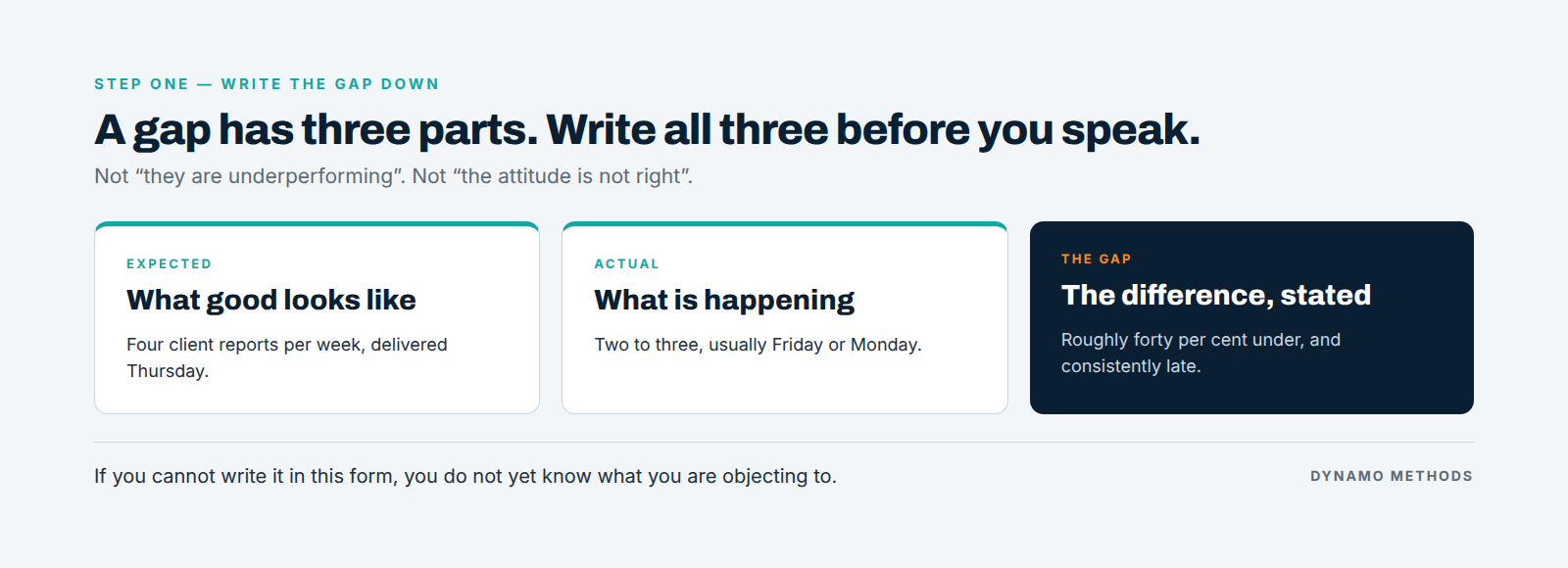
If you cannot write it in that form, you are not ready to have the conversation. That is not a delay it is the discovery that you do not yet know what you are objecting to, which happens more often than managers like to admit.
Step two — check it is not you
This is the one that gets skipped.
Before you treat this as a performance problem, check the four things that produce the appearance of underperformance in a perfectly capable person.
Did they know the expectation? Precisely, not approximately. Most managers are certain they communicated a standard they mentioned once, six months ago, in a meeting about something else.
Do they have the authority to meet it? If hitting the standard requires three decisions they cannot make, they are not underperforming. They are blocked, and they have probably stopped mentioning it.
Do they have the capability? Have they ever been shown how, by someone competent, recently? Or were they given the task and left to infer the method?
Is something being measured that they cannot see? If you are tracking a number they have no access to, they are playing a game without a scoreboard.
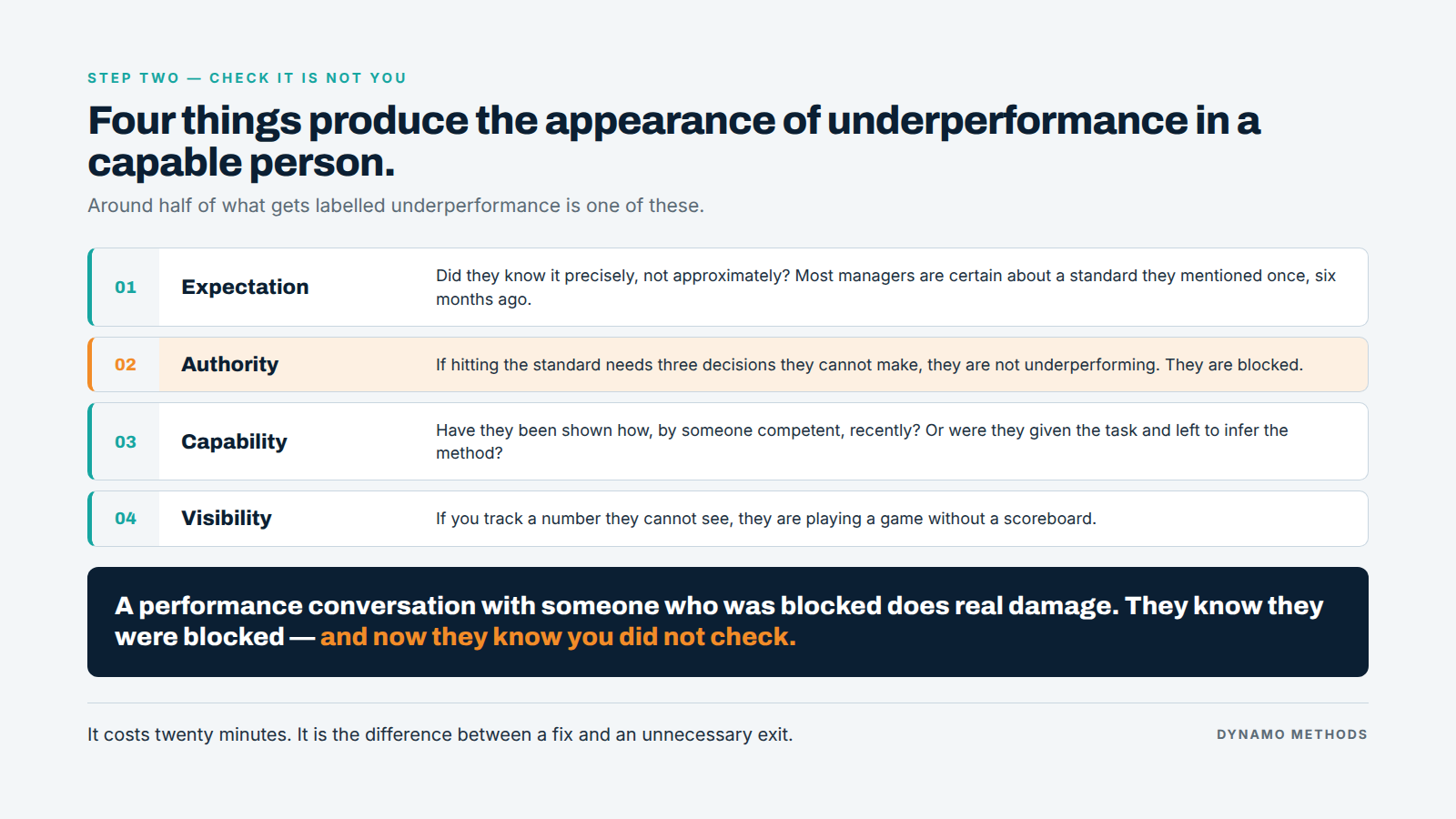
Run those four before you go further. In my experience somewhere around half of what gets labelled underperformance is one of them.
And the reason it matters so much is that a performance conversation with someone who was actually blocked does real damage. They know they were blocked. And they now know you did not check.
Step three — the first conversation
If the four checks are clear, have the conversation. Early, privately and low-drama.
The mistake here is escalating tone to signal seriousness. You do not need to. Specificity signals seriousness perfectly well, and a calm tone keeps the conversation about the work.
Here is the language.
"I want to talk about the client reports. What I need is four a week, delivered Thursday. What I am seeing is two or three, usually late. I wanted to raise it now rather than let it build. Help me understand what is happening from where you are sitting."
Then stop talking.
That last part is the whole step. Most managers deliver the setup and then fill the silence with their own theory, which means they never find out the actual cause. Ask, and then wait, even when it is uncomfortable.
Step four — agree on something observable
Whatever they tell you, land on something specific and observable.
Not I'll do better. Not I'll try to be more organised. Four reports, every Thursday, starting this week.
And then say the sentence that makes it real: let us check in on Thursday in two weeks and see where we are.
A date. In the calendar, before you leave the room.
Without a date, you have had a chat. With a date you have a process, and both of you know it.
Step five — follow up exactly when you said
Follow up on the day you said, whether or not things improved.
This is where most managers lose the thread. If things improve, they skip the check-in because it feels unnecessary. If things do not improve, they postpone it because it will be awkward. Both are mistakes.
Follow up when it improved, and you have reinforced that you notice. Follow up when it did not, and you have established that the process is real.
And if it improved, say so plainly. Four reports, on time, both weeks. I noticed, and I appreciate it. That is a fifteen-second conversation that does more for future performance than the first conversation did.
Step six — escalate cleanly
If nothing has changed after two cycles, escalate and escalate cleanly, meaning the person is not surprised.
"We have talked about this twice, on these dates. The expectation was four reports on Thursday. We are still at two or three. I need to be direct with you: this needs to change, and if it does not, we will be having a formal conversation about the role. I would much rather help you get there. What would actually need to be different?"
Two things about that. It is honest you have named the consequence rather than implying it. And it still leaves the door open, because a surprising number of people move at exactly this point, when the stakes stop being ambiguous.
If you have done steps one through five properly, nobody is blindsided at step six. That is the real test of whether you handled it well.
The part that is rarely said out loud
Sometimes you will do all six steps properly and it still will not work out. The person is not right for the role, or does not want it, and the honest outcome is that they leave.
That is not a failure of the process. That is the process working.
And I would go further. Leaving someone in a role they are failing at is not kindness. They know. They have known longer than you have. Everyone around them knows. The clarity you are avoiding is the thing that would let them go and be good at something else.
Eight months of missed deadlines
A manager in one of my programmes brought me a case — a team member she had nearly performance-managed out. Eight months of missed deadlines.
We ran step two. The four checks.
It turned out the person was waiting on sign-off from a second department for every deliverable, had no authority to chase it, and had raised it once, early, with a previous manager who had since left. So they had stopped raising it and simply absorbed being late.
Eight months of being seen as unreliable, for a structural problem that took one email to fix.
The thing that stayed with me is what she said afterwards. She had been building a case for eight months and had never once asked what was making it hard.
So run step two. It costs you twenty minutes, and it is the difference between a fix and an unnecessary exit.
What to do this week
Pick the person whose performance is worrying you most.
Do not start with the conversation. Write the gap in three parts: expected, actual, difference.
Then run the four checks expectation, authority, capability, visibility. Honestly.
If all four are clear, book the conversation for this week and use the language from step three. If any of the four is not clear, fix that first. You may find you do not need a performance conversation at all.
The objection: This is a lot of process for something I should just be able to raise.
You should be able to just raise it, and if your culture supports early direct feedback, do that.
But most managers are not over-processing this. They are avoiding it. The average underperformance conversation happens months late, and the process exists because the alternative is not a quick honest chat it is four months of nothing followed by an emotional conversation that surprises everyone.
And the six steps take less time than you think. Steps one and two are twenty minutes at a desk. Steps three and five are ten-minute conversations. The process is not the expensive part. The delay is.
NEXT STEP
See how this scores across your whole business. The Dynamo Business Stability Diagnostic scores all seven systems and names your biggest constraint.
𝗧𝗮𝗸𝗲 𝘁𝗵𝗲 𝗙𝗿𝗲𝗲 𝗕𝘂𝘀𝗶𝗻𝗲𝘀𝘀 𝗦𝘁𝗮𝗯𝗶𝗹𝗶𝘁𝘆 𝗗𝗶𝗮𝗴𝗻𝗼𝘀𝘁𝗶𝗰: https://dynamomethods.com/business-os
Isaac Wambua is an industrial engineer, business systems architect, and the creator of the Dynamo Business Operating System (DBOS) and the Dynamo Leadership Operating System (DLOS). He is the author of The Dynamo Business Blueprint: How to Build a Business That Runs, Grows and Thrives Without You. Through Dynamo Methods, he helps owners and executive teams install the operating systems and leadership capacity that allow a company to run — and improve — without depending on any one person.


