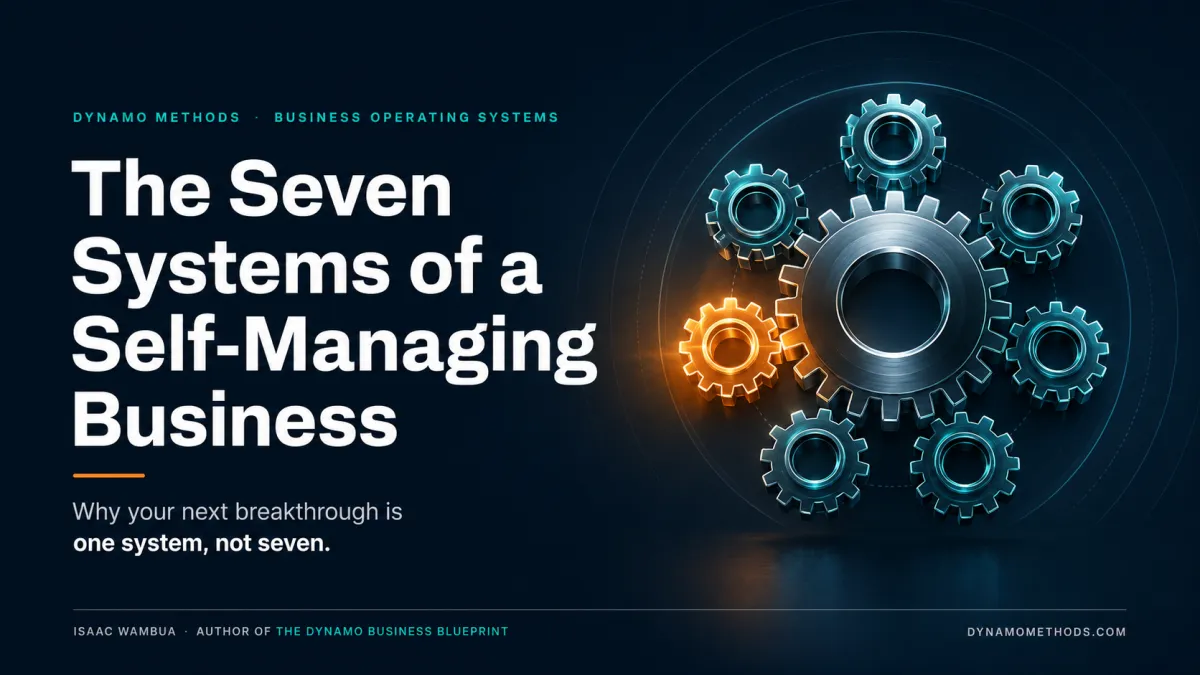
The Seven Systems of a Self-Managing Business
A business does not perform at the level of its average system. It performs at the level of its weakest one.
You have hired capable people. You have written the procedures. You have delegated the work. And still, two weeks away from the business is not something you can take without the phone finding you.
The usual conclusion is that you need to fix everything. So you start seven initiatives, and six months later you are more scattered than when you began — with seven systems that are marginally better and one that is still holding the whole company hostage.
Two decades of building and installing operating systems inside growing businesses has produced one conviction that shapes everything else in this article:
Your business does not need seven new systems. It needs one breakthrough in the system that is capping the others.
That distinction is the difference between a year of effort and a year of progress.
I recorded a video for you. You can watch it here:
The Drivetrain Model
Think of your business as a drivetrain. Seven gears, meshed together, transferring power from the market to the bottom line.
Power does not average across a drivetrain. It transfers through it. One slipping gear caps the output of every gear it touches — no matter how well-engineered the other six are. This is why businesses with excellent marketing still stall, why disciplined operators still cannot step away, and why hiring more good people rarely produces the relief owners expect.
You are not managing seven independent departments. You are managing one power transfer.
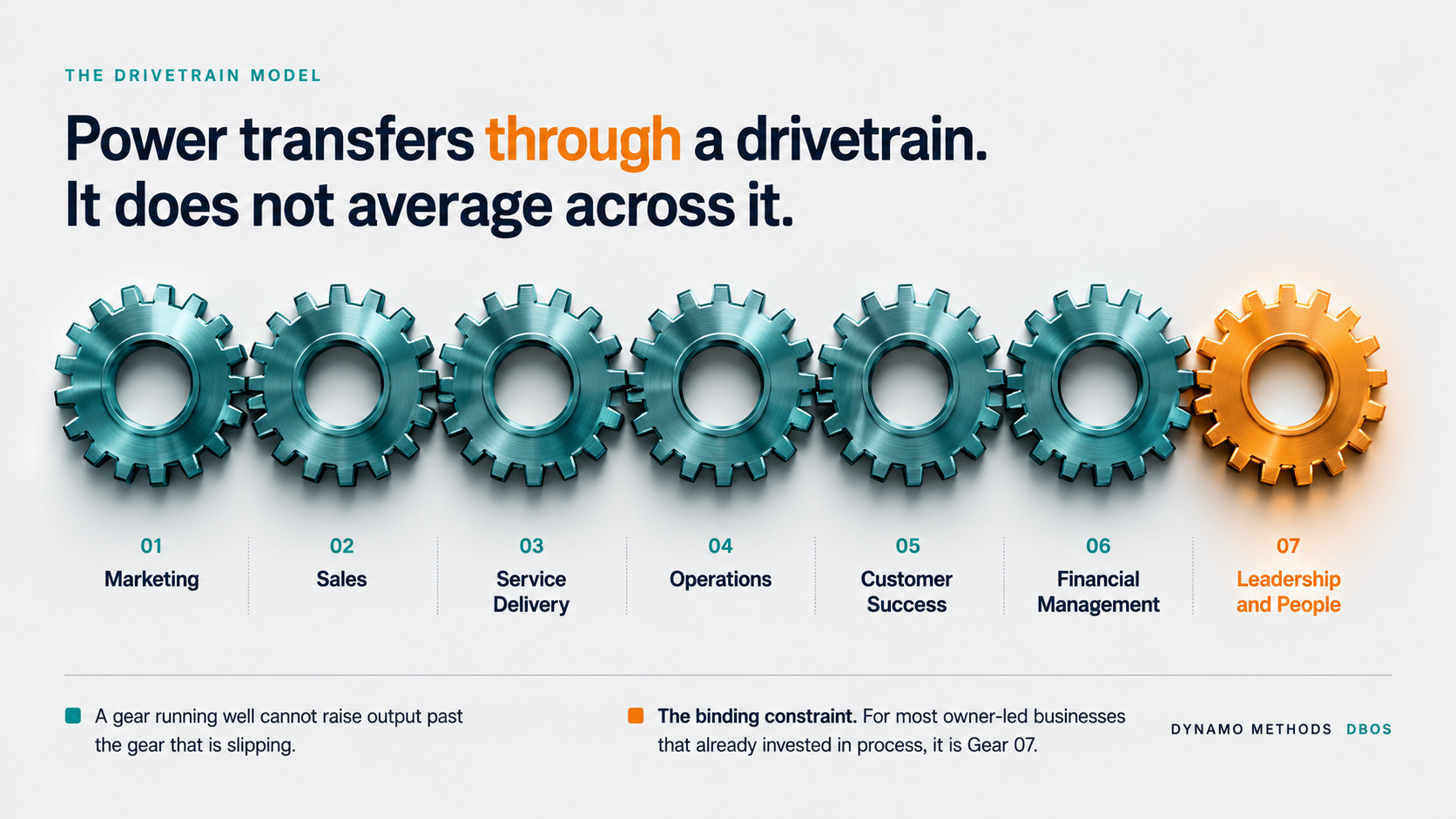
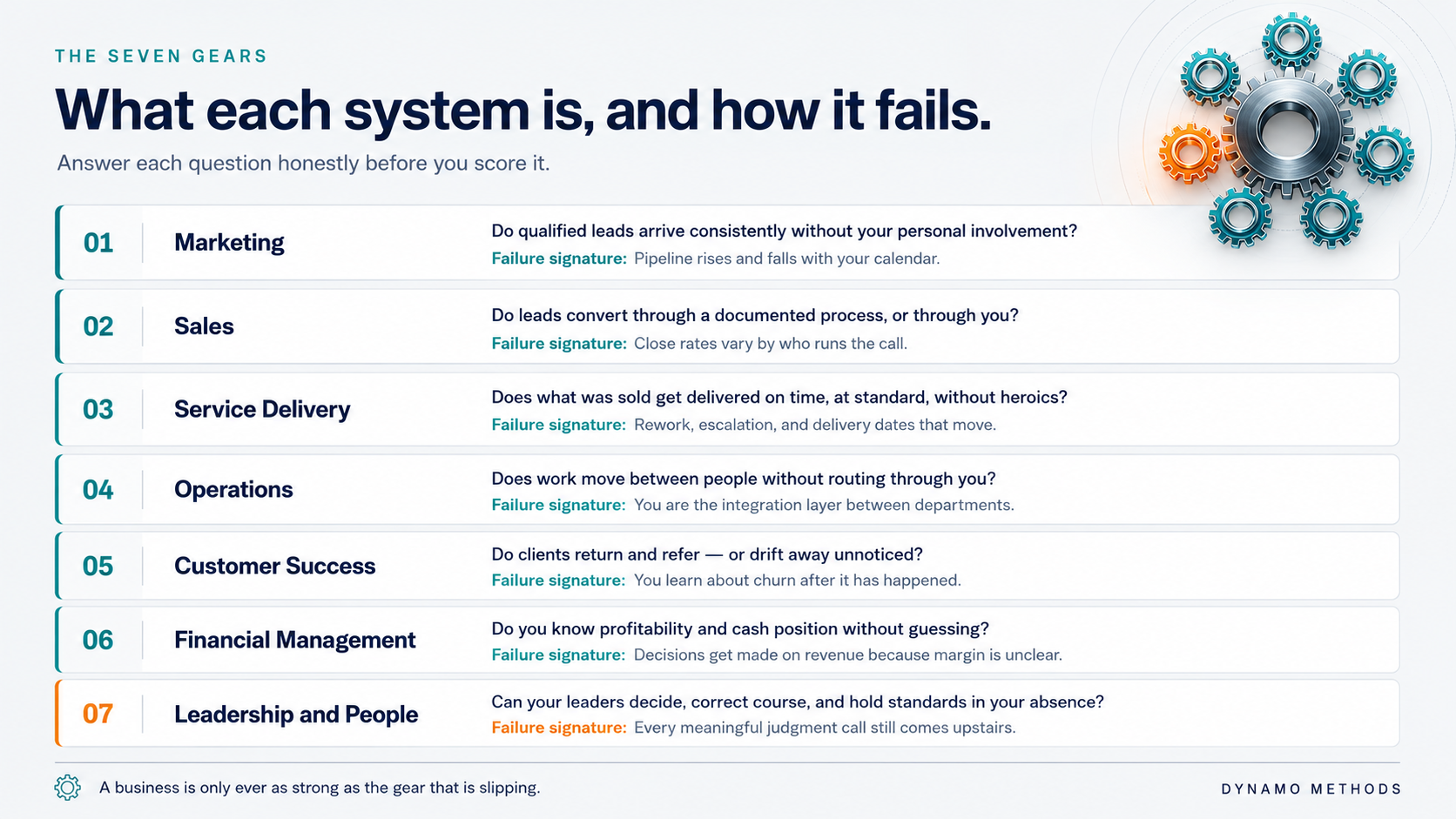
The seven gears
Each gear below carries a diagnostic question and a failure signature — what it actually looks like when that gear is slipping.
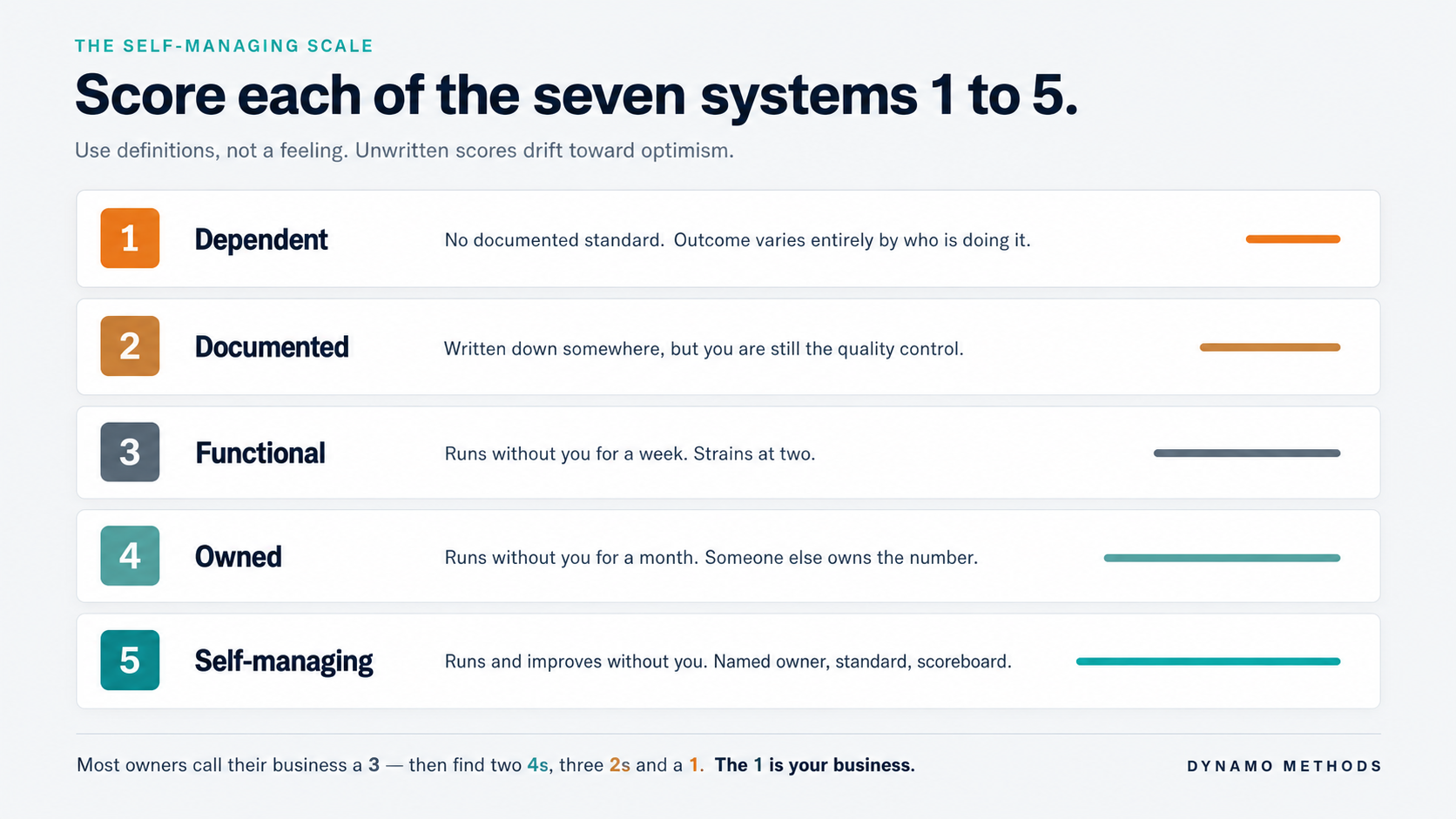
Most owners score their business a 3 and discover, on honest inspection, that they are running two 4s, three 2s and a 1. That distribution is the whole story. The 1 is your business.
The mistake: fixing the loudest system instead of the binding one
Here is where most diagnostics go wrong. The system causing the most pain is frequently not the one causing the problem.
Pain is downstream. Constraints are upstream. If you treat the symptom, you will improve the gear that hurts, only to watch the pain reappear within a quarter.
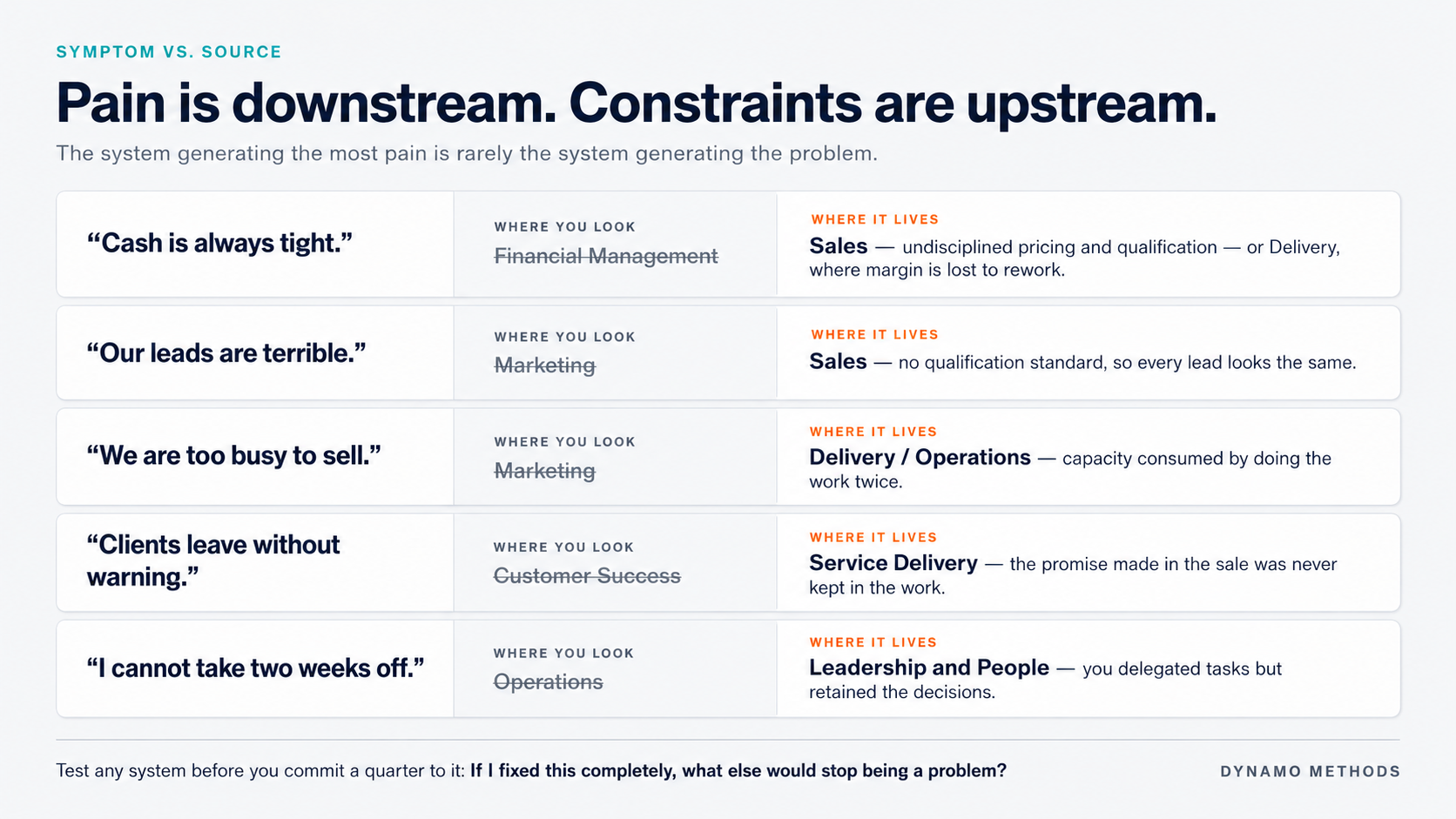
Before you commit a quarter to a system, ask one question of it: If I fixed this completely, what else would stop being a problem?
A system whose repair fixes nothing else is a symptom. A system whose repair makes three other complaints disappear is your constraint.
The four-step constraint diagnostic
Score all seven. Use the anchored scale above. Write the numbers down. Unwritten scores drift toward optimism.
Trace the pain upstream. For each of your three lowest scores, apply the symptom-versus-source test. Ask what would stop being a problem if that gear ran at a 5.
Select the binding constraint — one. Not the worst score. The one whose repair unlocks the most downstream capacity. Where two candidates tie, choose the one that is costing you money today rather than the one that will cost you money later.
Commit ninety days. One system. One named owner. One number that must move. A weekly review that does not get canceled. Depth over breadth is not a preference here — it is the mechanism. Attention distributed across seven systems yields seven improvements that are too small to change how the business runs.
One decision rule worth stating plainly: if your cash runway is under ninety days, fix Financial Management or Sales first, regardless of what the diagnostic says. Leadership capacity compounds — but it compounds slowly, and compounding requires that you still be in business.
Why Gear 7 is usually the answer
For most owner-led businesses that have already invested in process, the binding constraint is Leadership and People.
The reason is structural. Gears one through six can be solved with documentation. Gear seven cannot. You cannot write a procedure for judgment. You cannot delegate a decision by describing it — you delegate it by handing over the authority, absorbing the cost of the first imperfect calls, and correcting the reasoning rather than reversing the outcome.
This is why so many businesses are heavily documented and still entirely dependent on the owner. The processes were installed. The decision rights never moved. The organization became a permission machine: Can I? Should I? Is this okay? Will you approve this?
A self-managing business is not a well-documented business. It is a business where other people are trusted, equipped, and authorized to think.
If your team executes well but cannot decide well, stop optimizing processes. Your constraint has a name.
What to do this week
Three actions. None of them take longer than an hour.
Score the seven gears against the anchored scale. Honestly, in writing.
Name your constraint in one sentence: "The system costing me the most is ______, and fixing it would also resolve ______ and ______." If you cannot complete that sentence, you have not found the constraint yet.
Tell someone who will hold you to it. A private 90-day commitment is preferred. A witnessed one is a decision.
You are not choosing the only problem to solve. You are choosing the first — the one that makes the next six easier, cheaper, and in some cases unnecessary.
Most owners do not have a discipline problem. They have a sequencing problem. Fix the sequence, and the business you have been trying to build for three years becomes achievable in one.
Next Step
If you are unsure which system is holding you back, the Dynamo Business Stability Assessment will identify your binding constraint in about twelve minutes. If Leadership and People is already your suspicion, start there — that is the gear that determines whether the other six can ever run without you.
👉Take the Free Business Diagnostic here: dynamomethods.com/business-stability-assessment
Embark on this journey, focus on the real constraint blocking your business's progress, and nurture the self-management that will permanently enhance your business’s scalability and value.


