How to Stop Micromanaging — Even When You're Usually Right
You are trading a better outcome today for a weaker organization in a year. The trade is invisible, which is why it feels like pure gain every single time.
Almost every article about micromanaging assumes the micromanager is wrong. That you are interfering unnecessarily. That your team would be fine if you just let go. That this is fundamentally an anxiety problem.
Here is the thing nobody says. Most of the time, you are right.
You do spot the problem faster. Your instinct on the client is usually correct. When you intervene, the outcome usually is better.
That is exactly what makes this so hard to stop — and any advice that begins by pretending otherwise will be useless to you.
I recorded a video for you. You can watch it here:
What being right costs
Start from the accurate position. You are often right, and intervening often improves the immediate outcome. The problem is not that you are wrong. The problem is what being right costs.
Every time you step in and correct something, three things happen.
The immediate outcome improves. The person's judgment does not develop, because they never completed the loop and found out. And they learn that their judgment is not the one that counts.
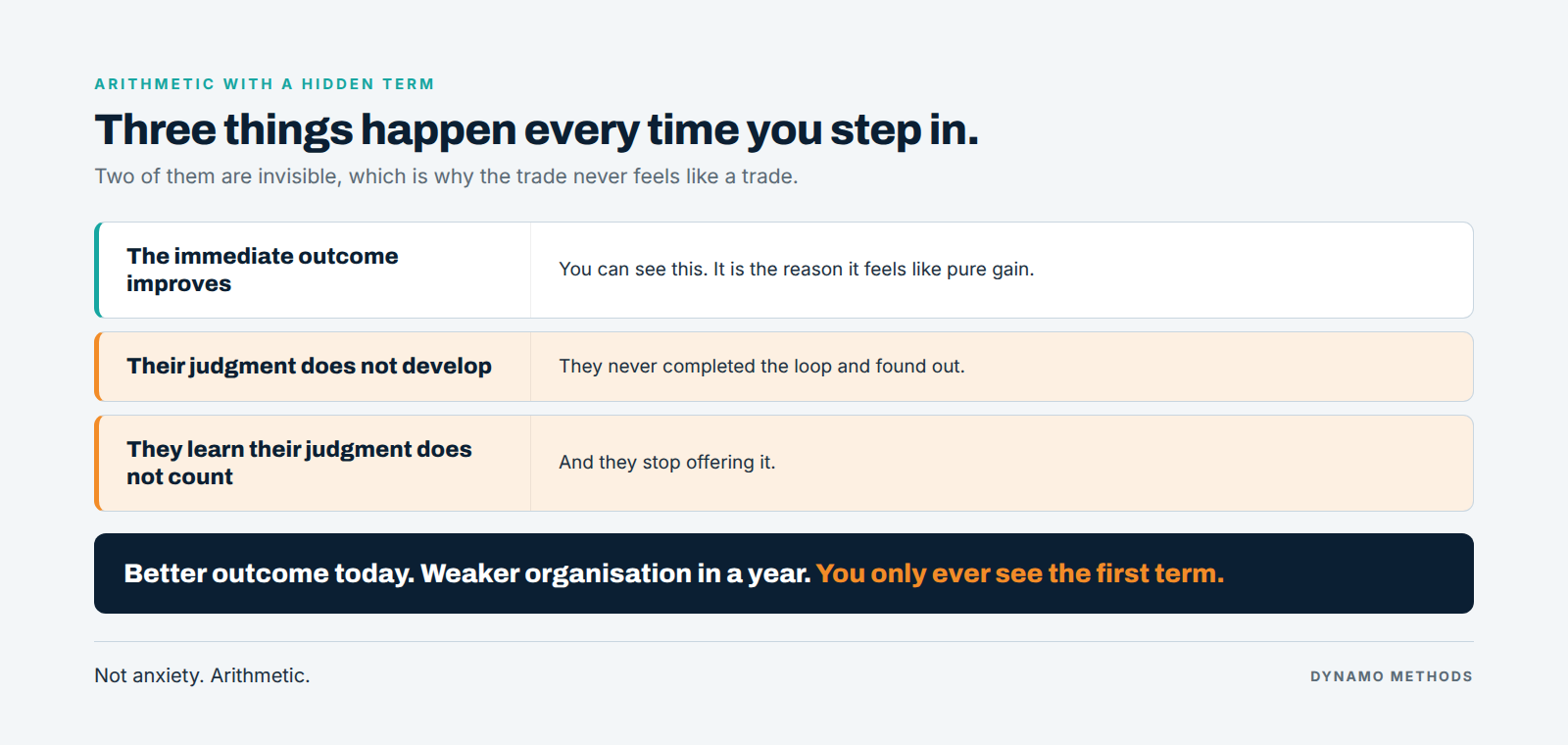
Because the trade is invisible — you can see the improved outcome, you cannot see the judgment that failed to develop — it feels like pure gain every single time.
That is the trap. Not anxiety. Arithmetic with a hidden term.
Why it compounds
It is self-justifying. You intervene, so their judgment does not develop; next time they are genuinely not ready, so you intervene. Each intervention produces the evidence for the next one.
After two years, you will have a team that objectively cannot operate without you — and you will have proof. Every incident where they got it wrong will be in your memory, and you will be right about all of them.
This is why micromanaging is so stable. It is not sustained by a mistaken belief. It is sustained by accurate observations of a situation you created.
That is not a character failing. It is what happens when the person with the best judgment in the building is also the person with the fewest constraints on using it.
Move one — name the honest level
Micromanaging is a mismatch. It is what happens when someone holds authority at one level and you trust them at a lower one. Hovering is what fills that gap.
So close the gap explicitly rather than trying to suppress the hovering.
Five levels of authority. Inform — you decide and explain. Consult — you decide, having asked their view. Delegate — they decide and tell you before acting. Ratify — they decide, act, and tell you after. Decide — it is entirely theirs.
Pick the honest level. Not the aspirational one. If you genuinely only trust them at level three, put them at level three and say so. That is not a demotion — it is the removal of a lie that was making you both miserable.
Then say it out loud:
"On this, you are at level three. You decide, tell me before you act, and I will only step in if I see something you cannot. In two months, if this keeps going well, you move to level four."
Now you have a legitimate touchpoint instead of an anxious one. And they know exactly how much room they have, which stops them checking pre-emptively.
Move two — transfer the reasoning
This is the move that actually shrinks the gap over time.
When you would have corrected something, do not correct the decision. Explain how you would have thought about it.
There is a real difference. Correcting the decision transfers an answer. Explaining the reasoning transfers a method.
So instead of no, do it this way, try: here is what I would have weighed. The thing I would worry about most is this. I would probably ignore that. And the reason is that I have seen this pattern go wrong in a specific way before, which is this.
Ninety seconds instead of four. And you are installing the thing that means you will not be needed next time.
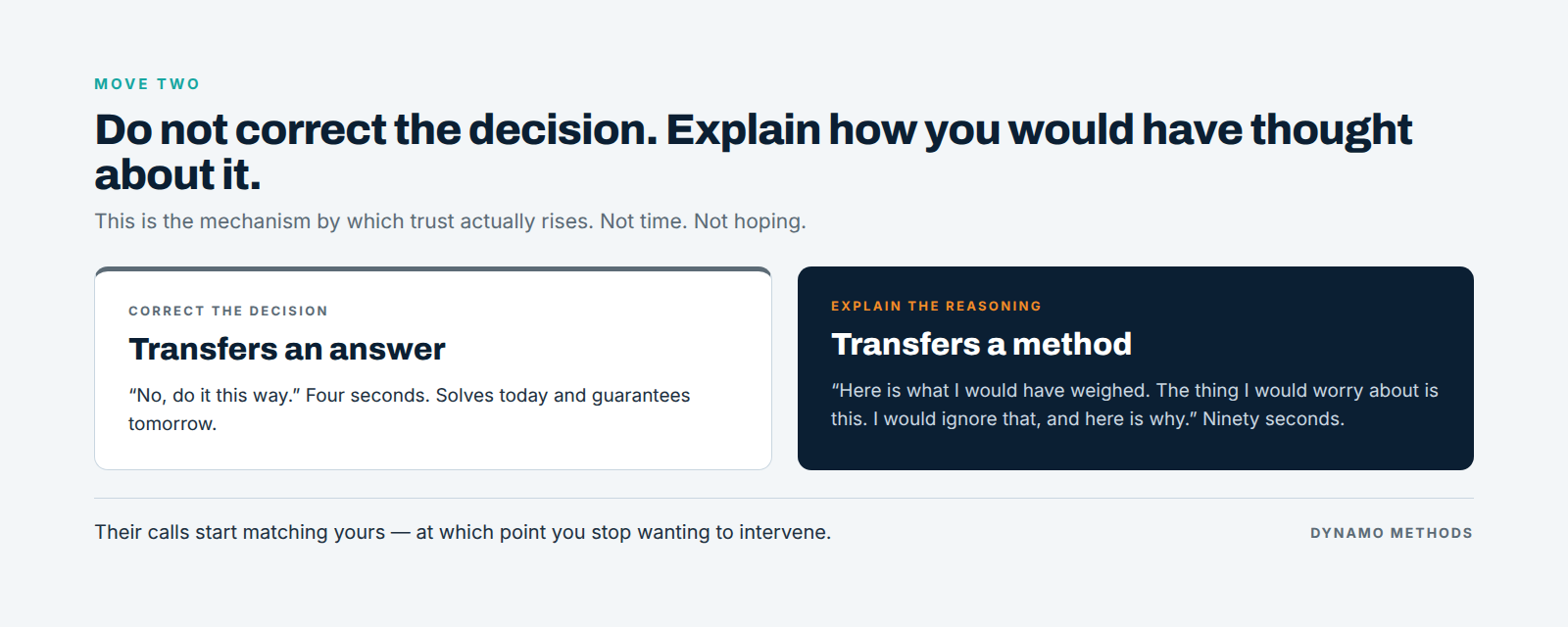
This is the mechanism by which trust actually rises. Not time. Not hoping. Repeated exposure to your reasoning, until their calls start matching yours — at which point you will stop wanting to intervene, because you will agree with them.
Move three — price the cost of wrong
This is the move that gives you permission.
Before you intervene, ask one question: if they get this wrong, what does it cost, and is it recoverable?
Most of the time the honest answer is: annoying, recoverable, a few thousand dollars, a slightly awkward client conversation.
And a recoverable mistake with reasoning attached afterwards is the single most efficient development tool you have. It costs a defined amount and produces a permanent improvement in someone's judgment.
So the question stops being should I let them get this wrong. It becomes is this a cheap enough lesson to buy.
Sometimes it is not — irreversible, a major client, a regulatory exposure. Intervene then, obviously. But when it is recoverable, you are not letting a mistake happen. You are purchasing something.
Eleven years of proposals
A founder I worked with — engineering firm, about nineteen million — was reviewing every client proposal before it went out. Every one. Had done for eleven years.
And his edits improved them. That is the awkward part. I looked at a stack of marked-up proposals and he was right nearly every time.
So we did not debate whether he was right. We priced it. Two proposals a week, forty minutes each. About fifty hours a year of his time. And in eleven years his two senior people had never sent a proposal without his edits — which means neither had ever found out what happens when you get one slightly wrong.
We agreed a rule. Proposals under a set value went out unreviewed. Above it, he saw them.
Over the next quarter, three proposals went out with errors he would have caught. All three recoverable. One cost a small discount to fix.
And by the end of the quarter both senior people were producing proposals at the standard he had been editing toward — because for the first time they were getting the consequence directly instead of having it removed by him.
He bought eleven years of stalled development for the price of one small discount.
What to do this week
Pick the one area where you intervene most. Just one.
Write down which of the five levels the person is actually at, and which they are formally supposed to be at. If those differ, that gap is your hovering.
Name the level out loud with them. Then for the next five days, in that area only, when you feel the urge to correct, do two things: ask the cost question — is this recoverable? And if it is, do not correct the decision. Explain your reasoning afterwards instead.
Five days, one area.
The objection I hear most: my standards are the reason this business works. If I stop enforcing them, quality drops.
In the short term, that is true. Quality will dip. I would rather say so than pretend otherwise.
But look at what you are comparing. On one side, a small temporary dip while people develop judgment. On the other, a permanent arrangement in which your standards exist only in your head and can only be applied by you being personally present.
The second one is not high standards. It is a single point of failure that happens to have good taste.
Real high standards are standards that survive your absence. If quality drops when you step back, it means standards haven't been built. You have been personally providing them. Those are different things, and only one of them is an asset.
NEXT STEP
See where this pattern is costing you most. The Dynamo Business Stability Diagnostic scores all seven systems and names your biggest constraint.
𝗧𝗮𝗸𝗲 𝘁𝗵𝗲 𝗙𝗿𝗲𝗲 𝗕𝘂𝘀𝗶𝗻𝗲𝘀𝘀 𝗦𝘁𝗮𝗯𝗶𝗹𝗶𝘁𝘆 𝗗𝗶𝗮𝗴𝗻𝗼𝘀𝘁𝗶𝗰: https://dynamomethods.com/business-os
Isaac Wambua is an industrial engineer, business systems architect, and the creator of the Dynamo Business Operating System (DBOS) and the Dynamo Leadership Operating System (DLOS). He is the author of The Dynamo Business Blueprint: How to Build a Business That Runs, Grows and Thrives Without You. Through Dynamo Methods, he helps owners and executive teams install the operating systems and leadership capacity that allow a company to run — and improve — without depending on any one person.


