The 4 Stages of Leadership: Why Most Leadership Development Programs Fail
Most leadership development efforts become vague because organizations lack a shared language for leadership maturity.
They know they need stronger leaders.
They know managers need to grow.
They know communication, accountability, ownership, and execution need to improve.
But when it comes time to develop leaders, many organizations still rely on broad categories. What senior leaders tell me quite often are things like:
“Our managers need more confidence.”
“They need to communicate better.”
“They need to take more ownership.”
Those observations may be true.
But they are often too general to guide real leadership development.
Because before an organization can develop leaders effectively, it must answer a more specific question:
What stage of leadership is this person currently operating from?
Without that clarity, leadership development becomes guesswork.
Some leaders are trying to stabilize themselves.
Some are trying to translate direction for others.
Some are trying to connect people, teams, and priorities.
Some are ready to multiply ownership and leadership capacity in others.
Those are not the same development needs.
That is why we use the Leadership Stage Assessment.
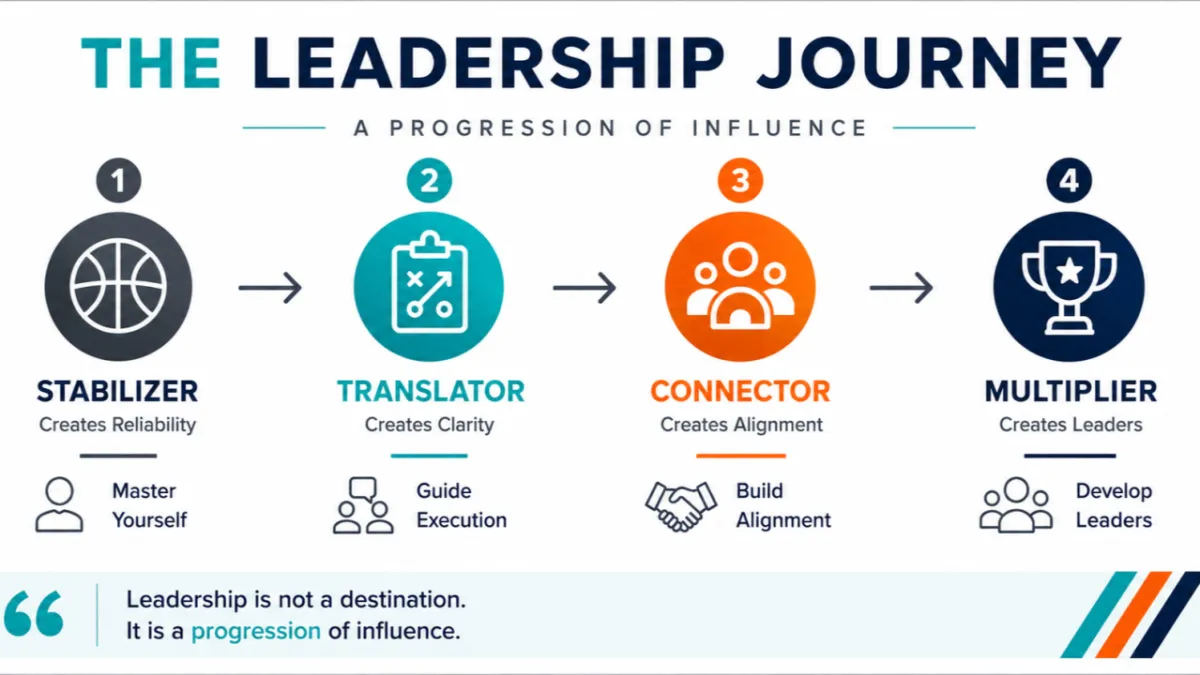
It gives leaders and organizations a clearer way to understand leadership maturity through four stages: Stabilizer. Translator. Connector. Multiplier.
Why Leadership Maturity Needs a Shared Language
One of the biggest challenges within organizations is that people often use the word “leadership” without defining which level they mean.
A front-line manager, a department head, a senior executive, and a high-potential employee may all need leadership development.
But they do not all need the same kind of development.
A new manager may need help becoming personally reliable and consistent.
A mid-level leader may need help translating executive direction into team-level priorities.
A cross-functional leader may need help building trust, alignment, and collaboration.
A senior leader may need help developing ownership and leadership capacity in others.
When those differences are not clear, organizations often deliver the same type of leadership training to everyone and hope each person gets what they need.
That approach may create inspiration.
But it does not always create transformation.
Leadership development becomes more impactful when the organization has a shared language for the stage leaders are at and what growth looks like at the next stage.
Stage 1: Stabilizer
The first stage is theStabilizer.
A Stabilizer is focused on becoming personally reliable, grounded, consistent, and trustworthy.
This stage is foundational but very crucial
Before someone can lead others well, they must first learn to lead themselves well.
Stabilizers are developing the internal habits and personal leadership practices that earn people’s trust.
They are learning to manage their energy, emotions, communication, commitments, priorities, and follow-through.
A Stabilizer creates confidence because people know they can be counted on.
They do what they say they will do.
They show up prepared.
They manage their responsibilities.
They respond instead of react.
They bring steadiness into the room.
The danger at this stage is inconsistency.
If a leader cannot stabilize themselves, their team will feel it.
Priorities shift too often.
Communication becomes reactive.
Follow-through becomes uneven.
Emotions leak into decisions.
People are unsure which version of the leader they will get.
That does not mean the leader lacks potential.
It means the first development need is internal leadership.
The Stabilizer stage asks:
Can people trust me to lead myself before I try to lead them?
Stage 2: Translator
The second stage is theTranslator.
A Translator takes direction, strategy, vision, and expectations and turns them into clarity for others.
This is one of the most important stages for managers.
Why?
Because managers sit between executive intention and team execution.
Executives may set the direction, but managers have to translate that direction into daily priorities, decisions, expectations, and behavior.
When leaders are weak Translators, people become busy but unclear.
The team may work hard, but not always on the right things.
Meetings become repetitive.
Expectations remain fuzzy.
People interpret priorities differently.
Employees wait for clarification.
Executives get pulled back into details that managers should have clarified.
A strong Translator reduces confusion.
They help people understand:
What matters most?
What does success look like?
What are the priorities?
Who owns what?
What decisions need to be made?
What should be escalated?
What should not be escalated?
Translators create movement by turning direction into action.
The danger at this stage is becoming only a messenger.
A weak Translator repeats information.
A strong Translator interprets it, clarifies it, and helps people act on it.
The Translator stage asks:
Can I turn direction into clarity, expectations, and execution for others?
Stage 3: Connector
The third stage is theConnector.
A Connector aligns people, relationships, collaboration, and trust.
This stage matters because leadership is not only about communicating tasks. It is about helping people work together toward shared outcomes.
Many execution problems are not caused by lack of effort.
They are caused by lack of alignment.
Departments may be working hard but moving in different directions.
Managers may be communicating, but not truly collaborating.
Teams may be productive inside their silos, but disconnected across the organization.
A Connector sees the relational and organizational dynamics that affect execution.
They ask:
Who needs to be aligned?
Where is trust weak?
Where are handoffs breaking down?
Where is communication getting distorted?
Where are teams working around each other instead of with each other?
Where is tension slowing down progress?
Connectors strengthen the tissue of the organization.
They build trust.
They improve collaboration.
They create alignment.
They help people understand one another.
They reduce unnecessary friction.
They make it easier for teams to move together.
The danger at this stage is confusing connection with harmony.
Connection is not avoiding tension.
Connection is building enough trust and clarity to move through tension productively.
A Connector does not simply make people feel good.
A Connector helps people work better together.
The Connector stage asks:
Can I align people, relationships, and collaboration so that the work moves more smoothly?
Stage 4: Multiplier
The fourth stage is theMultiplier.
A Multiplier builds ownership, judgment, confidence, and leadership capacity in others.
This is where leadership becomes less about what the leader can personally carry and more about what the leader can multiply through people.
Multipliers do not simply manage tasks. They develop thinkers.
They do not simply give answers. They build judgment.
They do not simply rescue the team. They increase the team’s capacity to own decisions and outcomes.
A Multiplier asks:
Who needs to grow?
What capacity needs to be developed?
Where am I carrying something someone else needs to learn to carry?
Where am I answering questions too quickly?
Where am I solving problems that should become opportunities for development?
Who is ready for more ownership?
This stage is critical for organizations that want to scale.
Because if leadership stays concentrated in a few high-capacity people, the organization becomes dependent.
Senior leaders become bottlenecks.
Managers wait for direction.
Teams hesitate to make decisions.
Growth depends on a few strong personalities.
Execution slows whenever those people are unavailable.
Multipliers change that.
They build leadership capacity beyond themselves.
The risk at this stage is control.
Many capable leaders struggle to multiply others because they are used to being the answer.
They are good at solving.
Good at deciding.
Good at carrying pressure.
Good at making things happen.
But if they never transfer capacity, the organization remains dependent on them.
The Multiplier stage asks this key question:
How can I build ownership and leadership capacity in others, so the organization grows beyond me?
Why This Framework Matters
The four stages matter because leaders cannot be developed effectively if the organization cannot identify their current stage.
If a leader is in the Stabilizer stage, they may need support with personal reliability, emotional regulation, priorities, and consistency.
If a leader is in the Translator stage, they may need support with communication, setting expectations, and translating strategy into execution.
If a leader is in the Connector stage, they may need support with trust-building, collaboration, cross-functional alignment, and relational leadership.
If a leader is in the Multiplier stage, they may need support with delegation, coaching, developing other leaders, and transferring ownership.
Each stage has a different development path.
This is where many organizations miss it.
They send everyone to the same leadership program and wonder why the outcomes are inconsistent.
But if people are operating from different stages, they need different kinds of development.
A Stabilizer does not need the same support as a Multiplier.
A Translator does not require the same level of development as a Connector.
A Connector does not grow the same way as someone who is still trying to stabilize their own leadership habits.
Leadership development becomes more effective when it becomes stage-based.
The Problem With Vague Leadership Development
Many organizations say they want to develop leaders, but they have not defined what leadership maturity looks like.
So development becomes activity-based.
• People attend workshops.
• Read books.
• Join masterminds.
• Receive coaching.
• Complete assignments.
• Have performance conversations.
All of those can be useful.
But activity does not always equal maturity.
The real question is:
Is this leader growing in capacity or just busy in activity?
Are they becoming more reliable?
Are they creating more clarity?
Are they building stronger alignment?
Are they multiplying ownership in others?
Those are different signs of growth.
Without a shared language, organizations may confuse participation with progress.
A leader can attend every training and still not move to the next stage.
That is why diagnosis matters.
Leadership Development Should Be Diagnosed, Not Guessed
TheLeadership Stage Assessmentis designed to give leaders and organizations a clearer starting point.
It helps identify where a leader is currently operating:
Stabilizer. Translator. Connector. Multiplier.
The goal is not to label people.
The goal is to create clarity.
When a leader knows their current stage, they can focus on the right next step in their growth.
When people leaders understand the stages across a leadership population, they can design more targeted development.
When executives understand where leadership capacity is strongest or weakest, they can make better decisions about coaching, training, delegation, succession, and organizational structure.
That is the power of a shared framework.
It gives people language.
And language creates clarity.
Clarity creates focus.
Focus creates better development.
A Practical Question for Your Organization
Here is a simple question worth asking:
Do we know what stage our leaders are currently operating from?
Not their title.
Not their tenure.
Not their personality.
Not their potential.
Their current leadership stage.
Because title and stage are not always the same.
Someone can have a senior title and still operate like a Translator.
Someone can be new to management and already show strong Connector qualities.
Someone can be highly competent but still struggle to multiply ownership.
Someone can be respected technically but still need to stabilize their leadership habits.
The point is not judgment.
The point is accuracy.
If you know the stage, you can support the growth.
If you do not know the stage, you are likely going to guess the development they need.
Final Thought
Leadership maturity does not happen automatically.
It has to be identified, developed, reinforced, and multiplied.
That begins with a shared language.
The four stages give organizations a practical way to understand leadership growth:
Stabilizerscreate personal reliability.
Translatorscommunicate direction and expectations.
Connectorsalign people, relationships, and collaboration.
Multipliersbuild ownership and leadership capacity in others.
Most organizations do not need more vague leadership development.
They need clearer diagnosis.
The truth is, leaders cannot be developed effectively if the organization cannot identify their current stage.
Take the Leadership Stage Assessment
If you want to discover your current leadership stage, take theLeadership Stage Assessment.
It will help you identify whether you are currently operating as aStabilizer, Translator, Connector, or Multiplierand what kind of development may help you move forward.
Take the assessment here:Leadership Stage Assessment
Reflection Question
Do you know what stage your leaders are currently operating from, or are you trying to develop everyone the same way?


