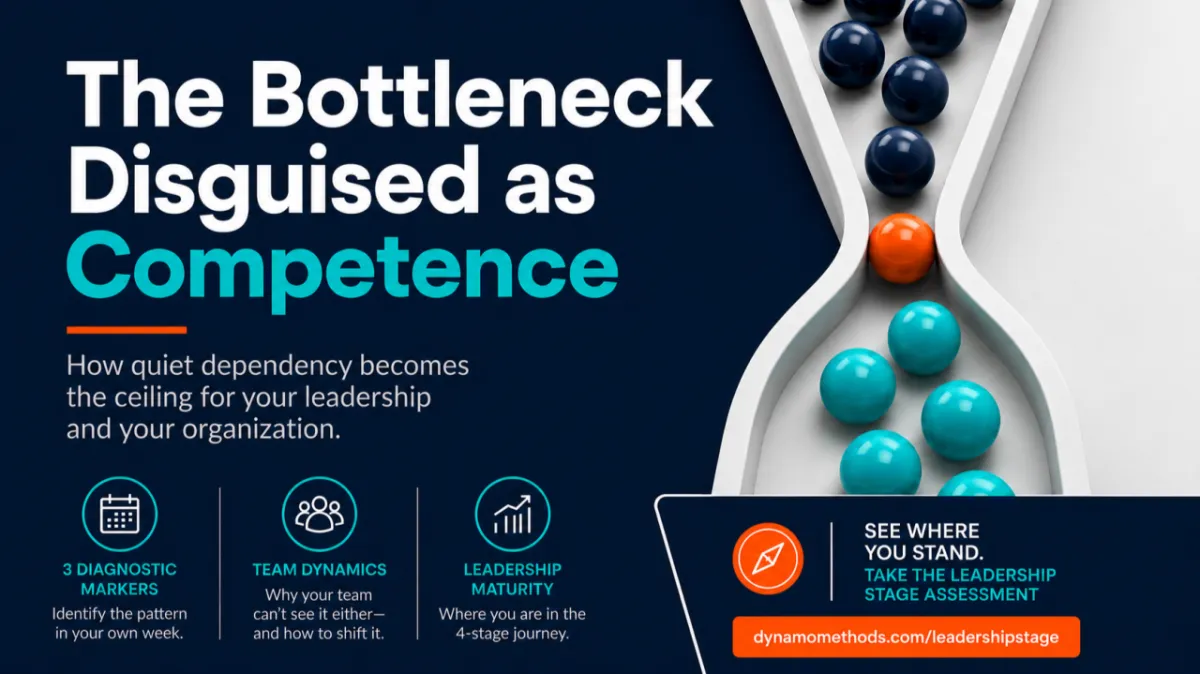
The Bottleneck Disguised as Competence
Most stuck leaders do not look stuck. They look responsible, available, trusted, and deeply involved. Their leadership ceiling does not show up as a visible failure. It shows up as a quiet dependency.

When leaders imagine “hitting a ceiling,” they usually picture something dramatic: a missed quarter, a failed initiative, a senior leader leaving, or a crisis big enough to name.
But the real ceiling rarely announces itself that way.
More often, it hides inside organizations that appear healthy from the outside. The numbers are steady. The team seems engaged. Clients are being served. Meetings are happening. Execution is moving.
By visible standards, leadership is working.
But underneath the surface, something more revealing is taking place.
Every meaningful decision still routes through the leader. Senior team members appear capable, but defer when the stakes rise. The leader takes a vacation, and the team operates a level below its normal rhythm. The leader steps out of a role, and the organization’s capability seems to leave with them.
That is the bottleneck disguised as competence.
And for many mid-career and senior leaders, it is the most common ceiling pattern they will face.
Why the Pattern Hides
This ceiling is difficult to detect because it does not trigger the usual warning signs.
An underperforming team generates feedback. A failing leader generates concern. A distressed culture generates exits.
But the bottleneck pattern often generates the opposite.
The team looks aligned. The leader looks indispensable. The culture looks loyal. The organization appears to be functioning well.
From inside the pattern, everything feels like success.
The leader is busy because the work is important. The team defers to the leader because the leader has strong judgment. The decisions concentrate because that is how things get done.
None of it feels broken. Much of it feels earned.
And that is what makes the pattern so dangerous. Structurally, the organization has already reached a ceiling. It simply has not become painful enough to expose itself yet.
Three Diagnostic Markers
If you suspect this pattern may be present in your leadership, look for three markers. One by itself may be circumstantial. All three together form the signature.

Why the Team Often Cannot See It Either
One reason this pattern is so difficult to break is that the team has adapted to it.
They have learned that the leader is the final stop. They have optimized their work around the leader’s preferences. They have become skilled at presenting decisions in a form the leader can quickly review, correct, or approve.
To the team, this does not feel like dependency. It feels like alignment. It feels like efficiency. It feels like knowing how to work well with the leader.
And at a tactical level, it may be working.
But at an architectural level, it is the very pattern keeping both the leader and the team at a ceiling.
When the development work begins, the earliest resistance may not come from the leader. It may come from the team.
Why?
Because the team has been rewarded for the existing pattern. Asking them to operate differently - to make decisions without pre-approval, escalate more selectively, and take fuller ownership - can initially feel like the leader is withdrawing.
But the leader is not withdrawing. The leader is developing capacity. That distinction matters.
What to Look For This Week
Before next week’s piece, run the three diagnostic markers against your own leadership:
Where does your calendar terminate at you?
Where does ambiguity automatically move upward?
When you ask the succession question honestly, what is the real answer?
If two of the three markers are present, you are likely inside the pattern.
If all three are present, the bottleneck is not just a leadership habit. It is the architectural limit your organization is pressing against, regardless of how healthy everything else appears.
The Leadership Stage Assessment was built to surface this kind of pattern. It locates where you are operating in the four-stage maturity model:

Most leaders inside the bottleneck pattern are not failing. They are operating as highly competent Translators.
That is why the next level of growth is not about working harder. It is about changing the structure of how leadership flows through the organization.
In the next article, we will go one layer deeper into the developmental architecture behind the four stages and why the jump from Tier 2 to Tier 3 marks the shift toward building self-managing organizations.
Would you like to know which stage you are leading from? Take the FREE Leadership Stage Assessment Here: Leadership Stage Assessment
This framework is anchored in The Multiplier Leader by Isaac Wambua, available on Amazon and through Dynamo Methods.


