The Executive Rescue Trap
The Executive Rescue Trap
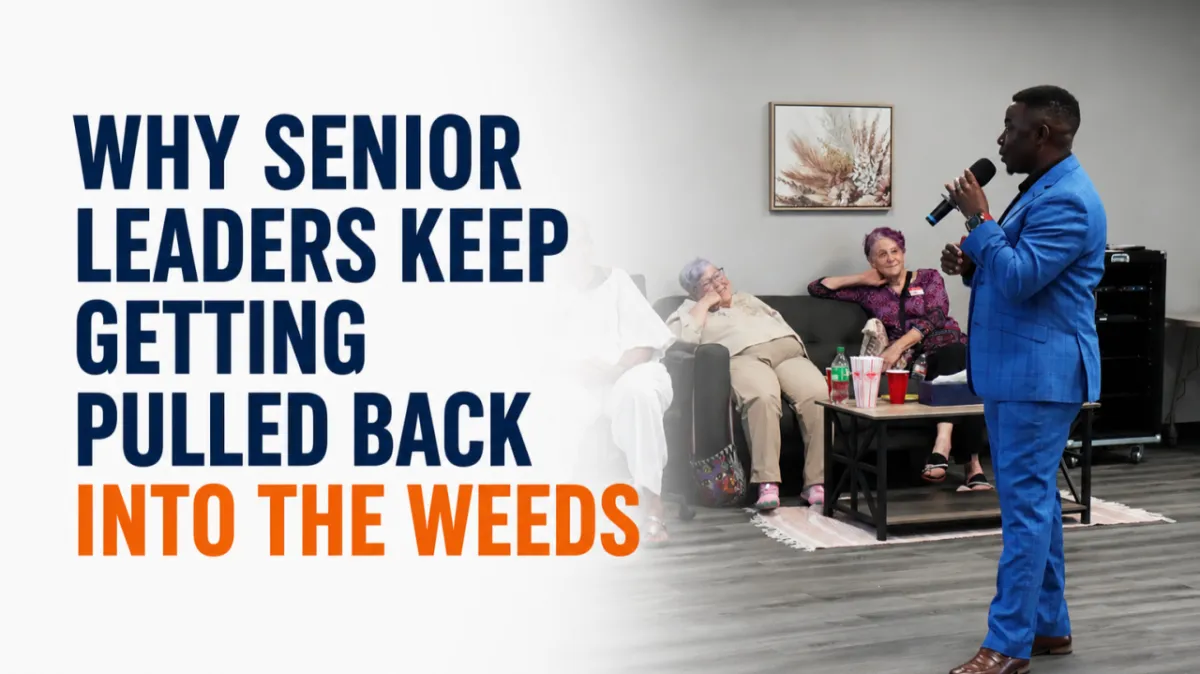
Why Senior Leaders Keep Getting Pulled Back Into the Weeds
Every executive I know wants the same thing.
More strategic time.
More time to think.
More time to plan.
More time to develop people.
More time to focus on the future.
Yet many senior leaders spend their days doing the exact opposite.
Instead of leading the organization, they find themselves rescuing it.
They jump into employee issues.
They resolve customer escalations.
They settle team conflicts.
They answer questions managers should answer.
They make decisions managers should make.
They solve problems that should have been solved two levels down.
At the end of the week, they feel exhausted.
And often frustrated.
Not because they're unwilling to help.
Because they never seem to escape the weeds.
If this sounds familiar, you're not alone.
Many executives believe they have a time management problem.
What they actually have is a leadership system problem.
The Rescue That Never Ends
Imagine a manager walks into your office.
"We have a situation."
You listen.
You assess.
You make a decision.
Problem solved.
It feels productive.
Helpful.
Responsible.
Then it happens again.
And again.
And again.
Eventually, a pattern forms.
Managers begin bringing decisions upward.
Employees begin waiting for direction.
Teams stop exercising judgment.
The executive becomes the organization's default decision-maker.
The rescue becomes routine.
And the cycle continues.
The challenge isn't the individual rescue.
The challenge is the pattern.
Every repeated rescue teaches the organization something.
What Rescues Teach
Leaders often underestimate how quickly organizations learn.
Every time an executive steps in to solve a problem that could have been solved elsewhere, the organization receives a message.
The message is:
"When in doubt, escalate."
"Wait for approval."
"Bring it to leadership."
"Someone else will decide."
No one says these things explicitly.
But behavior teaches culture.
Over time, people learn that the safest decision is often no decision at all.
And that is where dependency begins.
The Executive Rescue Cycle
Most organizations don't experience this as a single event.
They experience it as a cycle.
Step 1: Expectations Are Unclear
People aren't sure what decisions they own.
Authority is vague.
Responsibilities are blurred.
As uncertainty grows, people seek direction.
Step 2: Escalations Increase
Questions move upward.
Problems move upward.
Decisions move upward.
The executive becomes increasingly involved.
Step 3: Executives Rescue
Wanting to help, the executive steps in.
They provide answers.
Make decisions.
Resolve issues.
Move things forward.
Step 4: Dependency Grows
The organization learns that leadership will eventually provide the answer.
Confidence decreases.
Ownership weakens.
Escalations become more frequent.
Step 5: Executive Overload
The executive becomes overwhelmed.
Strategic work suffers.
Leadership capacity stalls.
The organization becomes increasingly dependent.
Then the cycle starts again.
Why Managers Stop Deciding
Many executives assume managers escalate because they lack capability.
Sometimes that's true.
More often, the issue is confidence.
Managers ask themselves:
"What if I make the wrong decision?"
"What if leadership disagrees?"
"What if this creates a problem?"
Without clear authority and support, escalation feels safer than ownership.
The issue is rarely intelligence.
The issue is uncertainty.
And uncertainty creates dependency.
The Cost of Executive Rescue
One executive I worked with tracked how much time he spent dealing with issues that should have been handled elsewhere.
The results surprised him.
More than half of his weekly decision-making conversations involved issues that should have been resolved at lower levels.
Think about that.
Half of his leadership capacity was being consumed by problems he should never have seen.
Once he began clarifying decision rights, establishing coaching rhythms, and strengthening manager confidence, the volume of escalations dropped dramatically.
The result wasn't simply fewer interruptions.
The result was more strategic leadership.
More planning.
More development.
More growth.
The organization became stronger because the executive became less necessary.
The Difference Between Helping and Rescuing
Helping is not the problem.
Rescuing is.
Helping develops capability.
Rescuing creates dependency.
Helping asks:
"What do you recommend?"
Rescuing says:
"Here's what we're going to do."
Helping develops judgment.
Rescuing replaces judgment.
Helping builds leadership capacity.
Rescuing concentrates leadership capacity.
The distinction matters.
Because the goal of leadership is not to become the answer.
The goal is to develop more people who can answer.
Breaking the Cycle
The solution is not to stop supporting your team.
The solution is to strengthen the system.
Four changes make the biggest difference.
1. Clarify Expectations
People need to know what decisions belong to them.
Ownership must be explicit.
2. Define Decision Rights
Who decides?
Who recommends?
Who approves?
Who executes?
Ambiguity fuels escalation.
3. Build Coaching Rhythms
Managers need support while developing judgment.
Coaching creates confidence.
Confidence reduces dependency.
4. Reward Ownership
Recognize thoughtful decision-making.
Celebrate initiative.
Encourage responsible risk-taking.
Organizations get more of what they reinforce.
A Leadership Question Worth Asking
At the end of each week, ask yourself:
"How many problems did I solve that someone else could have solved?"
The answer may reveal more about your leadership system than your calendar ever will.
Final Thought
Executives are often praised for being available.
Responsive.
Helpful.
Capable.
But there is a danger hidden inside those strengths.
Every rescue you perform trains your team to wait for you.
The goal of leadership is not to become the organization's permanent solution.
The goal is to build an organization that develops solutions without you.
That is how leadership capacity grows.
That is how organizations scale.
And that is how executives finally escape the weeds.
Leadership Team Challenge
Have your leadership team take the Leadership Stage Assessment.
Discover where decision dependency is forming.
Identify where ownership is weak.
Uncover where leadership capacity is being concentrated instead of distributed.
Because organizations don't scale when executives make more decisions.
Organizations scale when more people are capable of making them.
Take the Leadership Stage Assessment here


