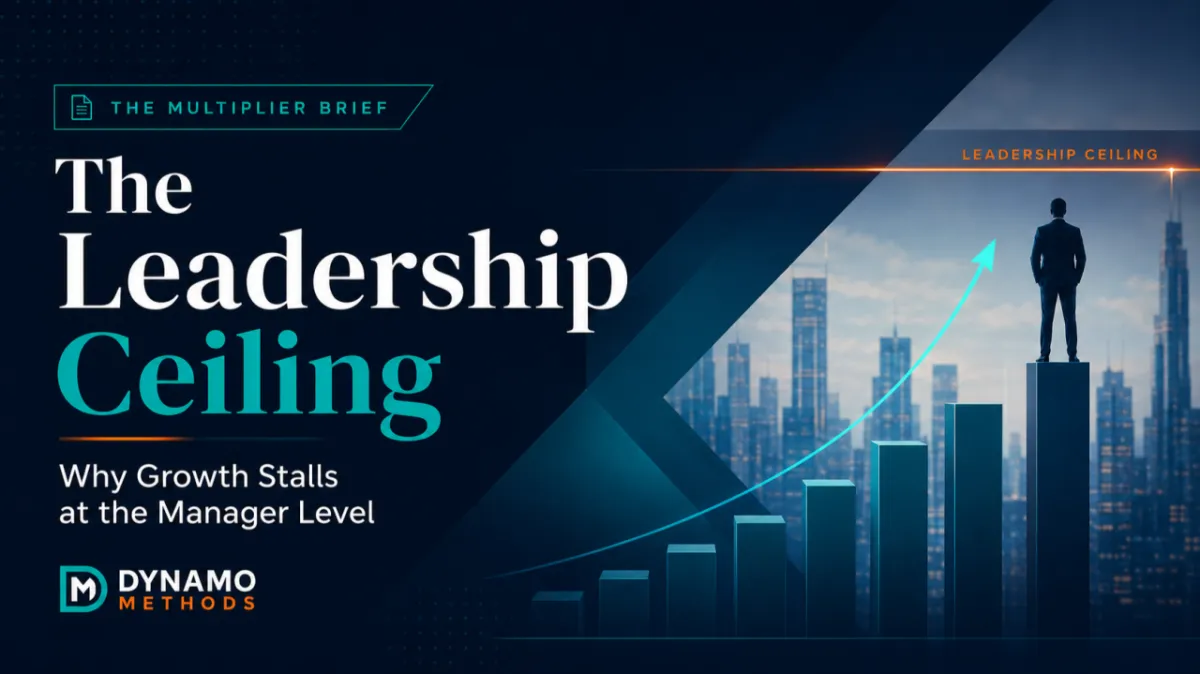
The Leadership Ceiling: Why Growth Stalls at the Manager Level
Most organizations do not stall because people are lazy.
They stall because the organization’s complexity outgrows the leadership capacity of the people responsible for carrying it out.
That is what I call The Leadership Ceiling.
It is the invisible limit an organization hits when growth, ambition, strategy, and operational complexity rise faster than the capacity of its leaders.
At first, the symptoms are subtle.
Decisions take longer.
Meetings multiply.
Managers wait for direction.
Senior leaders get pulled back into the weeds.
Communication becomes inconsistent.
Accountability depends too much on personality.
The same issues keep resurfacing under different names.
Eventually, someone says:
“We need better communication.” “We need more accountability.” “We need stronger managers.” “We need leadership training.”
And sometimes, those things are true.
But often, the deeper issue is not just a communication problem, a training problem, or a manager problem.
It is a Leadership Operating System problem.
Growth Exposes Leadership Capacity
Growth is exciting, but growth also creates pressure.
As organizations grow, they add more:
People
Decisions
Departments
Handoffs
Customers
Expectations
Ambiguity
Conflict
Communication layers
What used to work with a smaller team begins to break down.
The CEO can no longer be involved in every decision.
The executive team can no longer personally clarify every priority.
Managers can no longer rely only on being good people or strong individual contributors.
The organization needs leaders who can think, decide, communicate, align, coach, and create ownership at a higher level.
That is where many organizations hit the ceiling.
The business has grown.
But the leadership system has not.
The Manager Level Is the Leverage Point
One of the most important layers in any organization is the manager level.
Managers are the translation layer between strategy and execution.
Executives may set the direction.
HR may design the programs.
The organization may define the values.
But managers translate all of that into daily reality.
They translate priorities. They translate expectations. They translate communication.
When managers are clear, teams become clearer.
When managers are confused, teams become confused.
When managers do not create ownership, senior leaders continue to carry too much of the thinking.
This is why manager development is not a “nice to have.”
It is one of the most important growth strategies within an organization.
High Performers Do Not Automatically Become High-Capacity Leaders
Many organizations promote people into leadership because they were excellent individual contributors.
They were dependable. They got things done. They knew the work. They solved problems. They produced results.
That matters.
But leading people is a different assignment.
The individual contributor is rewarded for personal output.
The leader is responsible for multiplying output through others.
That shift is not automatic.
A strong performer may know how to do the work but struggle to delegate the work.
They may understand the task but struggle to clarify expectations.
They may work hard but unintentionally create dependency around themselves.
This is not a character flaw.
It is a development gap.
And if the organization does not have a clear system to help leaders grow through that transition, the ceiling drops.
The 7 Symptoms of the Leadership Ceiling
The Leadership Ceiling often shows up through patterns like these:
1. Too many decisions move upward.
Senior leaders keep solving problems that should be owned by managers closer to the work.
2. Managers wait for direction.
Instead of interpreting strategy and moving forward, they pause until someone above them confirms every step.
3. Execution becomes inconsistent.
Different teams interpret priorities, standards, and accountability differently.
4. Training does not stick.
Leaders may attend and enjoy a leadership workshop but return to old behaviors because there is no system in place to reinforce the change.
5. Senior leaders become the default rescue team.
The organization depends on a few strong people to keep everything moving.
6. Managers avoid accountability conversations.
Small issues become bigger because correction is delayed.
7. Growth creates more chaos instead of more capacity.
The organization gets bigger, but not necessarily stronger.
When these patterns repeat, the answer is not simply to blame managers.
The better question is:
What leadership system is producing these outcomes?
Training Alone Is Not Enough
Training matters.
Workshops matter.
Coaching matters.
Leadership content matters.
But training alone does not create a Leadership Operating System.
Training provides content.
A Leadership Operating System provides structure.
It gives the organization a clear way to:
Define leadership expectations
Diagnose leadership capacity
Identify where leaders are stuck
Reinforce behavior through rhythms and accountability
Create consistent leadership language across the company
Without that system, organizations often keep asking:
What training do our leaders need?
That is a useful question.
But it should not be the first question.
The better first question is:
At what stage of leadership are our leaders currently operating?
Because not every leader needs the same development.
A leader who is still trying to stabilize their own performance does not need the same development as a leader who is ready to multiply ownership in others.
A leader who struggles to translate expectations does not need the same development as a leader who needs to build cross-functional trust.
A senior leader who is carrying too much may not need another productivity strategy. They may need to develop leaders beneath them who can carry more judgment, ownership, and decision-making.
Leadership development should be diagnosed, not guessed.
The First Step Is Diagnosis
This is one reason we created the Leadership Stage Assessment.

The assessment helps identify whether a leader is currently operating as a:
Stabilizer
Translator
Connector
Multiplier
Each stage represents a different level of leadership capacity.
A Stabilizer is building personal reliability, consistency, and grounded leadership.
A Translator is learning to turn direction into clear expectations, priorities, and communication.
A Connector builds trust, alignment, collaboration, and relational strength among people and teams.
A Multiplier is developing ownership, judgment, confidence, and leadership capacity in others.
The goal is not to label people.
The goal is clarity.
When leaders know where they are, development becomes more practical.
When HR leaders know where their leaders are, programs become more focused.
When executives know where leadership capacity is breaking down, they can stop guessing and start building the right system.
The Real Work
The real work is not just building better managers.
The real work is building an organization where leadership capacity grows with complexity.
That requires more than a training calendar.
It requires a Leadership Operating System.
It requires clear expectations, shared language, and accountability structures.
Because the business cannot outgrow its managers' leadership capacity for long.
At some point, the ceiling will show up.
The only question is whether you will recognize it early enough to build beyond it.
Final Thought
Managers are not the problem.
Managers are the leverage point.
When organizations invest in managers without a system in place, development is inconsistent.
But when organizations diagnose leadership capacity and build a clear Leadership Operating System, managers become more than task supervisors.
They become translators of strategy. Builders of ownership. Carriers of culture. Developers of people. and Multipliers of capacity.
And that is how organizations grow stronger without becoming more dependent on a few people at the top.
Join This Week’s Multiplier Briefing
If this topic aligns with what you are seeing in your organization, I’ll unpack it further in this week’s Multiplier Briefing.
Topic: The Leadership Ceiling: Why Growth Stalls at the Manager Level
This live executive briefing is designed for HR leaders and executives responsible for building leadership capacity across their organizations.
Register here:https://www.dynamomethods.com/multiplierbriefing
Reflection Question
Where in your organization are you currently feeling the leadership ceiling? Is it in decision-making, communication, ownership, execution, or manager confidence?


