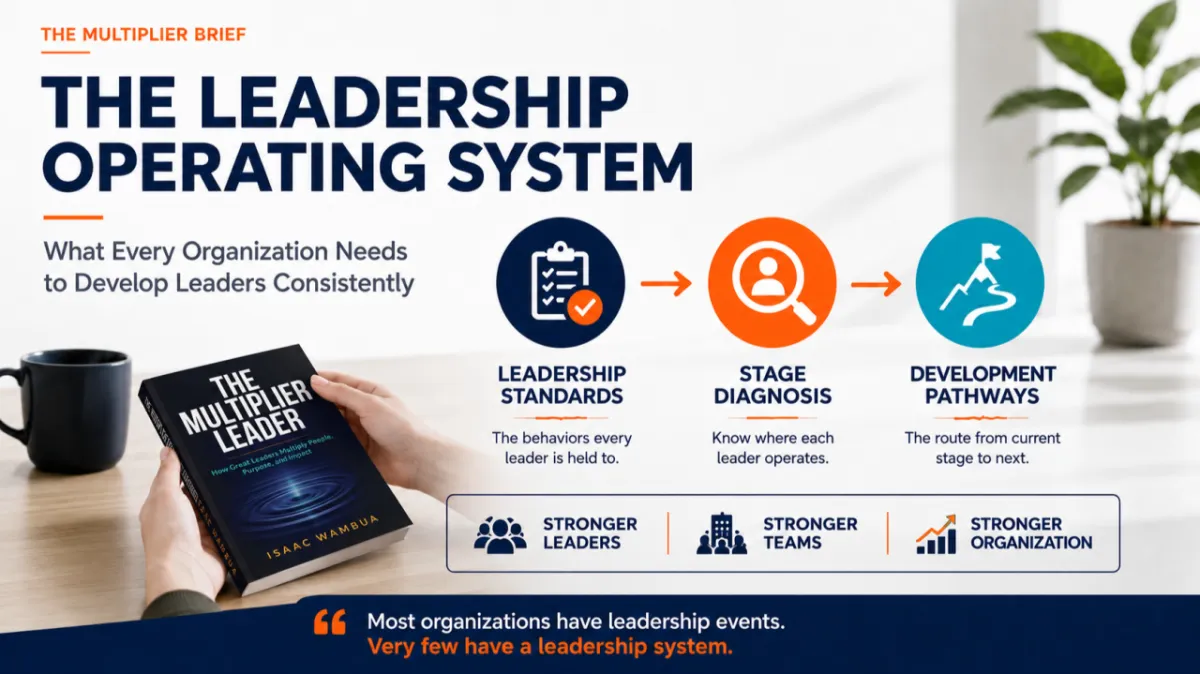
The Leadership Operating System
The Leadership Operating System
What Every Organization Needs to Develop Leaders Consistently
Most organizations invest in leadership development.
They send leaders to workshops.
Provide coaching.
Conduct performance reviews.
Offer leadership books.
Host training events.
Launch leadership initiatives.
And yet the same problems keep showing up.
Managers struggle with delegation.
Ownership remains inconsistent.
Decision-making varies wildly.
Accountability depends on the individual leader.
High-potential leaders develop unevenly.
Leadership effectiveness becomes unpredictable.
The issue is rarely effort.
The issue is structure.
Because most organizations have leadership activities.
Very few have a leadership system.
The Difference Between Events And Systems
Imagine two organizations.
Both invest in leadership development.
The first organization hosts leadership events.
Managers attend workshops.
Executives participate in coaching.
Books are distributed.
Conferences are attended.
Learning happens.
But development remains fragmented.
The second organization does something different.
Every leadership activity is connected.
Leadership expectations are defined.
Development pathways are structured.
Coaching follows a framework.
Leaders are assessed consistently.
Growth is measured.
The result is predictable.
One organization develops leaders occasionally.
The other develops leaders systematically.
The difference is not effort.
The difference is the system.
Why Leadership Development Feels Inconsistent
Many organizations accidentally create leadership randomness.
One manager receives coaching.
Another does not.
One leader gets development opportunities.
Another learns through trial and error.
One team experiences strong leadership.
Another experiences weak leadership.
The organization develops leaders.
But not consistently.
Without structure, leadership quality becomes dependent on individual initiative.
And anything dependent on individual initiative becomes difficult to scale.
The Leadership Operating System
A Leadership Operating System creates structure around leadership development.
It answers questions such as:
How do we define leadership?
How do we evaluate leadership?
How do we develop leadership?
How do we reinforce leadership?
How do we multiply leadership?
Without a system, leadership development becomes reactive.
With a system, leadership development becomes intentional.
Component #1: Leadership Standards
Every organization has standards.
The question is whether they are explicit.
Leadership standards define the behaviors expected of leaders.
How should leaders communicate?
How should they develop people?
How should they handle accountability?
How should they make decisions?
How should they build trust?
Without clear standards, leadership becomes subjective.
With clear standards, leadership becomes teachable.
The strongest organizations define leadership before they attempt to develop it.
Component #2: Stage Diagnosis
Not every leader needs the same development.
Yet many organizations treat leadership development as if everyone starts from the same place.
They don't.
Some leaders struggle with confidence.
Others struggle with delegation.
Others struggle with strategic thinking.
Others struggle with multiplication.
The first step in development is diagnosis.
Before prescribing development, leaders must understand where someone currently operates.
That's why stage diagnosis matters.
It creates clarity.
It prevents generic development.
And it makes growth more intentional.
The Leadership Stage Assessment was designed to solve this exact challenge.
Because effective development begins with accurate diagnosis.
Component #3: Development Pathways
Once leaders understand where they are, they need a path forward.
This is where many organizations get stuck.
They assess leaders.
Then stop.
Awareness increases.
Growth does not.
Development pathways provide structure.
They answer:
What comes next?
What skills should be developed?
What experiences should be created?
What support is needed?
How will progress be measured?
The pathway transforms diagnosis into development.
And development into growth.
What Most Organizations Are Missing
Leadership standards.
Stage diagnosis.
Development pathways.
Those three components alone create tremendous clarity.
But they are only part of the system.
Additional elements such as:
Coaching rhythms.
Communication practices.
Decision rights.
Accountability systems.
Succession planning.
Leadership reinforcement.
All play a role in creating a complete Leadership Operating System.
The organizations that develop leaders most effectively do not rely on isolated events.
They rely on integrated systems.
A Client Snapshot
One organization we worked with invested heavily in leadership development.
Training occurred regularly.
Managers attended workshops.
Coaching was available.
Yet leadership quality varied dramatically across departments.
Some teams thrived.
Others struggled.
The issue wasn't effort.
The issue was consistency.
Once leadership standards were defined, leaders were assessed against a common framework, and development pathways were established, leadership became significantly more predictable.
The organization stopped relying on individual leadership styles and started building organizational leadership capability.
The difference was structure.
A Question Worth Asking
If someone asked:
"How does your organization develop leaders?"
Would the answer describe a system?
Or a collection of activities?
The answer may reveal your greatest leadership opportunity.
Final Thought
Most organizations have leadership events.
Very few have a leadership system.
Events create awareness.
Systems create consistency.
Events create inspiration.
Systems create capability.
Events happen occasionally.
Systems operate continuously.
If leadership matters to the future of your organization, it deserves more than isolated development activities.
It deserves a system.
Because leadership excellence is rarely accidental.
It is designed.
Leadership Operating System Diagnostic
If you're serious about developing leaders consistently, start by understanding the system you currently have.
Book a Leadership Operating System Diagnostic.
We'll help you identify:
✓ Leadership development gaps
✓ Areas of inconsistency
✓ Missing leadership infrastructure
✓ Opportunities to strengthen leadership capacity
Because leadership development should not depend on chance.
It should depend on a system.
Take the Leadership Stage Assessment and discover where your leaders are—and what it will take to move them forward.
I’ll be unpacking this topic further in this week’s Multiplier Briefing. If you are responsible for building leadership capacity inside your organization, you can Register Here


