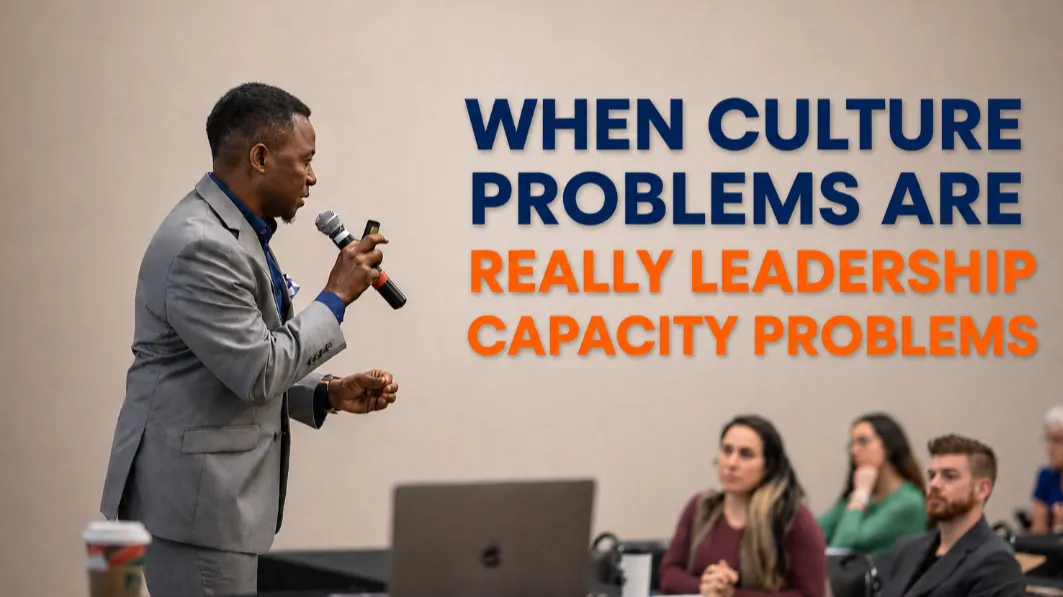
When Culture Problems Are Really Leadership Capacity Problems
When Culture Problems Are Really Leadership Capacity Problems
Most organizations believe they have a culture problem.
Employees are disengaged.
Teams are frustrated.
Communication feels inconsistent.
Conflict lingers longer than it should.
Burnout is rising.
Turnover is increasing.
The instinctive response is often to launch a culture initiative.
A new engagement survey.
A new values campaign.
A new recognition program.
Another communication initiative.
While those efforts may help, many organizations never address the real issue because they focus on the symptom instead of the source.
The uncomfortable truth is this:
Most culture problems are leadership-capacity problems wearing a disguise.
Culture is often the visible reflection of the leadership system operating underneath it.
If leaders lack clarity, teams become confused.
If leaders communicate inconsistently, teams become fragmented.
If leaders avoid difficult conversations, conflict spreads.
If leaders fail to delegate effectively, burnout becomes inevitable.
The culture simply reveals what leadership is producing.
The Leadership Capacity Gap Map
One of the most useful questions an HR leader can ask is:
"What leadership capability might be creating this culture symptom?"
Consider the following examples.
Culture Symptom #1: Low Ownership
Employees appear disengaged.
Initiative is low.
People wait to be told what to do.
The immediate conclusion is often that employees lack accountability.
But many times the real issue is leadership clarity.
People struggle to take ownership when expectations are unclear.
When priorities constantly shift.
When success is poorly defined.
Ownership often increases dramatically when leaders improve clarity.
Culture Symptom #2: Communication Breakdowns
Teams complain that nobody knows what is happening.
Projects stall.
Departments become disconnected.
Leaders often respond by increasing communication volume.
More emails.
More meetings.
More updates.
But communication breakdowns frequently stem from a leader-translation problem.
Leaders may understand the vision themselves but fail to translate it into actionable direction for others.
The issue isn't communication quantity.
It's communication quality.
Culture Symptom #3: Team Conflict
Many organizations view conflict as a personality issue.
But recurring conflict is often a relational leadership issue.
Leaders establish the emotional climate of a team.
When trust is weak, conflict escalates.
When difficult conversations are avoided, resentment grows.
When accountability is inconsistent, frustration spreads.
Conflict frequently reveals a gap in relational leadership capacity.
Culture Symptom #4: Burnout
Burnout is one of the most expensive organizational challenges today.
Many organizations blame workload alone.
But workload is often only part of the story.
Burnout frequently points to weaknesses in delegation, prioritization, and decision-making.
When leaders become bottlenecks, teams become overwhelmed.
When decision rights are unclear, people spend unnecessary energy navigating uncertainty.
When leaders fail to distribute responsibility effectively, burnout follows.
A Real Example
Several years ago, I worked with an organization experiencing growing frustration among employees.
Engagement scores were declining.
Managers believed morale was the problem.
HR believed communication was the problem.
Executives believed employees simply needed more accountability.
As we dug deeper, a different picture emerged.
The real issue was leadership clarity.
Managers were receiving mixed priorities from senior leadership.
As a result, teams constantly shifted focus.
Employees felt like success targets moved every week.
The organization attempted multiple culture initiatives before addressing the root cause.
Once leadership alignment improved and managers received clearer decision-making frameworks, engagement improved, frustration declined, and accountability increased naturally.
Nothing changed because of a new culture program.
Everything changed because leadership capacity improved.
What HR Leaders Should Remember
HR leaders are often asked to solve culture challenges.
But culture cannot be separated from leadership.
If leaders lack the capacity to create clarity, build trust, communicate effectively, delegate responsibly, and develop others, culture initiatives alone will produce limited results.
The next time a culture issue appears, resist the temptation to ask:
"How do we fix the culture?"
Instead ask:
"What leadership capability is this culture symptom revealing?"
Because culture is often telling you exactly where leadership development is needed.
And when leadership capacity grows, culture often improves faster than anyone expects.
The best culture strategy may not be another culture initiative.
It may be developing better leaders.
Take the Leadership Stage Assessment
If you want to discover your current leadership stage, take the Leadership Stage Assessment.
Join This Week’s Multiplier Briefing
If this topic aligns with what you are seeing in your organization, I’ll unpack it further in this week’s Multiplier Briefing.
Register here: The Multiplier Briefing


