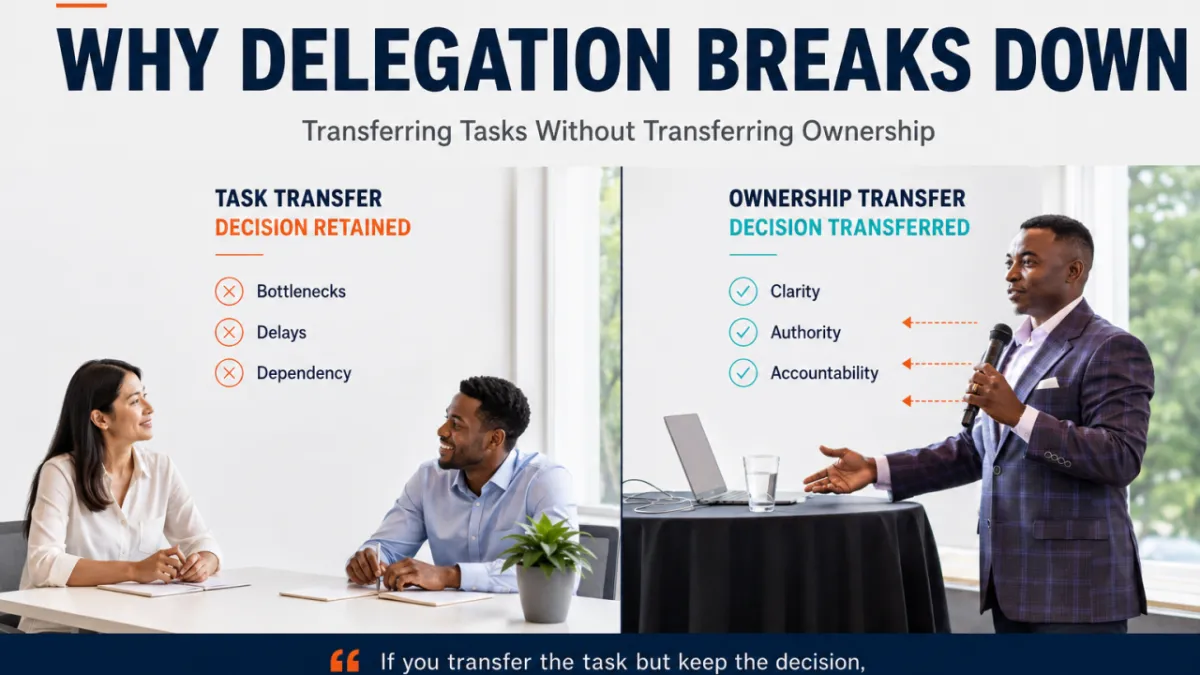
Why Delegation Breaks Down
Why Delegation Breaks Down
Transferring Tasks Without Transferring Ownership
Most leaders believe they delegate.
Yet many still feel overwhelmed.
Their calendars remain full.
Their teams continue asking questions.
Projects keep coming back for approval.
Decisions still flow upward.
And despite assigning work to others, they somehow remain responsible for nearly everything.
If this sounds familiar, the problem may not be delegation.
The problem may be how delegation is being done.
Because many leaders transfer tasks.
But very few transfer ownership.
And the difference matters.
A lot.
The Delegation Illusion
Imagine a manager assigns a project to an employee.
The work is handed off.
The responsibility appears transferred.
The employee begins working.
Then the questions start.
"Can I do this?"
"Should I move forward?"
"What would you prefer?"
"What decision should I make?"
The manager answers.
Approves.
Clarifies.
Redirects.
Adjusts.
Reviews.
Corrects.
The work was delegated.
The decisions were not.
And when decision-making remains centralized, delegation becomes an illusion.
The task moved.
The ownership stayed.
Why Delegation Fails
Most delegation breakdowns are not caused by lazy employees.
Nor are they usually caused by incapable managers.
Delegation fails because leaders often transfer responsibility without transferring the conditions necessary for ownership.
The result?
People execute.
But they do not own.
They work.
But they do not decide.
They complete tasks.
But they do not lead.
And leaders remain trapped in the middle of everything.
The Cost of Incomplete Delegation
One organization I worked with struggled with project delays.
Managers constantly delegated work.
Yet projects repeatedly stalled.
When we investigated, the issue became clear.
Team members could complete the work.
But every meaningful decision still required manager approval.
Nothing moved without permission.
The manager believed they were delegating.
The team believed they lacked authority.
The result was predictable.
Questions increased.
Delays multiplied.
Rework became common.
Everyone became frustrated.
The solution was not more delegation.
The solution was better delegation.
Specifically, clearer ownership.
Once decision rights were clarified and expectations were aligned, projects moved faster, questions decreased, and managers recovered significant time.
Not because people changed.
Because ownership changed.
Delegation Is Ownership Transfer
True delegation is not task transfer.
It is ownership transfer.
Ownership means:
Responsibility.
Authority.
Decision-making.
Accountability.
Clarity.
Without those elements, leaders simply create a queue.
Work sits waiting for approval.
Waiting for decisions.
Waiting for direction.
Waiting for leadership.
And waiting destroys capacity.
The CLEAR Delegation Framework
Effective delegation requires more than assigning work.
It requires structure.
That's why I use the CLEAR Delegation Framework.
C — Clarify the Outcome
Many leaders assign tasks.
Few define outcomes.
A task says:
"Complete this report."
An outcome says:
"Provide recommendations that help us reduce customer response times by 20%."
Outcomes create ownership.
Tasks create compliance.
The clearer the outcome, the stronger the delegation.
L — Lock Decision Rights
This is where delegation often breaks down.
Who decides?
Who recommends?
Who approves?
Who executes?
If those answers are unclear, confusion follows.
Decision rights must be explicit.
Ownership requires authority.
E — Establish Expectations
What does success look like?
What quality standards matter?
What deadlines exist?
What constraints must be respected?
Delegation succeeds when expectations are clear.
People cannot own what they do not understand.
A — Agree on Checkpoints
Delegation is not abandonment.
Leaders should not disappear.
Nor should they micromanage.
Checkpoints create accountability without dependency.
They provide support without taking ownership back.
R — Review Learning and Results
Every delegation opportunity is also a development opportunity.
What worked?
What didn't?
What was learned?
How can performance improve next time?
Delegation should build capability.
Not simply complete work.
Delegation and Leadership Capacity
Many leaders delegate because they want relief.
That is understandable.
But relief is not the ultimate goal.
Capacity is.
The best delegation systems do more than remove work from leaders.
They create stronger decision-makers.
Stronger leaders.
Stronger organizations.
Delegation becomes a development strategy.
Not a workload strategy.
And that changes everything.
A Question Worth Asking
Think about something you've delegated recently.
Now ask yourself:
Did I transfer the task?
Or did I transfer ownership?
The answer may explain why the work keeps coming back.
Final Thought
Delegation is one of the most misunderstood leadership skills.
Many leaders believe they are delegating because someone else is doing the work.
But if every decision still flows through leadership, ownership has not moved.
And without ownership, capacity cannot grow.
Because delegation is not task transfer.
Delegation is ownership transfer.
If you transfer the task but keep the decision, you haven't delegated.
You've built a queue.
Leadership Team Challenge
Have your leadership team take the Leadership Stage Assessment.
Identify whether your leaders are delegating effectively—or unintentionally creating dependency.
Discover where leadership capacity is being limited by weak delegation practices.
Because strong delegation doesn't simply distribute work.
It develops leaders.
Take the Leadership Stage Assessment and discover where your leaders are—and what it will take to move them forward.
I’ll be unpacking this topic further in this week’s Multiplier Briefing. If you are responsible for building leadership capacity inside your organization, you can Register Here


