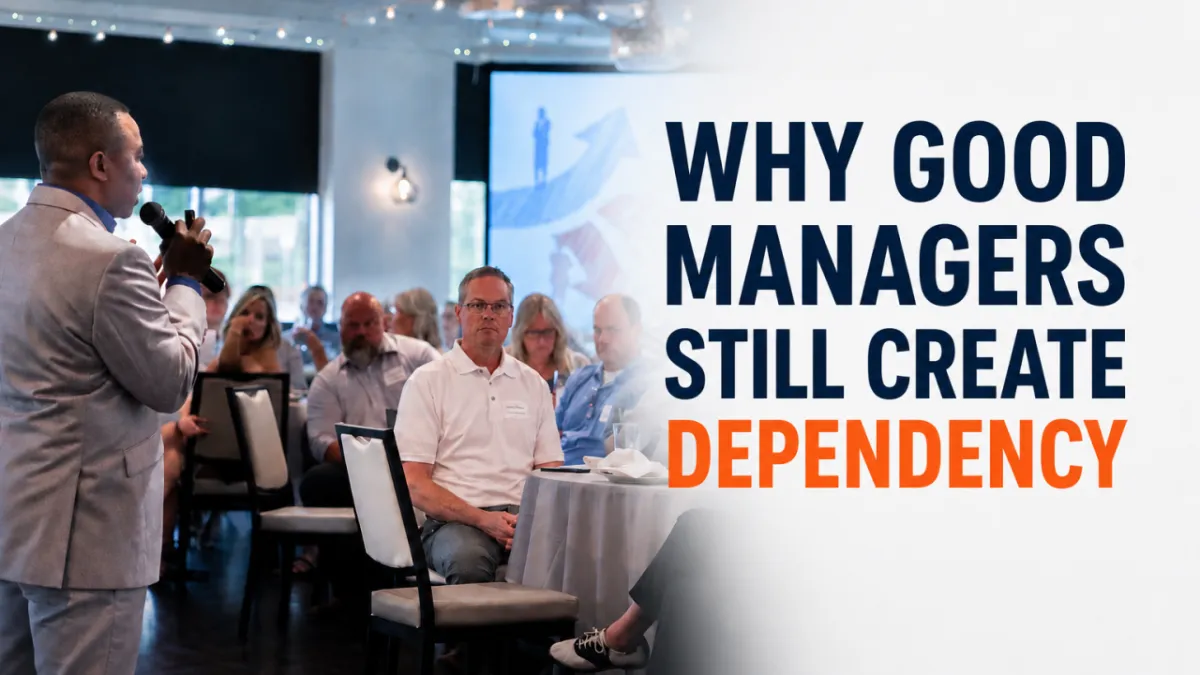
Why Good Managers Still Create Dependency
Why Good Managers Still Create Dependency
Your Best Manager May Be Quietly Limiting Your Team's Growth
Most organizations have at least one manager everyone depends on.
They're experienced.
Reliable.
Knowledgeable.
They solve problems quickly.
People trust them.
Executives love them.
Employees admire them.
When something goes wrong, everyone knows exactly who to call.
At first, this seems like leadership success.
But over time, something interesting begins to happen.
The team becomes increasingly dependent on that manager.
Questions flow upward.
Decisions flow upward.
Problems flow upward.
Complexity flows upward.
The manager becomes the center of everything.
And without realizing it, one of the organization's strongest leaders becomes one of its biggest bottlenecks.
This is one of the most common leadership challenges I see in growing organizations.
The manager is not failing.
In fact, they're often performing exceptionally well.
The problem is that they have become indispensable.
And when a leader becomes indispensable, the organization becomes dependent.
The Hidden Cost of Being the Hero
Many managers are promoted because they are excellent problem-solvers.
They know the business.
They know the customers.
They know the systems.
They know how to get things done.
When a challenge appears, they step in.
When a decision is needed, they make it.
When confusion arises, they provide answers.
These behaviors are often rewarded.
The manager looks productive.
The team gets quick solutions.
The organization keeps moving.
But there is a hidden cost.
Every time a manager solves a problem that someone else could have learned to solve, they unintentionally reinforce dependency.
The team learns:
"If I have a question, ask the manager."
"If I have a problem, take it to the manager."
"If a decision feels risky, let the manager decide."
Over time, capability stops spreading.
Instead, it accumulates at the top.
And that creates a leadership bottleneck.
The Manager Who Couldn't Take a Vacation
Several years ago, I worked with an organization that had a highly respected manager.
She was intelligent, hardworking, and deeply committed to her team.
Everyone viewed her as indispensable.
Then something happened.
She took a two-week vacation.
Within days, problems began to surface.
Approvals stalled.
Decisions slowed.
Projects paused.
Employees repeatedly asked the same question:
"What should we do?"
The organization discovered something important.
The manager had built a high-performing team.
But she had not built an independent team.
The team knew how to execute.
They did not know how to think without her.
That realization changed everything.
Instead of solving every problem herself, she began asking questions.
Instead of providing answers immediately, she developed judgment.
Instead of becoming the source of every solution, she became the builder of problem-solvers.
Over time, ownership increased.
Decision-making improved.
Confidence grew.
The team became more capable.
And the organization became less dependent on one person.
That is the shift from manager to multiplier.
The Difference Between Managers and Multipliers
Many leadership conversations focus on delegation.
Delegation matters.
But multiplication goes deeper.
Managers often transfer tasks.
Multipliers transfer capability.
Managers focus on getting work done.
Multipliers focus on developing people who can get work done.
Managers solve problems.
Multipliers build problem-solvers.
Managers increase output.
Multipliers increase capacity.
This distinction is critical.
Because organizations rarely scale through effort alone.
They scale through capability.
The Manager-to-Multiplier Shift
A multiplier leader makes four important transitions.
Shift #1: From Answering to Asking
Managers often feel pressure to provide answers.
Multipliers provide questions.
Instead of saying:
"Here's what you should do."
They ask:
"What options are you considering?"
"What would you recommend?"
"What risks do you see?"
The goal is not to avoid helping.
The goal is to develop thinking.
Shift #2: From Solving to Coaching
Many leaders accidentally become organizational firefighters.
They solve issue after issue.
The problem is that every solution creates another dependency.
Multipliers coach employees through the problem-solving process.
The immediate solution may take longer.
But the long-term capability grows.
Shift #3: From Delegating Tasks to Developing Judgment
Delegation alone does not create ownership.
Many managers delegate work while retaining every meaningful decision.
The employee completes tasks.
The manager still does the thinking.
Multipliers transfer decision-making responsibility over time.
They help employees develop judgment.
And judgment is what creates leadership capacity.
Shift #4: From Personal Performance to Organizational Capacity
Managers often measure success by what they accomplish.
Multipliers measure success by what others accomplish.
The question changes from:
"What did I get done?"
To:
"What capability did I build?"
That is how leadership capacity expands throughout an organization.
Why This Matters More Than Ever
Many organizations are struggling with capacity.
Leaders are overwhelmed.
Managers are overloaded.
Employees feel uncertain.
Decision-making is slow.
The instinctive response is often:
"We need stronger managers."
But the real need may be:
"We need more multipliers."
Because strong managers create results.
Multipliers create more leaders.
And organizations grow faster when leadership capacity spreads rather than concentrates.
A Leadership Test
Here's a simple question.
If your manager disappeared for two weeks, what would happen?
Would the team continue making decisions?
Would projects continue moving forward?
Would ownership remain strong?
Or would everything stop until the manager returned?
The answer may reveal whether the leader is multiplying capability or reinforcing dependency.
Final Thought
One of the greatest compliments a leader can receive is not:
"We can't do this without you."
It's:
"You helped us learn how to do this ourselves."
Leadership is not measured by how many people depend on you.
Leadership is measured by how many people become more capable because of you.
Your best manager can quietly become your biggest bottleneck.
But your best multiplier can become the catalyst that unlocks leadership capacity throughout the entire organization.
And that is the difference between managing work and multiplying people.
Leadership Team Challenge
Have your leadership team take the Leadership Stage Assessment.
Discover whether your managers are:
✓ Multiplying ownership
✓ Building leadership capacity
✓ Developing judgment
Or unintentionally reinforcing dependency.
The future of your organization depends on how leadership capability is transferred—not how tightly it is controlled.


