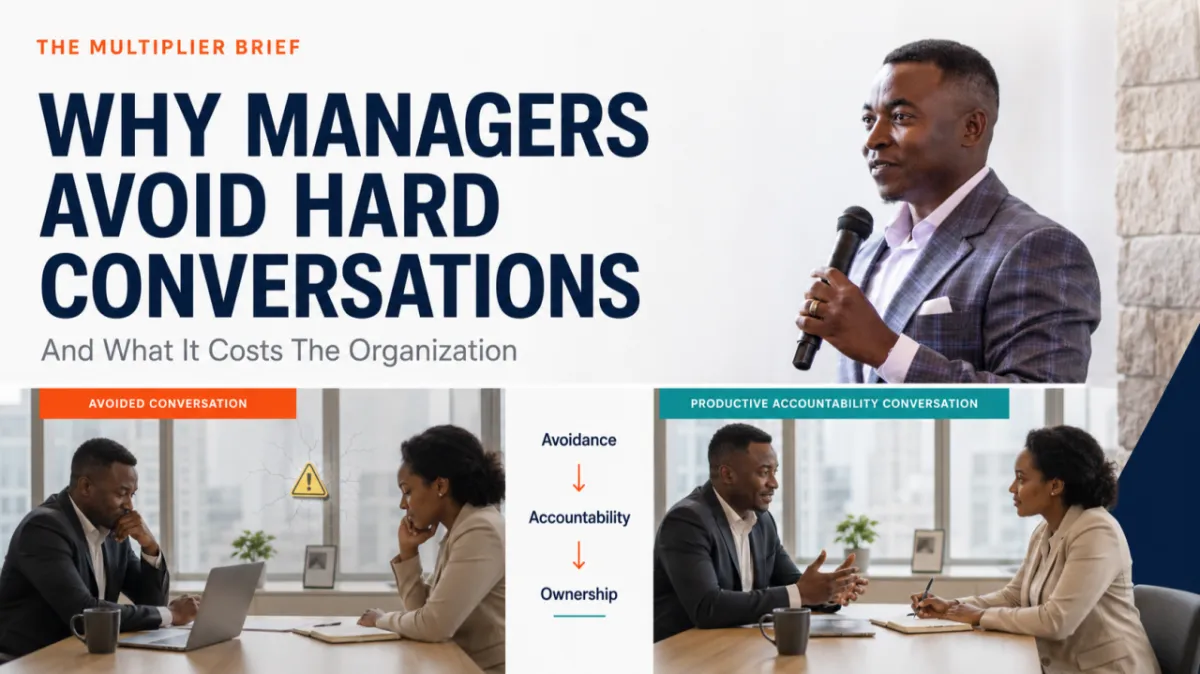
Why Managers Avoid Hard Conversations
Why Managers Avoid Hard Conversations
And What It Costs the Organization
Few leadership responsibilities create more anxiety than difficult conversations.
Most managers know they need to address performance issues.
They know they need to correct behavior.
They know they need to hold people accountable.
Yet many delay.
Avoid.
Minimize.
Or say nothing at all.
Not because they don't care.
Because hard conversations are uncomfortable.
Unfortunately, avoidance has a cost.
And that cost rarely stays contained.
The Hidden Cost of Avoidance
Consider a manager who notices a performance problem.
A team member repeatedly misses deadlines.
Communication is inconsistent.
Accountability is slipping.
The manager sees it.
But decides to wait.
Maybe things will improve.
Maybe the employee already knows.
Maybe the situation will resolve itself.
Weeks pass.
Then months.
The behavior continues.
Soon other employees notice.
Standards begin to drift.
Frustration grows.
High performers become discouraged.
Eventually the organization pays a price.
Not because of the original issue.
Because the issue was never addressed.
This is what I call performance debt.
Every conversation delayed creates future consequences.
Why Managers Avoid Hard Conversations
Most avoidance stems from one of four fears:
Fear of conflict.
Fear of damaging relationships.
Fear of being perceived negatively.
Fear of saying the wrong thing.
Ironically, avoidance often damages relationships more than honest accountability ever would.
Because unclear expectations create confusion.
And confusion creates frustration.
The conversation managers avoid today often becomes the crisis they manage tomorrow.
Feedback Is Not Just A Conversation Skill
Many organizations treat feedback as a communication skill.
It is.
But it is also something bigger.
Feedback is part of the Leadership Operating System.
Because organizations reinforce what leaders consistently address.
And they tolerate what leaders consistently ignore.
When accountability conversations occur inconsistently, performance standards become inconsistent.
When accountability conversations occur consistently, expectations become clearer.
The issue is not simply communication.
The issue is leadership infrastructure.
The TRUST Feedback Framework
Managers need a consistent way to address difficult issues without damaging trust.
That's where the TRUST Feedback Framework comes in.
T — Tell The Truth
Avoiding reality helps no one.
Describe the issue clearly and objectively.
Focus on observable behavior.
Not assumptions.
Not labels.
Not emotion.
Clarity is the starting point of accountability.
R — Reinforce The Desired Outcome
The purpose of feedback is not punishment.
The purpose is improvement.
Help employees understand what success looks like moving forward.
Define expectations clearly.
Create direction.
Not confusion.
U — Understand Their Perspective
Feedback should be a conversation.
Not a lecture.
Ask questions.
Listen carefully.
Seek understanding before judgment.
Often valuable context emerges.
Understanding strengthens trust.
S — Set Clear Commitments
Accountability requires clarity.
What will change?
What actions will occur?
What timeline exists?
What support is needed?
Commitments turn conversations into action.
T — Track Progress
Feedback should not be a one-time event.
Follow-up matters.
Reinforcement matters.
Consistency matters.
Because accountability without follow-through rarely creates lasting change.
The Cost of Harsh Correction
Avoidance is dangerous.
But so is overcorrection.
Some managers finally address an issue only after frustration has accumulated.
The result becomes criticism instead of coaching.
Employees comply.
Trust declines.
Ownership decreases.
Engagement suffers.
Harsh correction may create short-term obedience.
But it rarely creates long-term commitment.
The goal of accountability is not fear.
The goal is growth.
A Leadership Example
One organization struggled with accountability among frontline managers.
Leaders regularly avoided performance conversations.
Small issues accumulated.
Employee frustration increased.
Turnover eventually followed.
When accountability became necessary, conversations were often emotional and reactive.
The organization introduced a consistent feedback process based on clear expectations, structured conversations, and follow-up accountability.
Managers became more confident.
Conversations occurred earlier.
Performance improved.
Trust increased.
The difference was not tougher leadership.
The difference was better leadership structure.
Accountability Is A System
Many organizations focus on teaching managers how to have difficult conversations.
That matters.
But training alone is insufficient.
Managers must also operate within a system that reinforces accountability.
Leadership standards.
Coaching rhythms.
Performance expectations.
Decision rights.
Leadership measurement.
All play a role.
Because accountability is not a single conversation.
It is part of a larger operating system.
A Question Worth Asking
Think about your team.
What conversation are you currently avoiding?
And what is that avoidance already costing?
The answer may reveal your next leadership priority.
Final Thought
Every conversation a manager avoids becomes a cost the organization pays later.
Sometimes the cost is performance.
Sometimes the cost is engagement.
Sometimes the cost is trust.
Sometimes the cost is turnover.
But the bill eventually arrives.
The strongest leaders do not avoid accountability.
Nor do they weaponize it.
They use accountability to create clarity, ownership, and growth.
Because feedback done well does not weaken relationships.
It strengthens them.
Leadership Operating System Diagnostic
Want to understand how accountability is reinforced across your leadership team?
Book a Leadership Operating System Diagnostic.
We'll help you identify:
✓ Accountability gaps
✓ Leadership consistency issues
✓ Manager effectiveness risks
✓ Leadership system weaknesses
✓ Organizational performance barriers
Because accountability should not depend on individual courage alone.
It should be reinforced by the leadership system.
Take the Leadership Stage Assessment and discover where your leaders are—and what it will take to move them forward.
I’ll be unpacking this topic further in this week’s Multiplier Briefing. If you are responsible for building leadership capacity inside your organization, you can Register Here


