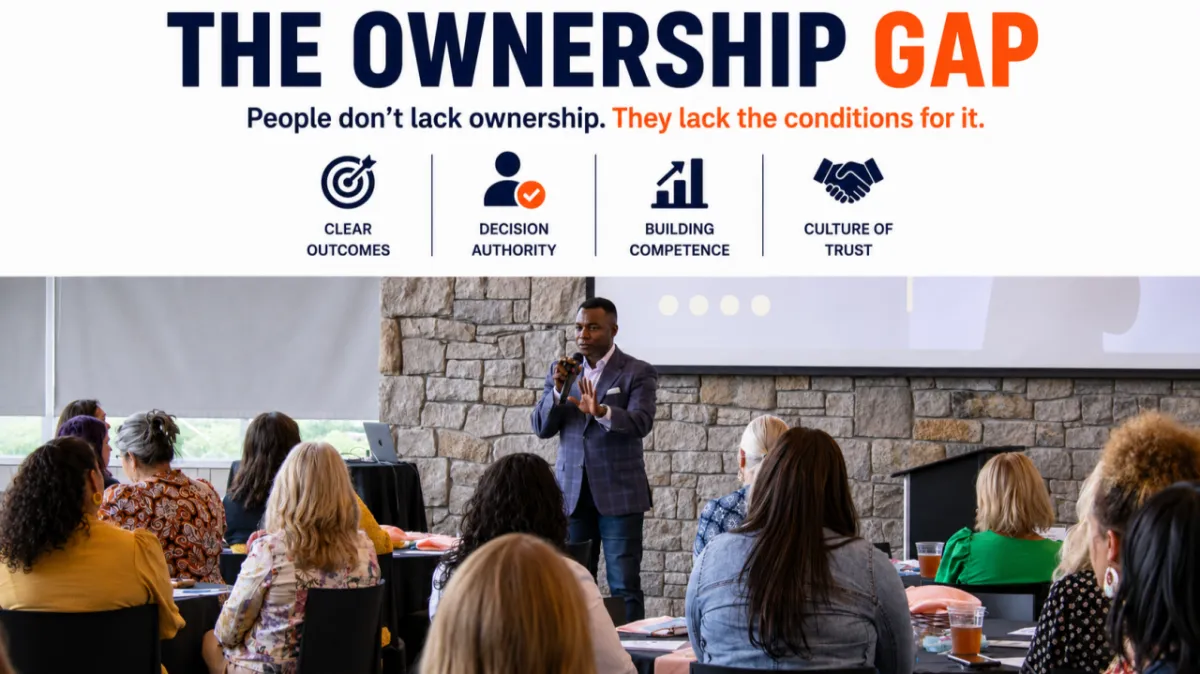
Why People Wait Instead of Lead
Why People Wait Instead of Lead
Walk into almost any organization and you'll hear leaders say the same thing.
"We need people to take more ownership."
Executives want ownership.
Managers want ownership.
HR leaders want ownership.
Employees are encouraged to "act like owners."
Yet despite all the conversations about ownership, many organizations continue to struggle with the same reality.
People wait.
They wait for approval.
They wait for direction.
They wait for permission.
They wait for leadership to decide.
Then leaders become frustrated.
They wonder why employees aren't taking initiative.
Why managers aren't stepping up.
Why accountability feels weak.
Why decision-making is slow.
The assumption is often that people lack ownership.
But what if that's not the real problem?
What if people don't lack ownership at all?
What if they lack the conditions for ownership?
The Ownership Myth
Many leaders treat ownership as a personality trait.
Some people have it.
Some people don't.
Some employees are proactive.
Others are passive.
Some managers lead.
Others wait.
This explanation is convenient.
But it is often incomplete.
Because ownership rarely exists in isolation.
Ownership is heavily influenced by the environment leaders create.
Think about it.
If someone is repeatedly criticized for making decisions, what happens?
They become cautious.
If someone is expected to ask permission before acting, what happens?
They stop initiating.
If authority is unclear, what happens?
People hesitate.
If leaders consistently override decisions, what happens?
People stop deciding.
The issue is not always motivation.
The issue is often design.
The Ownership Gap
The organizations that struggle with ownership often have a gap.
A gap between what they say they want and what their systems actually support.
They say:
"We want ownership."
But they create:
Permission-seeking.
They say:
"We want initiative."
But they reward compliance.
They say:
"We want leaders."
But they centralize decisions.
Over time, people learn an important lesson.
The safest behavior is waiting.
And waiting becomes culture.
Why People Wait
When we look closely, most ownership problems come down to four missing conditions.
1. Clarity
People need to know what success looks like.
They need clear outcomes.
Clear expectations.
Clear priorities.
Without clarity, initiative becomes risky.
When people aren't sure what success looks like, they wait.
2. Authority
People need permission to decide.
Not permission every time.
Permission by design.
When authority is unclear, escalation increases.
Questions move upward.
Ownership disappears.
People don't want responsibility without authority.
Nor should they.
3. Competence
Ownership requires confidence.
Confidence comes from competence.
If people don't feel capable, they hesitate.
Not because they don't care.
Because they don't feel ready.
Development matters.
Coaching matters.
Practice matters.
Competence fuels ownership.
4. Trust
Perhaps the most important condition of all.
People take initiative when they believe thoughtful mistakes will be treated as learning opportunities.
If the cost of being wrong feels higher than the reward of taking initiative, people will wait.
Every time.
The Team That Stopped Waiting
I worked with a leadership team that struggled with ownership.
Managers constantly escalated decisions.
Projects slowed down.
Leaders felt overwhelmed.
Executives complained that nobody took initiative.
At first, they assumed the managers lacked confidence.
But when we examined the situation more closely, the issue became obvious.
Nobody was sure who actually owned key decisions.
The same decisions were being discussed repeatedly.
People waited because they were afraid of stepping on someone else's authority.
One change transformed everything.
We clarified decision rights.
Who decides?
Who recommends?
Who approves?
Who executes?
Once those boundaries became clear, initiative increased almost immediately.
Not because the people changed.
Because the system changed.
The ownership already existed.
The conditions finally supported it.
Outcomes vs Tasks
One of the biggest mistakes leaders make is assigning tasks when they should be defining outcomes.
Tasks create compliance.
Outcomes create ownership.
A task says:
"Do this."
An outcome says:
"Achieve this."
When leaders focus only on tasks, employees become executors.
When leaders focus on outcomes, employees become thinkers.
Ownership grows when people are trusted to determine how success happens.
Not just instructed on what to do.
The Executive Responsibility
Ownership is not an employee problem.
It is a leadership responsibility.
Leaders shape the conditions that either encourage initiative or suppress it.
Executives influence ownership through:
Clarity.
Decision rights.
Development.
Trust.
Accountability.
HR leaders influence ownership through:
Leadership expectations.
Development pathways.
Performance systems.
Coaching frameworks.
The strongest organizations align all of these elements.
Ownership becomes predictable because it is designed.
A Question Worth Asking
The next time someone says:
"People need to take more ownership."
Ask this question:
Have we actually created the conditions for ownership?
Because ownership is rarely missing.
The environment that supports it often is.
Final Thought
People don't lack ownership.
They lack the conditions for ownership.
The organizations that create the most ownership aren't necessarily filled with different people.
They're led by leaders who intentionally design systems that support initiative, judgment, accountability, and trust.
Ownership is not something leaders demand.
Ownership is something leaders create.
Leadership Team Challenge
Have your leadership team take the Leadership Stage Assessment.
Discover where your leaders may be unintentionally limiting ownership.
Identify where decision rights are unclear.
Uncover where leadership capacity is being constrained by permission-seeking behavior.
Because ownership isn't a culture issue alone.
It's a leadership system issue.
Take the Leadership Stage Assessment and discover where your leaders are—and what it will take to move them forward.
I’ll be unpacking this topic further in this week’s Multiplier Briefing. If you are responsible for building leadership capacity inside your organization, you can Register Here


