Work On Your Business: The Systems Test That Buys Back Your Time
Strategic thinking is not system building. The difference is one question.
Work on your business, not in it.
You have heard it a hundred times. It is probably the most repeated piece of advice in small business, and one of the least useful — not because it is wrong, but because almost nobody tells you what on actually means.
So you get the instruction without the definition. And what most owners do with an undefined instruction is exactly what you would expect: block out a Friday afternoon, feel vaguely strategic, redesign something, and go back to normal on Monday.
Let me make it specific.
I recorded a video for you. You can watch it here:
Operating the machine, or building it
In engineering terms there are two completely different jobs around any machine. Operating it. And designing, installing and maintaining it.
That is the whole distinction. In-work is operating. On-work is designing, installing and maintaining.
Notice what that immediately rules out. On-work is not thinking about your business. It is not the strategy offsite. It is not vision work. Those things can be useful, but they are not what the phrase means — and this is where most owners lose two years.
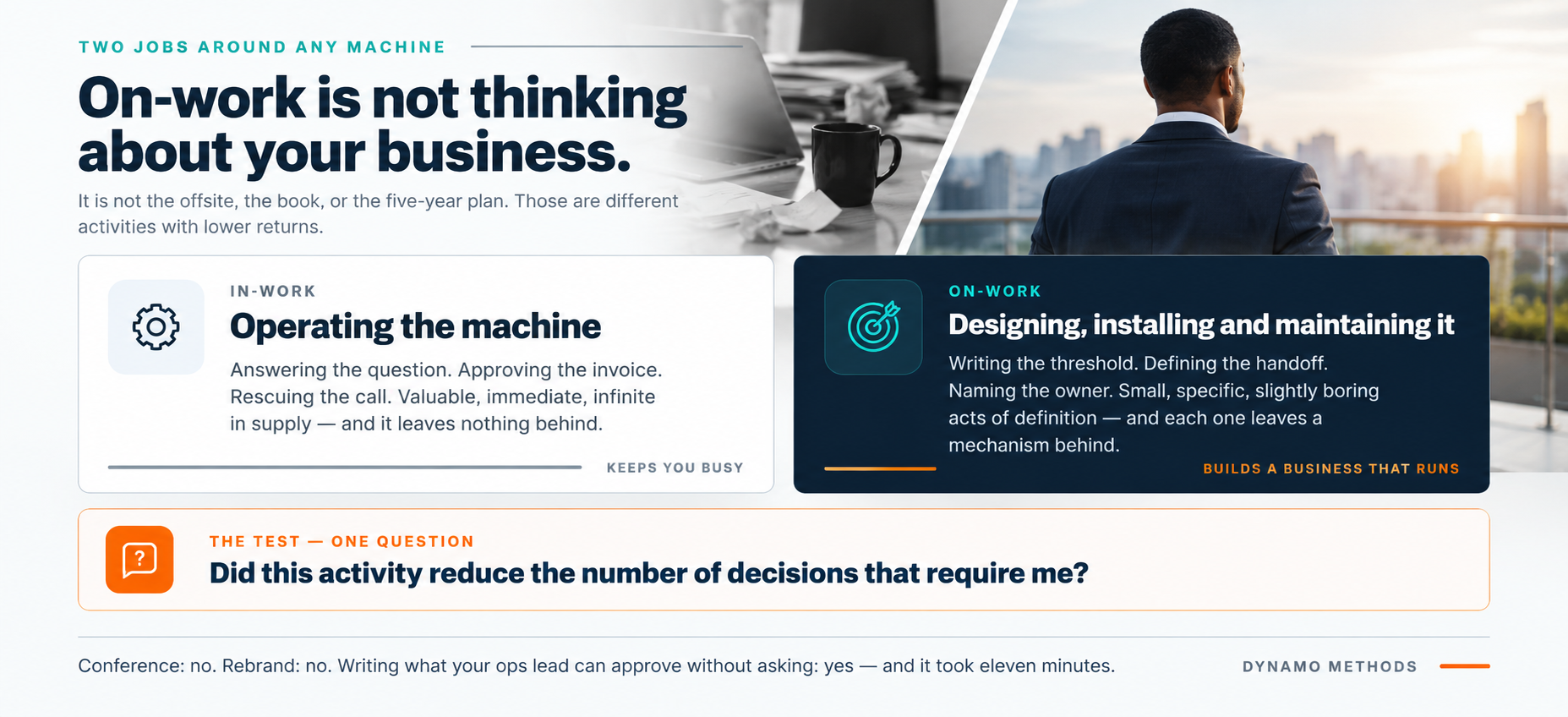
On-work produces a mechanism that did not exist before. If nothing new exists at the end of it, you were not working on the business. You were thinking about it, which is a different activity with a much lower return.
The one-question test
Here is the test, and it is one question:
Did this activity reduce the number of decisions that require me?
If yes, it was on-work. If no, it was in-work — possibly valuable in-work, but in-work.
The test is uncomfortable, because it disqualifies a great deal that feels strategic. Going to a conference: no. Reading a business book: no. Rebranding: no. Building a five-year plan: almost always no. Having a great meeting about culture: no.
Writing down what your operations lead can approve without asking you: yes. That is on-work, and it took eleven minutes.
Which tells you something important. On-work is not glamorous and it is not big. It is mostly small, specific, slightly boring acts of definition.
Why you drift back
Owners return to in-work every time, even knowing better. Three reasons, all structural rather than personal.
In-work has immediate feedback. You answer a question and something moves. On-work has delayed feedback — you define a decision threshold today and the payoff arrives in six weeks as an absence, as a conversation that did not happen. Absence is very hard to notice and impossible to feel good about.
In-work is externally triggered. Someone asks you something, so you do it. On-work is only ever self-triggered. Nothing in your business will ever ask you to design a system. The demand for in-work is infinite; the demand for on-work is zero.
You are better at in-work. You have done it for years. On-work means being a beginner at something inside your own company, and that is genuinely unpleasant.
So it is not discipline. Everything in the environment favours one and nothing favours the other.
On-work has exactly seven targets
You do not fix the drift with willpower. You fix it by giving on-work an object, which is where most advice leaves you empty-handed.
Every mechanism in your business sits inside one of seven systems: Marketing, Sales, Service Delivery, Operations, Financial Management, Customer Success, and Leadership and People. That is the whole surface area. When you sit down to work on the business, you are working on one of those seven or you are not working on the business.
And you do not work on all seven. You work on one — the one currently constraining everything else — for ninety days. A business is only as strong as its weakest system, and strengthening a strong one produces no measurable change at all.
So the instruction becomes something you can execute. Not work on your business. Instead: for the next ninety days my on-work is the operations system, and here is the artifact I will produce each week.
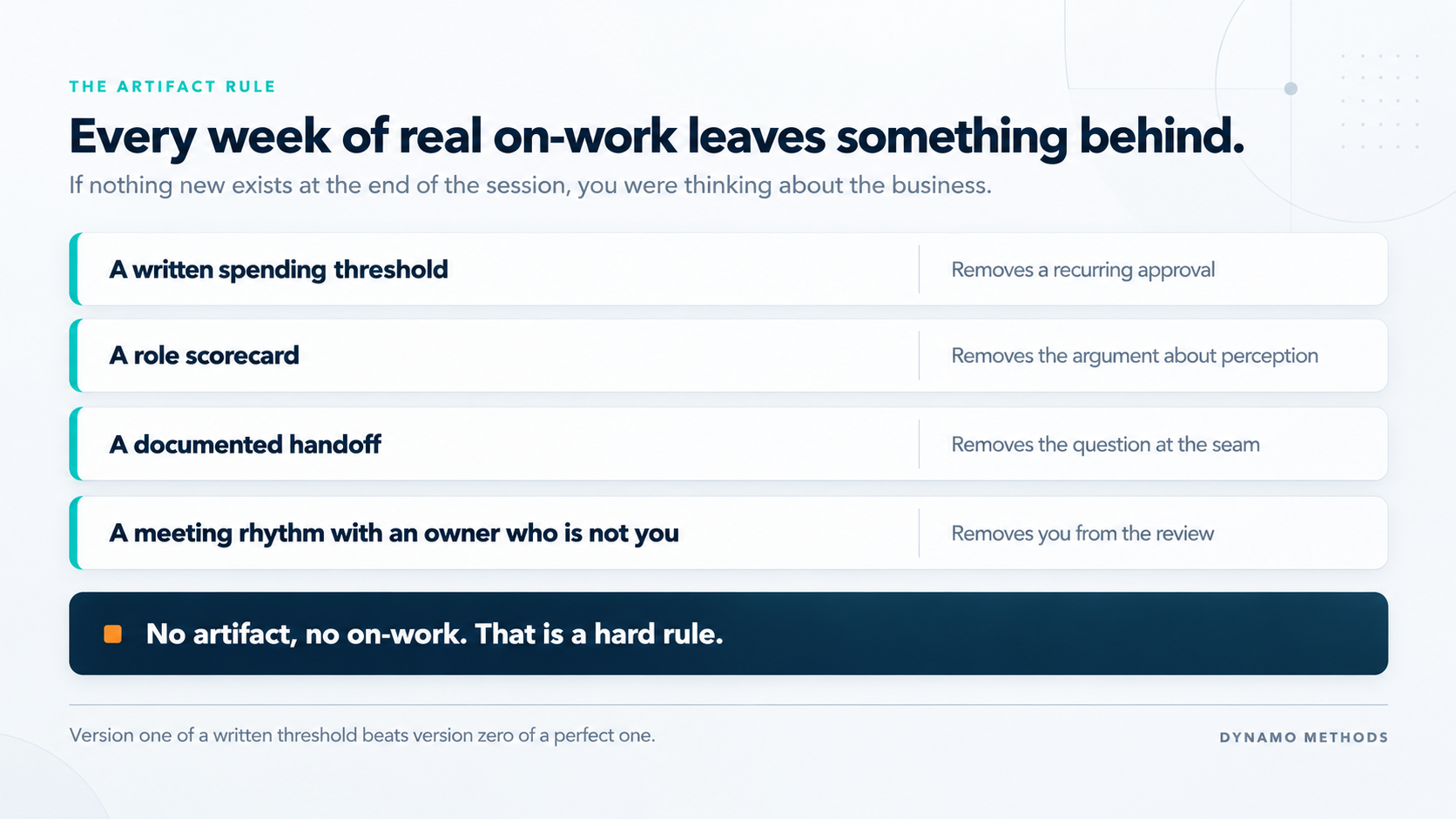
Artifact is the word to hold on to. Every week of real on-work leaves something behind that did not exist before. A written threshold. A role scorecard. A documented handoff. A defined meeting rhythm with an owner who is not you.
No artifact, no on-work. That is a hard rule and the most useful one here.
A hundred Friday afternoons
An owner I worked with — logistics, about sixteen million — told me he spent every Friday afternoon working on the business. Had done for two years. Blocked out, protected, non-negotiable.
So I asked what existed now that had not existed two years ago.
Long pause. He had read a lot. He had thought carefully about a lot. He had a much clearer sense of where the company was going. Nothing had been installed.
Two years of Friday afternoons — call it a hundred sessions — and not one mechanism that removed a decision from his desk. He was not lazy. He was doing the thing everyone told him to do, without a definition of what done looked like.
We changed one thing: every Friday session had to end with a written artifact, even a bad one.
Nine weeks later he had a decision authority matrix for his leadership team, thresholds for four roles, and a Monday operations meeting that ran without him. Same Friday afternoons. The only difference was a definition of output.
What to do this week
Take your next block of on-work time. Before it starts, write down the artifact it will produce. One line:
"By the end of this session, my delivery lead will have a written spending threshold."
Then produce it. Badly is fine — version one of a written threshold beats version zero of a perfect one. At the end, ask the test question: does this reduce the number of decisions that require me? If the honest answer is no, you have learned something valuable about how you have been spending that time.
One session. One artifact.
The objection I hear most is I do not have time to work on the business, I am too busy running it. That is true, and the usual answer — you have to make time — is useless.
So here is the reframe. You are not being asked to find a spare day. On-work compounds in a way in-work does not, and the units are small. Writing down one spending threshold takes about ten minutes. If it removes three questions a week from your desk, and each costs you fifteen minutes of context-switching, you have bought back forty-five minutes a week — permanently — for a ten-minute investment.
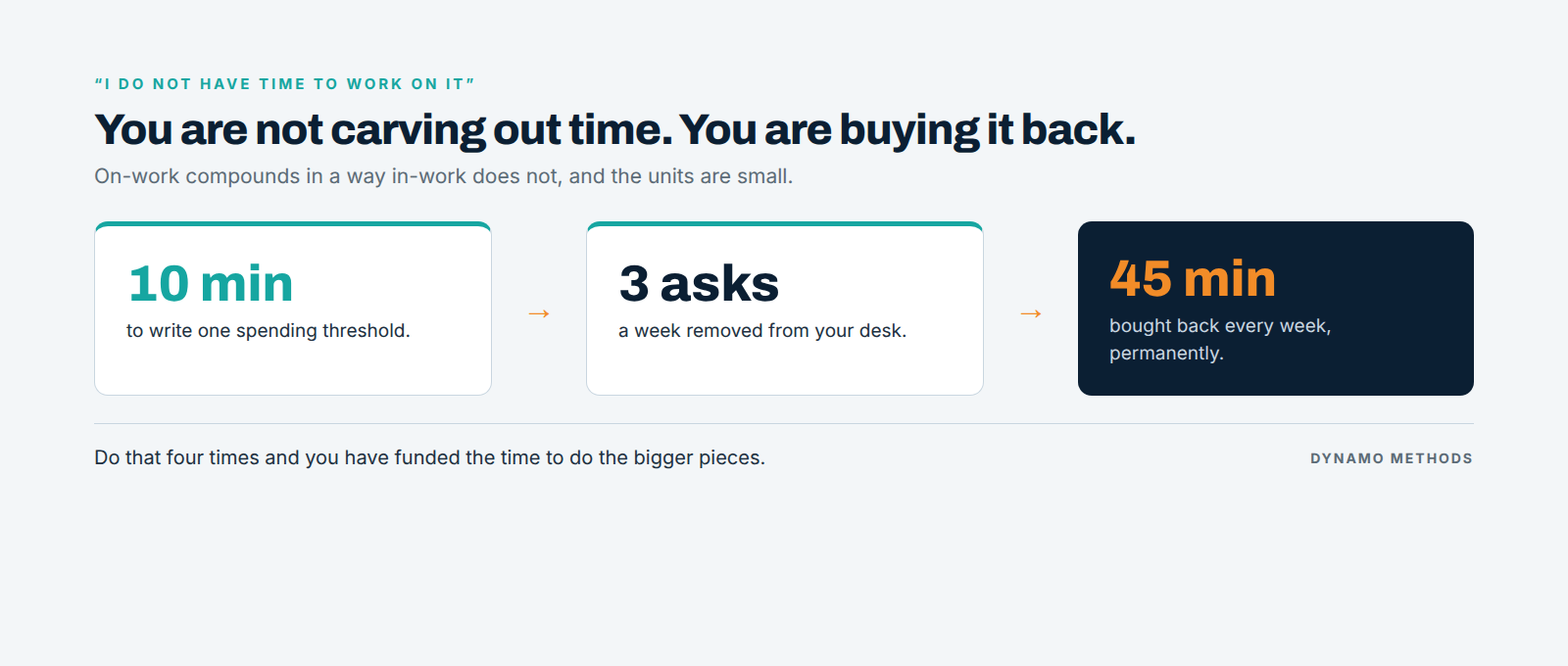
Do that four times and you have funded the time to do bigger pieces. So do not start with the system that takes ninety days. Start with the smallest artifact that removes the most frequent interruption.
You are not carving out time. You are buying it back in increments and reinvesting it. Do not guess which of the seven should be your ninety-day target. The Dynamo Business Stability Diagnostic scores all seven and tells you.
Do not guess which of the seven should be your ninety-day target. The Dynamo Business Stability Diagnostic scores all seven and tells you. Free, about 12 minutes:
𝗧𝗮𝗸𝗲 𝘁𝗵𝗲 𝗙𝗿𝗲𝗲 𝗕𝘂𝘀𝗶𝗻𝗲𝘀𝘀 𝗦𝘁𝗮𝗯𝗶𝗹𝗶𝘁𝘆 𝗗𝗶𝗮𝗴𝗻𝗼𝘀𝘁𝗶𝗰: https://dynamomethods.com/business-os
Isaac Wambua is an industrial engineer, business systems architect, and the creator of the Dynamo Business Operating System (DBOS) and the Dynamo Leadership Operating System (DLOS). He is the author of The Dynamo Business Blueprint: How to Build a Business That Runs, Grows and Thrives Without You. Through Dynamo Methods, he helps owners and executive teams install the operating systems and leadership capacity that allow a company to run — and improve — without depending on any one person.


